
Gameplay
Teen Patti Hand Rankings: Examples and Tie-Breaks
Compare the hand category first: Trail → Pure Sequence → Sequence → Colour → Pair → High Card. Only compare individual ranks when the categories match. The treatment of A-2-3 and exact ties depends on the table convention.
Scope: worked examples of general Teen Patti rules, not rules tested in a specific Star app. Check your table’s rules. Sources & limitations
The six standard categories
Swipe the table sideways to compare.
| Order | Hand | Example | Recognition |
|---|---|---|---|
| 1 | Trail / Trio | A♠ A♥ A♦ | Three cards of one rank |
| 2 | Pure Sequence | 9♥ 8♥ 7♥ | Consecutive ranks, one suit |
| 3 | Sequence / Run | Q♠ J♦ 10♣ | Consecutive ranks, mixed suits |
| 4 | Colour / Flush | A♣ J♣ 6♣ | One suit, not consecutive |
| 5 | Pair | K♠ K♥ 4♦ | Two equal ranks and a kicker |
| 6 | High Card | A♦ 10♣ 7♥ | None of the combinations above |
1
- Hand
- Trail / Trio
- Example
- A♠ A♥ A♦
- Recognition
- Three cards of one rank
2
- Hand
- Pure Sequence
- Example
- 9♥ 8♥ 7♥
- Recognition
- Consecutive ranks, one suit
3
- Hand
- Sequence / Run
- Example
- Q♠ J♦ 10♣
- Recognition
- Consecutive ranks, mixed suits
4
- Hand
- Colour / Flush
- Example
- A♣ J♣ 6♣
- Recognition
- One suit, not consecutive
5
- Hand
- Pair
- Example
- K♠ K♥ 4♦
- Recognition
- Two equal ranks and a kicker
6
- Hand
- High Card
- Example
- A♦ 10♣ 7♥
- Recognition
- None of the combinations above
This guide concerns the standard three-card game, not a confirmed Star app rulebook. Joker and Muflis variations require their own rules. Hand strength does not depend on whether the holder is blind or seen.
For disputed Ace runs, use the A23 versus AKQ rule-by-rule examples. If the confusion is about matching suits, compare Sequence versus Colour before comparing high cards.
Choose two hands and compare
For classic 52-card Teen Patti only. This is not a Joker, Muflis or win-probability tool. Choose the A-2-3 convention below; it applies to the whole comparison.
Example: hand A ranks higher
A: Q♠ Q♥ 5♣ · B: J♦ J♣ A♥
- Both hands are pairs. Compare the pair ranks first.
- The pair of Qs beats the pair of Js. B’s A kicker does not change that result.
- This is a card comparison, not payment or betting advice.
The category comes before the highest card
Sequence
Colour
Sequence versus Colour: a low run beats an Ace-high suit
Compare A: 4♠ 5♥ 6♦ with B: A♣ J♣ 8♣. A has consecutive ranks but mixed suits: Sequence. B has one suit but no run: Colour. A wins, despite B’s Ace. If A instead has 4♠ 5♠ 6♠, it becomes a Pure Sequence and still wins. All six physical cards in each comparison are distinct.
The decision order is: classify both hands; compare categories; only compare ranks if the categories match. In the comparison tool, load “Sequence / Colour” to reproduce the first result. This is not five-card poker’s flush-over-straight order.
For how often each category is dealt, see the exact probability counts. Rarity and strength are different questions.
A low trail defeats a high-card hand containing an ace. Likewise, 5♥ 4♥ 3♥ defeats a mixed-suit A-K-Q: pure sequence is above sequence. Do not add card values together or borrow the five-card poker ranking order.
A♥ K♥ J♥ is colour, not pure sequence: Q is missing. Q♠ 10♦ J♣ becomes a valid sequence when sorted. Moving cards on the screen does not alter their ranks.
Compare pairs in two steps
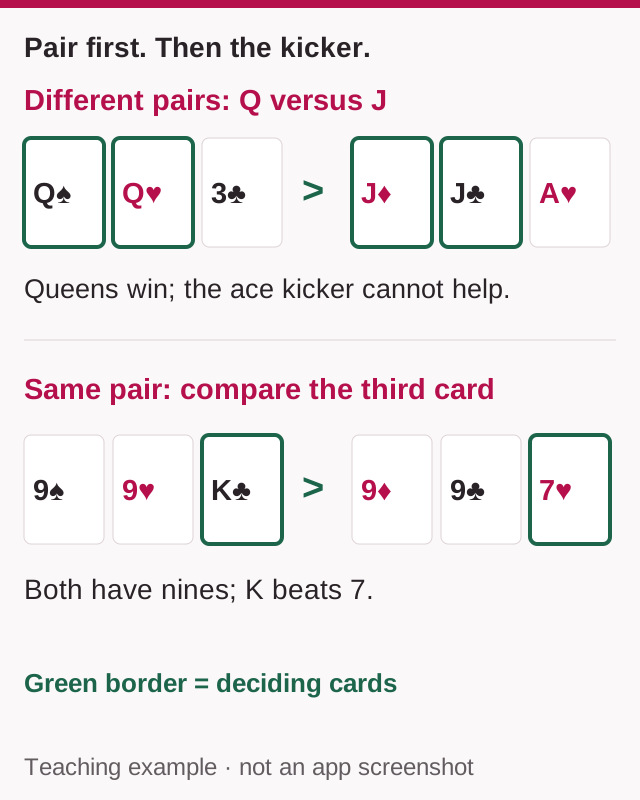
First compare the paired rank. Q♠ Q♥ 3♣ beats J♦ J♣ A♥ because queens outrank jacks; the ace kicker cannot rescue the lower pair.
Only when the paired ranks match does the unmatched card decide. In 9♠ 9♥ K♣ versus 9♦ 9♣ 7♥, the king kicker wins. These examples use distinct cards, so each comparison is possible with one standard deck.
Colour and high card: compare left to right
Sort each hand from high to low. Compare the top rank; if equal, compare the second and then the third.
Swipe the table sideways to compare.
| Player A | Player B | Deciding comparison |
|---|---|---|
| A♠ J♠ 5♠ | A♥ 10♥ 9♥ | J beats 10; A wins |
| K♠ 9♠ 7♠ | K♥ 9♥ 5♥ | 7 beats 5; A wins |
| K♠ 9♦ 5♣ | K♥ 8♣ 7♦ | 9 beats 8; A wins |
A♠ J♠ 5♠
- Player B
- A♥ 10♥ 9♥
- Deciding comparison
- J beats 10; A wins
K♠ 9♠ 7♠
- Player B
- K♥ 9♥ 5♥
- Deciding comparison
- 7 beats 5; A wins
K♠ 9♦ 5♣
- Player B
- K♥ 8♣ 7♦
- Deciding comparison
- 9 beats 8; A wins
The first two rows are colour comparisons; the third is high card. Suits make categories such as colour, but do not normally provide an extra tie-break rank.
A-2-3 versus A-K-Q: two published conventions
Mixed-suit Sequence
Mixed-suit Sequence
Compare the same category under both agreements
Use A: A♠ 2♥ 3♣ and B: A♥ K♦ Q♣. Both are mixed-suit Sequences. With A-K-Q first, B wins; with A-2-3 first, A wins. Load the Ace example in the tool and change only the convention selector: the cards remain fixed.
Swipe the table sideways to compare.
| Comparison | A-K-Q-first convention | A-2-3-first convention |
|---|---|---|
| Mixed-suit A-2-3 versus mixed-suit A-K-Q | A-K-Q wins | A-2-3 wins |
| Same-suit A-2-3 versus mixed-suit A-K-Q | A-2-3 wins by category | A-2-3 wins by category |
| K-A-2, mixed suits | High Card, not Sequence | High Card, not Sequence |
Mixed-suit A-2-3 versus mixed-suit A-K-Q
- A-K-Q-first convention
- A-K-Q wins
- A-2-3-first convention
- A-2-3 wins
Same-suit A-2-3 versus mixed-suit A-K-Q
- A-K-Q-first convention
- A-2-3 wins by category
- A-2-3-first convention
- A-2-3 wins by category
K-A-2, mixed suits
- A-K-Q-first convention
- High Card, not Sequence
- A-2-3-first convention
- High Card, not Sequence
The second row is a category test, so the Ace-order setting cannot reverse it. Read the suit symbols as well as the ranks before choosing the rule switch.
Do not settle this by whichever article calls itself universal. Pagat places A-2-3 above A-K-Q. The other ranking guide linked in Sources describes A-K-Q above A-2-3. Both put K-Q-J below those two. This is a rule-convention difference, not a calculation error.
Before a session, record which order the table uses. K-A-2 is not a valid wraparound sequence under the conventions discussed here. If an app uses a different rule, label that example with its actual table rule.
An exact tie needs a procedure, not a stronger suit
9♠ 9♥ K♣ and 9♦ 9♣ K♥ have the same pair and kicker under suit-neutral rules. Some tables split; Pagat's described show convention makes the requester lose. Check the procedure before requesting a comparison rather than inventing a spades-beats-hearts rule afterward.
Try these before revealing the answer
Which wins: 4♠ 4♥ A♦ or A♣ Q♣ 10♣? The colour wins despite the pair's ace kicker. Which wins: 8♠ 7♥ 6♦ or A♠ A♥ 3♣? The sequence wins over the pair.
Record your decision and the deciding category or rank in your own notes. Learn with a deck or non-withdrawable practice chips. Correct comparison prevents mistakes; it cannot guarantee a winning deal.
These comparisons award the stronger conventional hand. For a lowest-hand-wins table, use the Muflis comparison examples and agree the Ace convention before reversing the result.
Sources & scope
Specific sources revisited
- — Checked hand-comparison order and the A-2-3-first convention for the teaching tool.
- — Checked the classic Teen Patti section placing A-K-Q ahead of A-2-3; this is a separate tool option.
- — Revisited classic category precedence and the A-2-3-first convention.
These limited checks do not replace the original source dates below or constitute a device test.
Public sources checked on 6 September 2026. No hands-on device test was performed. Menus and table rules may differ.
Related guides
Gameplay
Teen Patti Show vs Sideshow: Rules, Eligibility and Examples
Check who can request Show or Sideshow, compare Blind and Seen eligibility, and follow accepted, refused and tied-hand examples.

Gameplay
Blind vs Seen in Teen Patti: Rules and a Worked Round
Work out Blind and Seen contributions with a practice-counter calculator. Follow the current stake, a complete round and final Show eligibility.
Gameplay
Joker Teen Patti Rules for Beginners: Wild Cards, Hand Rankings and Examples
Learn nominated-rank Joker Teen Patti with seven worked hands. Try three reveal-answer exercises and see why natural cards cannot change rank or suit.