Gameplay
Teen Patti Hand Probabilities: How Rare Is Each Hand?
With 52 distinct cards and no wild cards, there are 22,100 unordered three-card hands. A Trail occurs in 52 of them (0.2353%); a Pure Sequence in 48 (0.2172%). These are chances of being dealt a category, not chances of winning a round. The counts below state the sequence rules and can be reproduced.
Method: a public-documentation guide, not a hands-on test of a Star build. Diagrams are illustrative. Sources & limitations
The model behind the numbers
Assume a fair shuffle of one standard 52-card deck: 13 ranks, 4 suits, no replacement, no printed jokers and no wild ranks. Each unordered set of three distinct cards is equally likely. We count only the strongest category a hand belongs to, so a Pure Sequence is not counted a second time as a Colour or Sequence.
There are 12 accepted rank sequences: A-2-3; 2-3-4 through J-Q-K; and Q-K-A. K-A-2 is excluded. Whether A-2-3 beats A-K-Q changes their ordering, not whether they are sequences. Those two ordering conventions therefore give identical category probabilities. See the Ace comparison examples before applying a table-specific order.
All six hand probabilities
Swipe the table sideways to compare.
| Hand | Combinations | Probability | About 1 in |
|---|---|---|---|
| Trail / Trio | 52 | 0.2353% | 425.00 |
| Pure Sequence | 48 | 0.2172% | 460.42 |
| Sequence | 720 | 3.2579% | 30.69 |
| Colour | 1,096 | 4.9593% | 20.16 |
| Pair | 3,744 | 16.9412% | 5.90 |
| High Card | 16,440 | 74.3891% | 1.34 |
| Total | 22,100 | 100% | — |
Trail / Trio
- Combinations
- 52
- Probability
- 0.2353%
- About 1 in
- 425.00
Pure Sequence
- Combinations
- 48
- Probability
- 0.2172%
- About 1 in
- 460.42
Sequence
- Combinations
- 720
- Probability
- 3.2579%
- About 1 in
- 30.69
Colour
- Combinations
- 1,096
- Probability
- 4.9593%
- About 1 in
- 20.16
Pair
- Combinations
- 3,744
- Probability
- 16.9412%
- About 1 in
- 5.90
High Card
- Combinations
- 16,440
- Probability
- 74.3891%
- About 1 in
- 1.34
Total
- Combinations
- 22,100
- Probability
- 100%
- About 1 in
- —
The percentages are rounded to 4 decimal places; the integer counts are exact for this model. “About 1 in” means total hands divided by category hands, not a promised interval between deals. The rounded percentage column can differ slightly from 100% when added.
Pure Sequence is slightly rarer than Trail, yet standard Teen Patti ranks Trail higher. The rule order is not obtained by sorting categories from rarest to most common. Use the hand-comparison tool for strength; use this table for the distribution of deals.
Reproduce the counts without trusting a screenshot
The number of unordered hands is C(52,3) = 52 × 51 × 50 ÷ 6 = 22,100. Dividing by 6 removes the different orders of the same three cards. C(n,k) means choosing k objects from n without caring about order.
Trail: choose one rank and three suits
There are 13 possible ranks. For each, choose 3 of its 4 suits: C(4,3) = 4. Thus 13 × 4 = 52 Trails. For three Aces specifically, only 4 hands qualify: 4 ÷ 22,100 × 100 = 0.0181%. Do not multiply by the order in which those Aces arrive after already using an unordered denominator.
Pure Sequence and mixed-suit Sequence
For each of the 12 rank sequences, a Pure Sequence has 4 possible suits: 12 × 4 = 48. The three different ranks have 4³ = 64 suit assignments altogether. Remove the 4 all-one-suit assignments to leave 60 mixed-suit choices per run: 12 × 60 = 720 Sequences.
Colour: remove the pure runs
Choose one of 4 suits, then 3 of its 13 ranks. C(13,3) = 286. Of those rank triples, 12 form Pure Sequences, so 4 × (286 − 12) = 1,096 Colours. Calling all same-suit hands “Colour” here would double-count the pure runs.
Pair: choose the pair and its kicker
Choose the paired rank in 13 ways and its two suits in C(4,2) = 6 ways. The kicker must use a different rank: 12 possibilities, each with 4 suits. Therefore 13 × 6 × 12 × 4 = 3,744 Pairs. Allowing the kicker to repeat the paired rank would incorrectly include Trails.
High Card: no repeated rank, run or single suit
Of the 286 different-rank triples, 12 are sequences, leaving 274. Each has 64 suit assignments, but the 4 same-suit cases belong to Colour. Thus 274 × 60 = 16,440 High Card hands. Adding the six categories gives 52 + 48 + 720 + 1,096 + 3,744 + 16,440 = 22,100, with nothing left over.
An exhaustive check you can inspect
We also enumerate each distinct card triple with positions i < j < k, classify it once and compare the totals with the formulas. This is a deterministic calculation, not a simulation, a device test or an audit of any app’s random-number generator. The downloadable calculation record is generated by that check when this site is built.
Read the calculation record and explicit assumptions. For a separate check, enumerate ranks and suits yourself and apply category precedence: Trail, Pure Sequence, Sequence, Colour, Pair, then High Card. Reordering three cards must not change their category.
What if a table does not accept A-2-3 as a sequence?
That is a different model, with 11 rank sequences. Pure Sequence becomes 44; Sequence 660; Colour 1,100; High Card 16,500. Trail remains 52 and Pair 3,744. The total stays 22,100: hands have moved between categories, not disappeared. Do not silently combine a table from one model with a rule explanation from the other.
A deal probability is not a winning probability
A Pair occurs in 3,744 of the 22,100 hands before anything is known. That does not mean a dealt Pair has a 16.9412% chance to win, nor that it beats that percentage of opponents. Winning depends on your exact cards, the number of opponents, the unseen deck, their possible hands, folds and the comparison rules.
For example, after you hold three specific cards, only 49 cards remain. One opponent has C(49,3) = 18,424 possible hands under a uniformly random-deal model, not 22,100. Several opponents draw without replacement from that shared remainder, so their hands are not independent. We do not compute a round-win percentage from the category table.
Blind and Seen describe information, not different dealt cards. Looking at your hand does not reroll it. The free practice page lets you practise comparisons without confusing category frequency with a prediction.
Why a rare hand is not due after a long wait
Across 100 independent fresh-deck deals, the expected number of Trails is 100 × 52 ÷ 22,100 = 0.2353. That is an average over repeated sets of deals, not a fraction of a hand you must receive. Many such sets have no Trail; some have more than one.
If every new deal is independently reshuffled, a run of misses does not change the next deal’s Trail probability. If cards are not returned and shuffled, the deck has changed and this fresh-deck calculation no longer applies. Neither statement is a reason to chase losses or increase stakes.
When not to use this table
Do not reuse these figures for nominated Jokers, AK47, a shortened deck, four-card selection games or dealer-versus-player side bets. They have different outcomes or evaluation rules. Our four-variant comparison shows how even identical physical cards can receive different evaluations.
The lesson is to separate three questions: what can be dealt, how a hand is ranked, and how a round is settled. These calculations answer the first under stated assumptions. They do not certify an app, predict your next hand or promise profit.
Sources & scope
Public sources checked on 9 October 2026. Examples are illustrative; no hands-on device test of a specific app was performed. Table and platform rules may differ.
Related guides
Gameplay
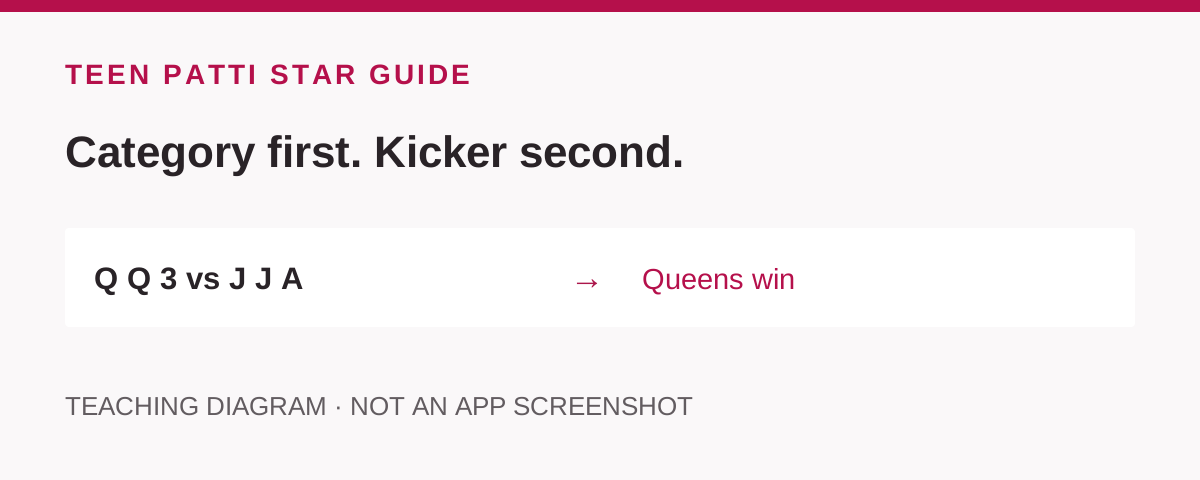
Teen Patti Hand Rankings: Examples and Tie-Breaks
Compare two Teen Patti hands with a free card selector. Follow category and kicker comparisons, choose the A-2-3 convention and work through tie examples.

Gameplay
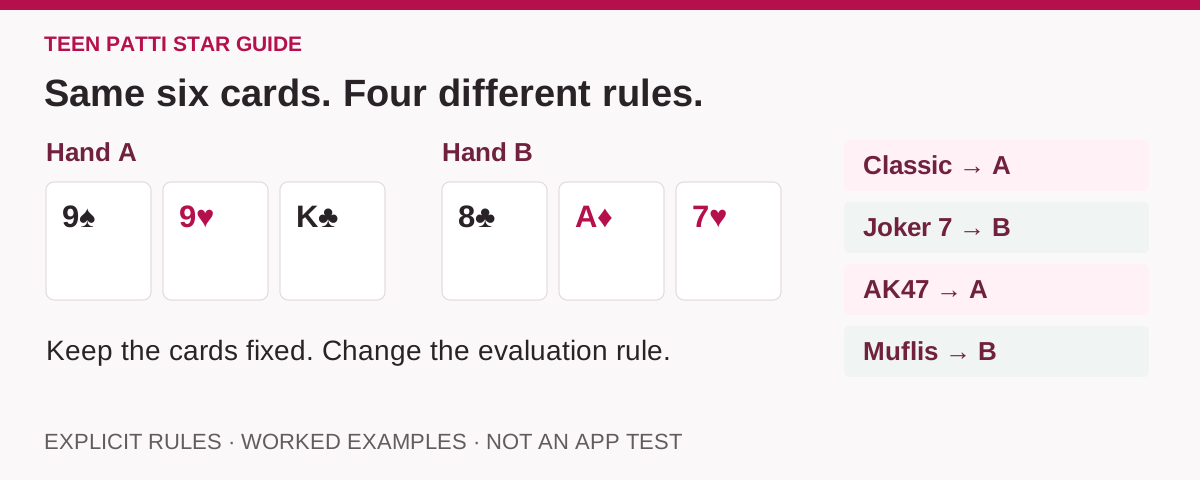
Teen Patti Variants Compared: Classic, Joker, AK47 and Muflis
Keep the same six cards and compare four Teen Patti variants. See the exact Joker and AK47 substitutions, the Muflis reversal and the rules to agree first.
Gameplay
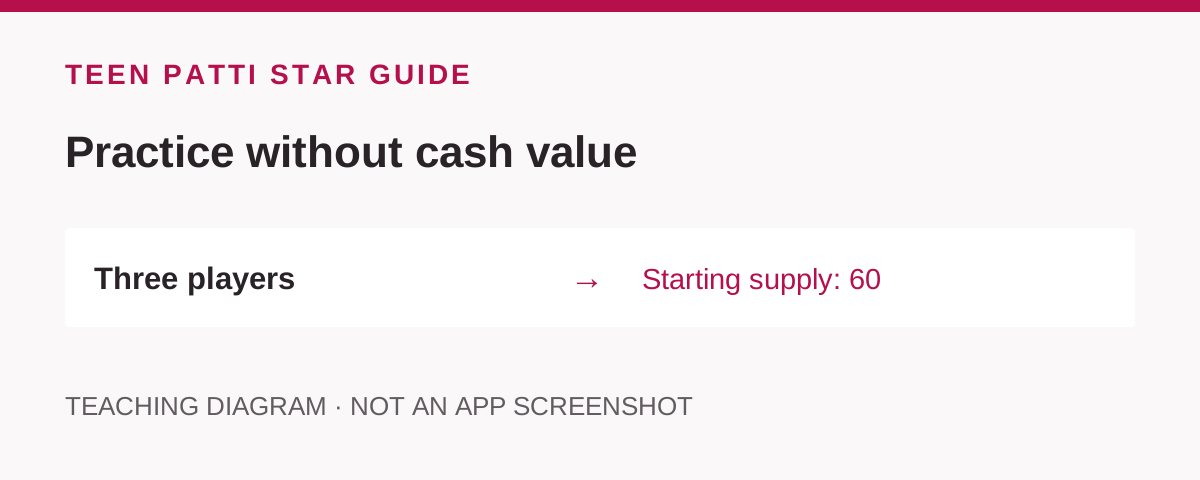
Play Teen Patti for Free: No-Money Practice and Hand Exercises
Practise Teen Patti hand comparisons here without an account or payment. Reveal answers, follow a no-money round, and distinguish free play from free downloads.