
Gameplay
Muflis Teen Patti: Which Hand Wins?
In Muflis, the conventionally weaker Teen Patti hand wins. Identify each category first, then reverse the normal comparison within that category. A lower single card or a smaller sum is not enough to decide. Agree Ace and sequence rules before comparing ambiguous hands.
Method: a public-documentation guide, not a hands-on test of a Star build. Diagrams are illustrative. Sources & limitations
The comparison rule used in this guide
For the distinction between changing cards and reversing comparisons, see the Classic, Joker, AK47 and Muflis overview.
Octro and TeenPatti Royale describe Muflis as weakest-hand-wins Teen Patti. Below, we apply that as a strict reversal of conventional hand strength: categories still exist, and ordinary within-category comparison still determines which hand is weaker. No wild cards are used.
Unless a row says otherwise, Aces are high in High Card, Colour, Pair and Trail comparisons. Straights and Colours still count as categories. We separate the A-2-3 convention later rather than pretend every table uses the same sequence order. These are worked rule examples, not a tested Star-app mode or a prediction of profit.
The same deal: classic winner versus Muflis winner

Hand A is Q♠ Q♥ 5♣, a Pair. Hand B is K♦ 8♣ 3♥, a High Card hand: no pair, no run and no shared suit.
Swipe the table sideways to compare.
| Question | Classic Teen Patti | Muflis under this guide’s convention |
|---|---|---|
| Which category is stronger normally? | A: Pair beats High Card | Still A; the category labels do not change |
| Which hand wins the comparison? | A: Q♠ Q♥ 5♣ | B: K♦ 8♣ 3♥ |
| Does B’s King settle it? | No; category comes first | No; B wins because its category is weaker |
Which category is stronger normally?
- Classic Teen Patti
- A: Pair beats High Card
- Muflis under this guide’s convention
- Still A; the category labels do not change
Which hand wins the comparison?
- Classic Teen Patti
- A: Q♠ Q♥ 5♣
- Muflis under this guide’s convention
- B: K♦ 8♣ 3♥
Does B’s King settle it?
- Classic Teen Patti
- No; category comes first
- Muflis under this guide’s convention
- No; B wins because its category is weaker
Only the comparison objective changed. No cards were replaced. Calling the King “too high for Muflis” would miss the first decision: an ordinary High Card hand is weaker than every Pair. For the starting hierarchy, see the standard ranking examples.
Reverse the categories before inspecting individual ranks
The following is best to worst for Muflis under a full reversal of the ordinary hierarchy.
Swipe the table sideways to compare.
| Muflis order | Category | A hand in this category beats |
|---|---|---|
| 1 | High Card | Pair, Colour, Sequence, Pure Sequence, Trail |
| 2 | Pair | Colour, Sequence, Pure Sequence, Trail |
| 3 | Colour | Sequence, Pure Sequence, Trail |
| 4 | Sequence | Pure Sequence, Trail |
| 5 | Pure Sequence | Trail |
| 6 | Trail | Only a conventionally stronger Trail |
1
- Category
- High Card
- A hand in this category beats
- Pair, Colour, Sequence, Pure Sequence, Trail
2
- Category
- Pair
- A hand in this category beats
- Colour, Sequence, Pure Sequence, Trail
3
- Category
- Colour
- A hand in this category beats
- Sequence, Pure Sequence, Trail
4
- Category
- Sequence
- A hand in this category beats
- Pure Sequence, Trail
5
- Category
- Pure Sequence
- A hand in this category beats
- Trail
6
- Category
- Trail
- A hand in this category beats
- Only a conventionally stronger Trail
Small-looking cards can still form a bad Muflis category. Compare 4♠ 3♥ 2♦ with 5♣ 3♦ 2♣. The first is a Sequence; the second is High Card. Classic awards the comparison to the Sequence, but Muflis awards it to 5-3-2. Do not discard the run merely to describe both hands as low cards.
Same category: compare from the correct starting point
For High Card and Colour, arrange ranks from highest to lowest. Compare the first different rank; lower wins in this Muflis convention. Do not start with each hand’s smallest card and do not add the values together.
Swipe the table sideways to compare.
| Hand A | Hand B | Classic winner | Muflis winner and reason |
|---|---|---|---|
| 9♠ 6♥ 2♣ | 9♥ 5♦ 3♠ | A | B: 9 ties, then 5 is lower than 6 |
| 8♠ 7♥ 2♦ | 9♣ 4♦ 3♥ | B | A: highest card 8 is lower than 9 |
| 6♠ 6♥ Q♦ | 6♦ 6♣ 9♥ | A | B: Pair ranks tie; kicker 9 is lower than Q |
| 9♣ 9♦ 9♥ | 8♣ 8♦ 8♥ | A | B: Trail of 8s is conventionally weaker |
9♠ 6♥ 2♣
- Hand B
- 9♥ 5♦ 3♠
- Classic winner
- A
- Muflis winner and reason
- B: 9 ties, then 5 is lower than 6
8♠ 7♥ 2♦
- Hand B
- 9♣ 4♦ 3♥
- Classic winner
- B
- Muflis winner and reason
- A: highest card 8 is lower than 9
6♠ 6♥ Q♦
- Hand B
- 6♦ 6♣ 9♥
- Classic winner
- A
- Muflis winner and reason
- B: Pair ranks tie; kicker 9 is lower than Q
9♣ 9♦ 9♥
- Hand B
- 8♣ 8♦ 8♥
- Classic winner
- A
- Muflis winner and reason
- B: Trail of 8s is conventionally weaker
The second row is a useful arithmetic trap. A’s ranks sum to 17 while B’s sum to 16, yet A wins Muflis. Rank comparison is not a lowest-total contest. The third row also shows why sorting all three cards is wrong for a Pair: compare the repeated rank first and the kicker only if the pairs match.
Ace conventions can change the answer
The phrase “lowest wins” does not specify how an Ace is valued. Take A♠ 8♥ 3♣ versus K♠ 9♥ 2♦. Neither hand is a run or Colour. With Ace high, the King-high hand is conventionally weaker and wins Muflis. If a table explicitly makes Ace low for High Card comparisons, the first hand becomes 8-3-A and wins instead. This second result is conditional, not a claim that every Muflis table uses Ace low.
Sequences require their own agreement. For mixed-suit A♠ 2♥ 3♣ against A♥ K♣ Q♦:
Swipe the table sideways to compare.
| Agreed conventional sequence order | Classic winner | Winner after strict Muflis reversal |
|---|---|---|
| A-2-3 above A-K-Q | A-2-3 | A-K-Q |
| A-K-Q above A-2-3 | A-K-Q | A-2-3 |
A-2-3 above A-K-Q
- Classic winner
- A-2-3
- Winner after strict Muflis reversal
- A-K-Q
A-K-Q above A-2-3
- Classic winner
- A-K-Q
- Winner after strict Muflis reversal
- A-2-3
Pagat records the first conventional order. Our Ace-sequence comparison guide discusses the alternative as well. Decide which ladder is being reversed before awarding the hand. An instruction that merely says “Ace is low” does not settle whether A-2-3 remains a Sequence.
A tied rank is still tied
Try 9♠ 6♥ 2♣ against 9♥ 6♦ 2♠. With suits having no ranking priority, the sorted ranks are identical in both modes. Reversing a comparison does not manufacture a lower hand or a stronger suit.
Now consult the table’s tie-settlement rule. A tied Show may penalise the requester under a specified convention; another situation may have different handling. Do not assume “weaker wins” means all tied pots are shared. Review Show versus Sideshow before treating a ranking tie as permission to request a comparison.
Use a five-line rule card before practising
Write down: whether all categories are reversed; whether straights and Colours still count; Ace value outside sequences; the sequence ladder including A-2-3; and the tied-hand procedure. If one is unknown, mark it unresolved rather than filling it in from another app.
Use a deck and counters with no cash value. Deal once, name the classic winner, then name the Muflis winner without moving the cards. Explain the category first and the decisive rank second. The same exercise can be used in a home practice session.
Common questions
Is 2-3-5 always the best Muflis hand?
Mixed-suit 5-3-2 is the lowest High Card under the Ace-high, straights-count convention used here. It is not a universal answer if the table changes Ace treatment or whether straights count.
Can a Pair win Muflis?
Yes, against a conventionally stronger category or a stronger Pair. It loses to an ordinary High Card hand under this convention. “Pair is bad” is not a complete comparison.
Are A, K, 4 and 7 wild here?
No. Those are the AK47 wild ranks, not a rule automatically inherited by Muflis. Our standard hand calculator also does not settle Muflis outcomes; do not use its higher-hand result as the Muflis winner.
Sources & scope
Public sources checked on 26 September 2026. Examples are illustrative; no hands-on device test of a specific app was performed. Table and platform rules may differ.
- Octro — published AK47 and Muflis variations
- TeenPatti Royale — variation definitions
- Pagat — category comparisons and ace-sequence convention
Related guides
Gameplay
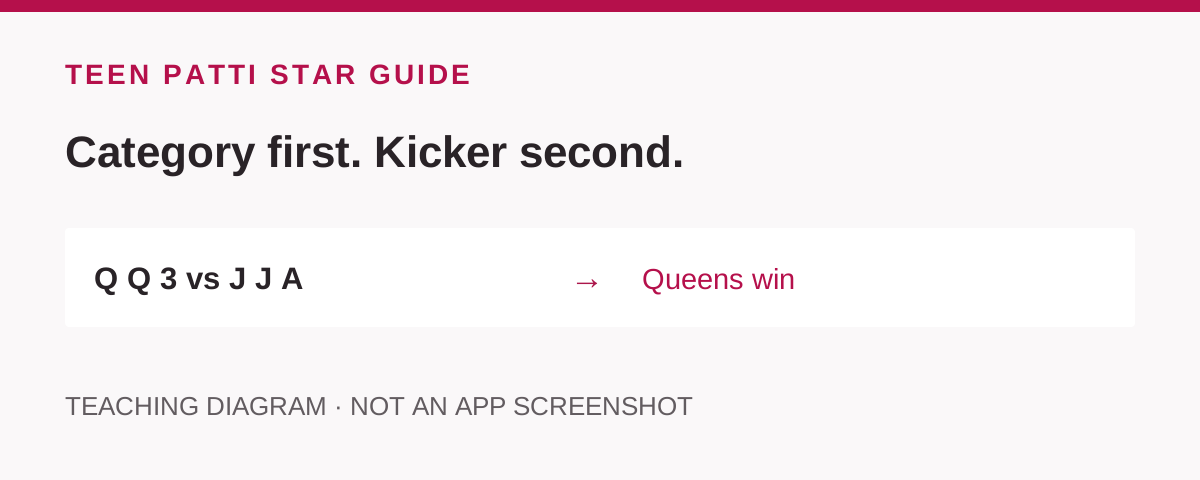
Teen Patti Hand Rankings: Examples and Tie-Breaks
Compare two Teen Patti hands with a free card selector. Follow category and kicker comparisons, choose the A-2-3 convention and work through tie examples.

Gameplay
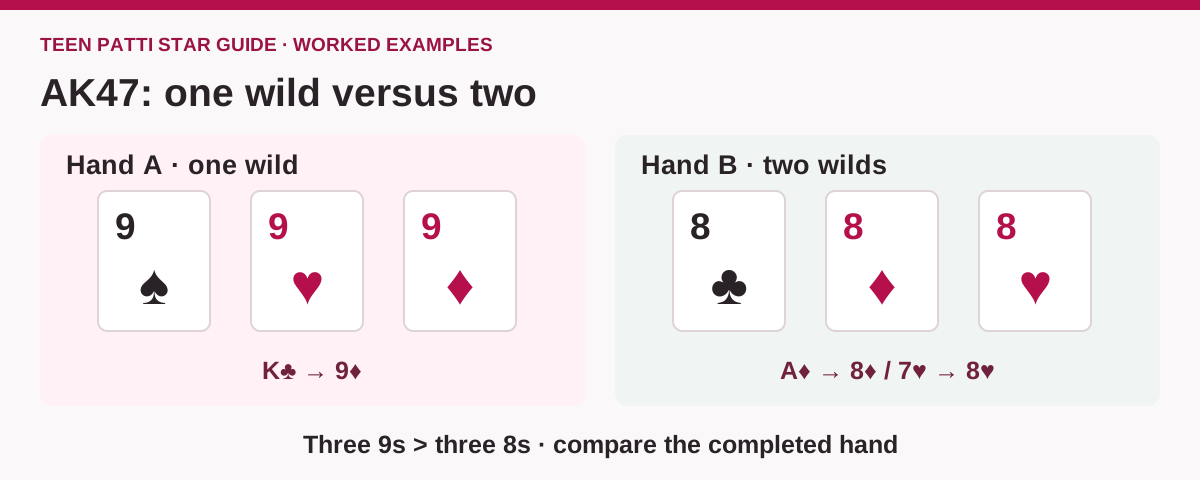
AK47 Teen Patti Rules: Wild Cards and Worked Examples
See exactly how A, K, 4 and 7 substitute in AK47 Teen Patti. Compare one wild making three 9s with two wilds making three 8s, then try worked hands.
Gameplay
Teen Patti Rules for Beginners: Rankings, Chaal and Show
Learn classic Teen Patti rules with hand-ranking examples, Blind and Seen contributions, Show eligibility, tie-breaks, and table rules to confirm.