
Gameplay
Blind vs Seen in Teen Patti: Rules and a Worked Round
Blind means you have not looked at your cards; Seen means you have. Under the convention used here, Blind contributes 1–2 times the current stake and Seen 2–4 times. The next current stake depends on who paid, not simply the last contribution.
Scope: worked examples of general Teen Patti rules, not rules tested in a specific Star app. Check your table’s rules. Sources & limitations
The quick comparison
Swipe the table sideways to compare.
| Question | Blind | Seen |
|---|---|---|
| Have you looked at your cards? | No | Yes |
| Contribution in our example | 1–2 × current stake | 2–4 × current stake |
| Can you pack? | Yes | Yes |
| Can your status change? | You may look and become Seen | You cannot unsee the cards |
| Does status improve the hand? | No | No |
Have you looked at your cards?
- Blind
- No
- Seen
- Yes
Contribution in our example
- Blind
- 1–2 × current stake
- Seen
- 2–4 × current stake
Can you pack?
- Blind
- Yes
- Seen
- Yes
Can your status change?
- Blind
- You may look and become Seen
- Seen
- You cannot unsee the cards
Does status improve the hand?
- Blind
- No
- Seen
- No
This is a teaching example with practice chips, using the betting convention documented by Pagat. It is not a tested rulebook for every Star app. Fixed buttons, pot caps and variant rules may behave differently.
To see what remains in the pot after someone folds, follow the Pack rules and four-player ledger. It separates leaving one hand from joining the next deal.
The detail that makes the arithmetic work
Boot, Chaal and Pot are not three names for the same amount
Boot is each player’s agreed opening contribution. Chaal is an action that adds a permitted contribution on a turn; current stake S is the reference used to calculate it. Pot P is the running total already in the middle. Paying a Chaal does not require matching the entire pot.
In the next section, follow the same four-player ledger from the 10-chip boot to the 210-chip final pot. When B pays 20 as Seen, P rises from 50 to 70 but S remains 10. When C then pays 20 as Blind, P rises to 90 and S becomes 20. The payment is the same; its effect on the next stake differs because the status differs.
Copy one row into the calculator
After C’s Blind contribution of 20, enter current stake 20 and choose Seen in the practice calculator. It shows a permitted contribution of 40–80. If the next player pays the minimum 40, the pot moves from 90 to 130 and the next S stays 20. The calculator does not know the previous pot: add the selected contribution to P separately. It does not calculate final Show fees.
Test yourself: if someone packs at that point, do you subtract their old boot? No. Add 0, leave the pot unchanged and leave S unchanged. This reconciles the ledger rather than treating every visible number as a new price.
Keep two columns: contribution and next current stake. Under this convention, a Blind contribution becomes the next current stake; a Seen contribution sets it to half that amount. That is why a Seen payment of 40 can be followed by a Blind payment of 20 without an error.
If you look at your cards on your turn, Seen rules apply from that turn onward. Placing them face down again does not restore Blind status. Packing means leaving the round; contributions already made remain in the pot.
A seen payment is not the next blind price
If the previous player paid 40 while Seen, the current stake is 20. The next Blind player can contribute 20 or 40; the next Seen player can contribute 40 or 80. If the previous player instead paid 40 while Blind, the current stake is 40: the next Blind options become 40 or 80, and Seen options 80 or 160.
The same last payment can therefore lead to different choices. Record the previous player’s status as well as their contribution. For a table you can set up at home, follow the four-player offline round.
Blind/Seen practice-counter calculator
Calculate an ordinary contribution, not a Show fee or a recommended move. Apply your table’s caps separately. Practice counters have no monetary value.
Example: current stake 10, player Blind.
- Minimum contribution
- 10
- Next stake after minimum
- 10
- Raised contribution
- 20
- Next stake after raise
- 20
Follow a complete round, one entry at a time
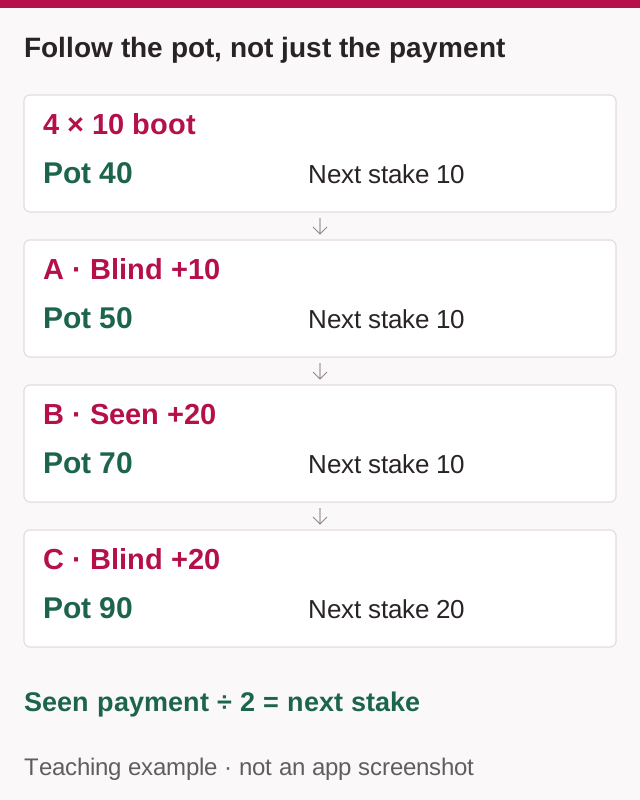
- Start: four boots4 × 10S = 10 · P = 40
- A pays 10 BlindP: 40 + 10 = 50S = 10 · P = 50
- B pays 20 SeenP: 50 + 20 = 70S = 10 · P = 70
S = next contribution reference. P = accumulated pot. A Seen payment of 20 does not automatically make S equal 20.
Four players each put in a 10-chip boot, so the pot starts at 40 and the current stake at 10. The following ledger is an original worked example, not a record of a live app session.
Swipe the table sideways to compare.
| Action | Added | Next current stake | Pot |
|---|---|---|---|
| Four boots of 10 | 40 | 10 | 40 |
| A stays Blind and pays 10 | 10 | 10 | 50 |
| B looks; Seen pays 20 | 20 | 10 | 70 |
| C stays Blind and pays 20 | 20 | 20 | 90 |
| D packs | 0 | 20 | 90 |
| A looks; Seen pays 40 | 40 | 20 | 130 |
| B stays Seen and pays 40 | 40 | 20 | 170 |
| C packs, leaving A and B | 0 | 20 | 170 |
| A pays 40 for a final Show | 40 | — | 210 |
Four boots of 10
- Added
- 40
- Next current stake
- 10
- Pot
- 40
A stays Blind and pays 10
- Added
- 10
- Next current stake
- 10
- Pot
- 50
B looks; Seen pays 20
- Added
- 20
- Next current stake
- 10
- Pot
- 70
C stays Blind and pays 20
- Added
- 20
- Next current stake
- 20
- Pot
- 90
D packs
- Added
- 0
- Next current stake
- 20
- Pot
- 90
A looks; Seen pays 40
- Added
- 40
- Next current stake
- 20
- Pot
- 130
B stays Seen and pays 40
- Added
- 40
- Next current stake
- 20
- Pot
- 170
C packs, leaving A and B
- Added
- 0
- Next current stake
- 20
- Pot
- 170
A pays 40 for a final Show
- Added
- 40
- Next current stake
- —
- Pot
- 210
At the Show, suppose A holds Q♠ Q♥ 5♣ and B holds J♦ J♣ A♥. A wins: the queen pair outranks the jack pair, regardless of B's ace kicker. The final pot is 210 practice chips. No player's contribution has been returned just because they packed.
Final Show is different from Sideshow
A final Show resolves the round when two players remain. Under the chosen convention, a Blind player can request it against either status; a Seen player cannot force a Blind opponent to show. If both are Seen, either may request it on their turn. Show costs vary across tables, so use the actual table rule.
A Sideshow is a private comparison during a continuing round. Pagat's described convention requires all remaining players to be Seen; some app rules use other eligibility conditions. Do not assume that simply looking at your cards always makes the button available. If a request is declined, the round continues.
Three checks before using another table
| Rule to confirm | Why it matters |
|---|---|
| Current-stake calculation and contribution limits | A copied multiplier is incomplete without the update rule |
| Show and Sideshow eligibility | The two comparisons are not interchangeable |
| Exact tie and pot-cap procedure | Equal cards may not mean a split pot |
Current-stake calculation and contribution limits
- Why it matters
- A copied multiplier is incomplete without the update rule
Show and Sideshow eligibility
- Why it matters
- The two comparisons are not interchangeable
Exact tie and pot-cap procedure
- Why it matters
- Equal cards may not mean a split pot
In the convention used for this ledger, an exact Show tie goes against the requester. Other tables can differ. Blind status never makes an equal-ranked hand stronger.
Is staying Blind a way to get better cards?
No. The hand is already dealt. Blind changes the information you have and the contribution rules, not the card ranks. Lower contributions can still accumulate. Use the worked ledger above and the practice calculator to check the arithmetic with counters that have no monetary value.
Sources & scope
Specific sources revisited
- — Octro’s published stake-update convention rechecked; the counter examples and calculator are our teaching aids, not an app test.
- — Revisited Blind/Seen contributions and the current-stake update rule.
These limited checks do not replace the original source dates below or constitute a device test.
Public sources checked on 6 September 2026. No hands-on device test was performed. Menus and table rules may differ.
Related guides
Gameplay
Teen Patti Show vs Sideshow: Rules, Eligibility and Examples
Check who can request Show or Sideshow, compare Blind and Seen eligibility, and follow accepted, refused and tied-hand examples.

Gameplay
Teen Patti Hand Rankings: Examples and Tie-Breaks
Compare two Teen Patti hands with a free card selector. Follow category and kicker comparisons, choose the A-2-3 convention and work through tie examples.
Gameplay
How to Play Teen Patti Offline with Friends: Setup and Step-by-Step Rules
Set up a four-player Teen Patti game with a deck and no-money counters. Follow the deal, Blind/Seen turns, Show and a checked 15-counter round.