
Gameplay
Teen Patti Sequence vs Colour: Which Hand Wins?
A Sequence beats a Colour in classic Teen Patti, even when the Colour contains an Ace. A Pure Sequence beats both. Identify consecutive ranks and matching suits separately; three red cards are not necessarily a Colour.
Method: a public-documentation guide, not a hands-on test of a Star build. Diagrams are illustrative. Sources & limitations
The two checks behind the names
This guide compares three-card hands from one standard deck, without wild cards. It is about classic stronger-hand rankings, not Muflis or a special room with a different objective. “Colour,” “color” and “flush” refer here to the same category, not three different hands.
Ask two separate questions: are the ranks consecutive, and do all suits match? Start with the ranks as a set; the order in which the screen lays them out is irrelevant. Then inspect the suit symbols, not just their red or black ink.
Swipe the table sideways to compare.
| Consecutive ranks? | All one suit? | Classification |
|---|---|---|
| Yes | Yes | Pure Sequence |
| Yes | No | Sequence |
| No | Yes | Colour |
| No | No | Check for Trail, Pair or High Card |
Yes
- All one suit?
- Yes
- Classification
- Pure Sequence
Yes
- All one suit?
- No
- Classification
- Sequence
No
- All one suit?
- Yes
- Classification
- Colour
No
- All one suit?
- No
- Classification
- Check for Trail, Pair or High Card
This is a classifier for the run-and-suit question, not a replacement for the complete ranking guide. Three identical ranks are a Trail, for example, even though they do not form a run.
A small sequence against an Ace-high colour
Player A has 4♠ 5♥ 6♦. Player B has A♣ J♣ 8♣. A’s ranks are consecutive with mixed suits: Sequence. B’s suits match but the ranks have gaps: Colour. A wins by category. There is no need to compare the Ace with the 6.
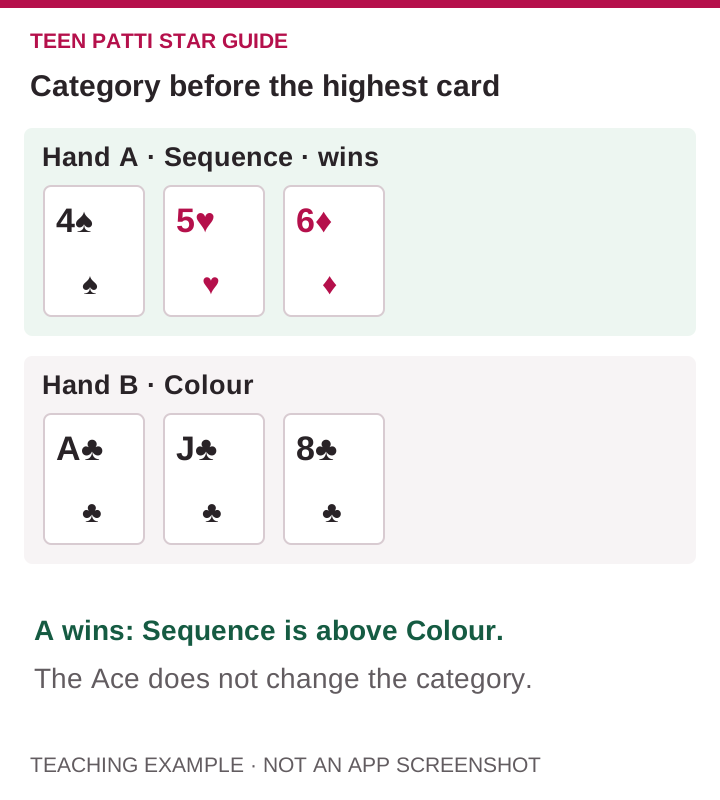
Write the explanation in two parts: “Sequence versus Colour; Sequence is higher.” This makes the reason visible. Simply writing “6 beats Ace” teaches the wrong rule, because individual ranks have not changed their values.
Now replace A’s 5♥ with 9♥, keeping 4♠ and 6♦. The new hand is 4♠ 9♥ 6♦, a High Card hand. B’s Colour now wins. That single change breaks the run; it is not the appearance of a larger 9 that makes the hand stronger. All six physical cards in either comparison are distinct.
Pure sequence versus ordinary sequence
Compare 4♥ 5♥ 6♥ with A♠ K♦ Q♣. The first hand is a Pure Sequence; the second is an ordinary Sequence. The first wins even at an AKQ-first table, because the categories differ.
Now change only 5♥ to 5♣. 4♥ 5♣ 6♥ is still a valid run, but is no longer pure. Against mixed AKQ, it loses under the ordinary sequence order. Two matching suits do not create a category halfway between Sequence and Pure Sequence.
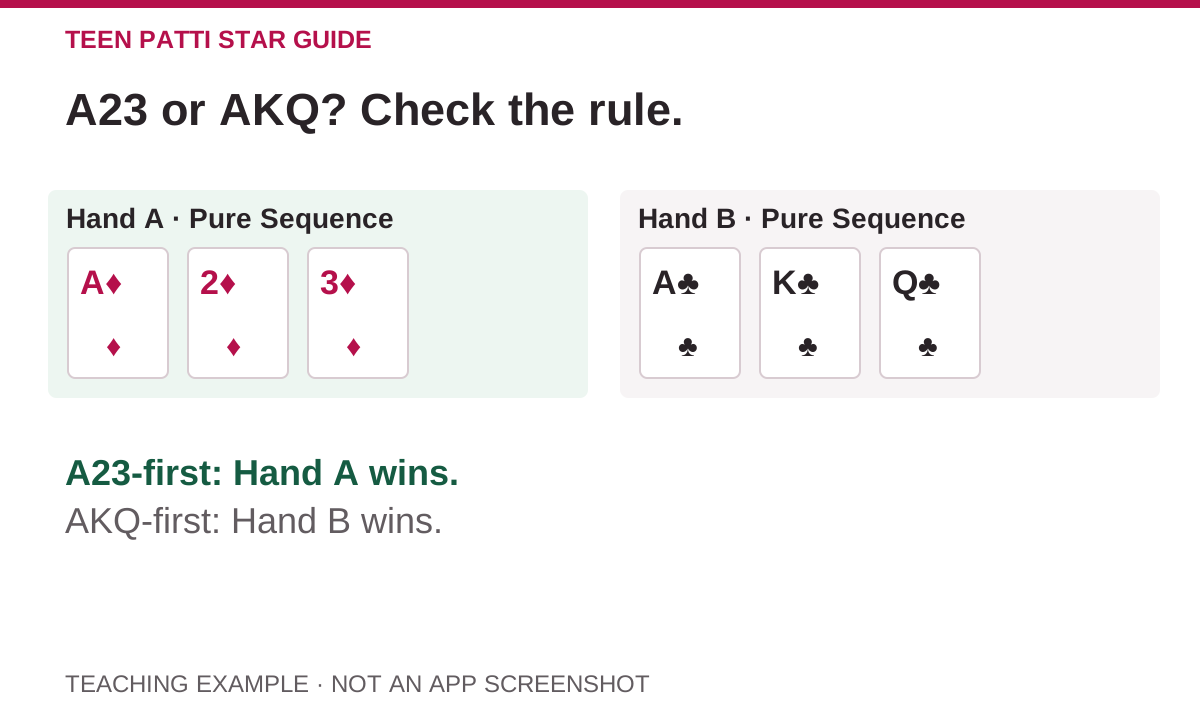
The special Ace question matters when the hands share a sequence category. Use A23 versus AKQ for the competing conventions, rather than applying an Ace rule before identifying suits.
Three red cards are not always a colour
A♥ J♦ 8♥ has three red cards but two suits. It is not a Colour. Without a run or pair, it is High Card. Change J♦ to J♥ and it becomes A♥ J♥ 8♥, a Colour. The suit symbol is the decisive change, not the printed rank.
The same distinction applies to black clubs and spades. When reporting a disputed hand, write the symbol beside every rank. A screenshot described only as “all red” cannot establish a flush. If a theme changes card colours for accessibility, use the actual suit marks rather than the artwork.
When both players have colour
For A♥ J♥ 8♥ against A♠ 10♠ 9♠, compare the Ace first: equal. Compare the next rank: J beats 10, so the hearts hand wins. Its lowest card, 8, does not need to beat the opponent’s 9. Do not total the three rank values.
If the second hand changes to A♠ J♠ 9♠, the first two ranks tie and the third decides: 9 beats 8. These two examples deliberately change only one card, so you can identify the first comparison that stops being equal.
If all three ranks match, the hands are equal in strength under suit-neutral rules. Settlement is another step; do not automatically award spades the pot or assume a split. Read the table’s procedure and the Show and Sideshow guide.
A short classification practice
For each row, name both categories before choosing the winner. The examples use classic rankings and no jokers. They are constructed lessons, not screenshots from a tested app.
Swipe the table sideways to compare.
| Hand A | Hand B | Answer and reason |
|---|---|---|
| 7♣ 8♦ 9♥ | K♠ 10♠ 4♠ | A: Sequence beats Colour |
| 3♦ 4♦ 5♦ | Q♣ K♥ A♠ | A: Pure Sequence beats Sequence |
| K♥ 9♦ 4♥ | 2♣ 6♣ J♣ | B: Colour beats High Card |
| A♦ 10♦ 6♦ | A♣ 10♣ 5♣ | A: same Colour ranks until 6 beats 5 |
7♣ 8♦ 9♥
- Hand B
- K♠ 10♠ 4♠
- Answer and reason
- A: Sequence beats Colour
3♦ 4♦ 5♦
- Hand B
- Q♣ K♥ A♠
- Answer and reason
- A: Pure Sequence beats Sequence
K♥ 9♦ 4♥
- Hand B
- 2♣ 6♣ J♣
- Answer and reason
- B: Colour beats High Card
A♦ 10♦ 6♦
- Hand B
- A♣ 10♣ 5♣
- Answer and reason
- A: same Colour ranks until 6 beats 5
Try the two-hand comparison tool with these cards. It evaluates the stated classic categories; it is not a predictor of a hidden opponent or a future deal. Learning the order does not guarantee winning a round. Practise with face-up cards and counters that have no cash value.
Sources & scope
Public sources checked on 19 October 2026. Examples are illustrative; no hands-on device test of a specific app was performed. Table and platform rules may differ.
- Teenpatti.com — Sequence, Colour and Pure Sequence definitions
- Pagat — category-first hand comparison
Related guides
Gameplay
A23 vs AKQ in Teen Patti: Which Sequence Wins?
Compare A23 and AKQ under different Teen Patti rules, with suited and mixed-suit examples, sequence-order tables, and tips for checking your table.

Gameplay
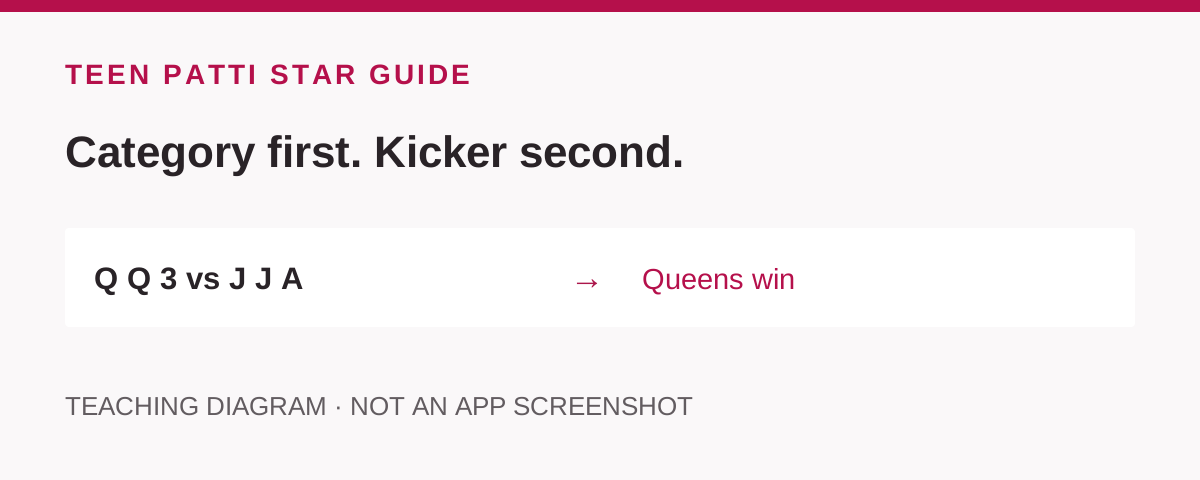
Teen Patti Hand Rankings: Examples and Tie-Breaks
Compare two Teen Patti hands with a free card selector. Follow category and kicker comparisons, choose the A-2-3 convention and work through tie examples.
Gameplay
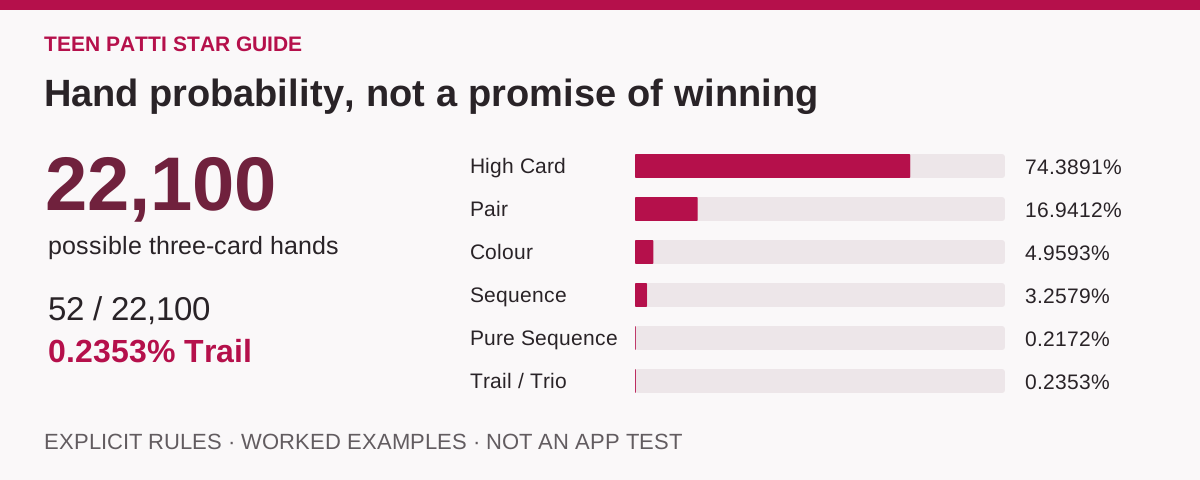
Teen Patti Hand Probabilities: How Rare Is Each Hand?
Exact counts for all 22,100 Teen Patti hands, with formulas and a reproducible check. Understand rare hands, Ace conventions and why deal probability is not win probability.