
Gameplay
A23 vs AKQ in Teen Patti: Which Sequence Wins?
A23 beats AKQ when the table ranks A-2-3 first. AKQ beats A23 when the table ranks A-K-Q first—provided both hands belong to the same category. If one hand is a pure sequence and the other is an ordinary sequence, the pure sequence wins under the classic category hierarchy before the ace-order question matters.
Method: a public-documentation guide, not a hands-on test of a Star build. Diagrams are illustrative. Sources & limitations
That qualification is essential. “I had A23” leaves out the suits, and “AKQ is highest” leaves out the table convention. To decide a particular result, identify the category of each hand and then apply the ranking used by that game mode.
The examples below use a standard deck without wild cards. They explain different rule conventions, not a single confirmed ranking for every application or table using the Teen Patti Star name.
What A23 and AKQ Mean
A23 means an ace, a two, and a three. AKQ means an ace, a king, and a queen. Both are accepted sequence patterns in the conventions discussed here, although their positions in the sequence order differ.
The way the cards are displayed does not change the hand. Q-K-A, K-Q-A, and A-K-Q contain the same ranks. Similarly, 3-2-A and A-2-3 describe the same rank pattern. Read the cards as a group rather than interpreting the leftmost card as the start of a different run.
Suits determine whether the sequence is pure. A♦ 2♦ 3♦ is a pure sequence because all three cards are diamonds. A♦ 2♣ 3♥ is an ordinary sequence. Two matching suits are not enough to make a pure sequence, but they do not prevent an ordinary sequence from being valid. For the complete category ladder, use the hand-ranking guide.
The Main Sequence Orders
Pagat places A23 first; the ranking article on Teenpatti.com places AKQ first and A23 second. The third column below is an explicitly agreed A23-lowest house-rule example, not a verified Star-app setting. These are different rule choices; the word “sequence” alone does not tell you which one applies.
Swipe the table sideways to compare.
| Position | A23 first | AKQ first and A23 second | A23 lowest house convention |
|---|---|---|---|
| Highest | A-2-3 | A-K-Q | A-K-Q |
| Next | A-K-Q | A-2-3 | K-Q-J |
| Then | K-Q-J | K-Q-J | Q-J-10 |
| Lowest | 4-3-2 | 4-3-2 | A-2-3 |
Highest
- A23 first
- A-2-3
- AKQ first and A23 second
- A-K-Q
- A23 lowest house convention
- A-K-Q
Next
- A23 first
- A-K-Q
- AKQ first and A23 second
- A-2-3
- A23 lowest house convention
- K-Q-J
Then
- A23 first
- K-Q-J
- AKQ first and A23 second
- K-Q-J
- A23 lowest house convention
- Q-J-10
Lowest
- A23 first
- 4-3-2
- AKQ first and A23 second
- 4-3-2
- A23 lowest house convention
- A-2-3
Under both AKQ-first columns, AKQ defeats A23 within the same category. However, the columns do not produce the same result when A23 faces KQJ. A23 wins that comparison when it is second highest and loses when it is lowest.
This is why asking only “Which is highest?” may not settle every future hand. A complete ranking, or an explicit statement of where A23 sits, is more useful than a partial rule remembered from another table.
Example One Both Hands Are Pure Sequences
Nisha holds A♦ 2♦ 3♦. Kabir holds A♣ K♣ Q♣. Every card in each hand shares one suit, so both players have pure sequences.
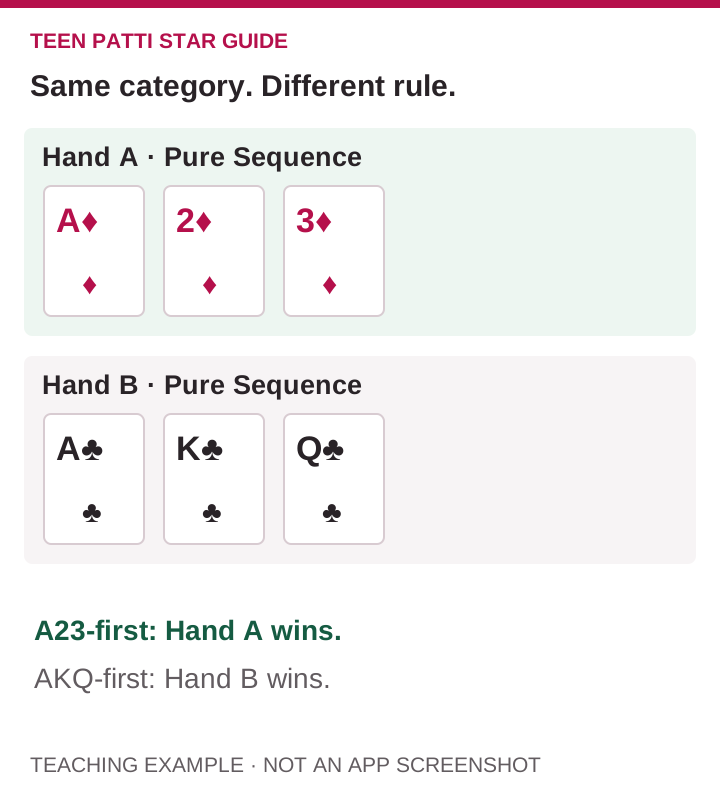
At an A23-first table, Nisha wins. At an AKQ-first table, Kabir wins. The result depends on the sequence ranking, not on diamonds versus clubs. These names are fictional participants in a constructed practice deal, not a record of an author’s actual game.
There is no need to compare individual cards one by one as though these were high-card hands. Saying “both have an ace, so compare king against three” silently assumes an AKQ-first system. Under an A23-first system, the special sequence position takes precedence over that reasoning.
The correct explanation names the rule: “Nisha wins because this table ranks A23 above AKQ among pure sequences.” That is clearer and more accurate than claiming that A23 always wins everywhere.
Example Two Both Hands Have Mixed Suits
Meera holds A♥ 2♠ 3♣. Arjun holds A♠ K♦ Q♥. Neither hand is entirely one suit, and both have valid sequence ranks.
Because both hands are ordinary sequences, the same convention check applies. Meera wins under A23-first rules; Arjun wins under AKQ-first rules.
Now change Meera’s cards to A♥ 2♥ 3♣. Her hand remains an ordinary sequence. Having two hearts does not create a higher intermediate category between sequence and pure sequence. It also does not give her a partial flush bonus when comparing the two runs.
All cards in these examples can coexist in a single deck. Checking that detail matters when building practice hands: accidentally using the same physical ace for both players makes the deal impossible, even if the intended ranking lesson seems clear.
Example Three Pure A23 Against Mixed AKQ
Ravi holds A♠ 2♠ 3♠. Priya holds A♦ K♥ Q♣. Ravi has a pure sequence; Priya has an ordinary sequence.
Under the classic category order, Ravi wins even if the table places AKQ above A23 within each sequence category. The higher category is resolved first. A table’s preference for AKQ does not promote every mixed AKQ above every suited run.
Reverse the categories: give Ravi A♠ 2♦ 3♣ and Priya A♥ K♥ Q♥. Priya now wins because she has the pure sequence. An A23-first convention does not rescue Ravi’s lower-category hand.
Swipe the table sideways to compare.
| A23 hand | AKQ hand | Result under classic categories |
|---|---|---|
| Pure sequence | Pure sequence | Apply the table’s ace-sequence order |
| Ordinary sequence | Ordinary sequence | Apply the table’s ace-sequence order |
| Pure sequence | Ordinary sequence | A23 wins by category |
| Ordinary sequence | Pure sequence | AKQ wins by category |
Pure sequence
- AKQ hand
- Pure sequence
- Result under classic categories
- Apply the table’s ace-sequence order
Ordinary sequence
- AKQ hand
- Ordinary sequence
- Result under classic categories
- Apply the table’s ace-sequence order
Pure sequence
- AKQ hand
- Ordinary sequence
- Result under classic categories
- A23 wins by category
Ordinary sequence
- AKQ hand
- Pure sequence
- Result under classic categories
- AKQ wins by category
This four-row check resolves the question more reliably than memorizing either rank pattern as an unconditional winner. The Sequence versus Colour examples apply the same category-first check.
Why K A 2 Is Not Another Ace Sequence
Allowing an ace at either end does not make the ranks circular. Q-K-A uses the ace above the king, while A-2-3 uses it below the two. K-A-2 attempts to connect both ends at once and is not a normal sequence under these conventions.
For example, K♦ A♦ 2♦ is a colour, not a pure sequence. All three suits match, but the ranks do not form an accepted run. K♦ A♣ 2♥ is a high-card hand in ordinary no-joker play because it has neither a pair, a colour, nor a valid sequence.
This distinction also explains why an ace cannot replace a missing card simply because it seems versatile. In A♣ 3♦ 4♥, the ace does not act as a two unless the selected variation explicitly makes it wild. Ace-sequence rules and Joker rules are separate subjects.
Same Sequence Ties Are a Different Question
A23 versus AKQ is normally a ranking decision, not an exact strength tie, once the convention is known. A genuine equal-rank example is A♠ 2♠ 3♠ against A♥ 2♥ 3♥: both hands have the same sequence ranks and the same category.
Under suit-neutral comparison, neither is stronger. The table must then apply its settlement procedure. Some final-show conventions make the requester lose when the hands are equal; other agreed formats may settle the pot differently.
Do not introduce a spades-over-hearts hierarchy after the reveal. If ranked suits are a deliberate house rule, they need to be agreed before dealing. Similarly, do not assume that a rule for an accepted sideshow is identical to the rule for an automatic final reveal. Read Show versus Sideshow for eligibility and settlement.
How to Check the Rule in a Teen Patti Star Table
Identify the exact application and selected mode before relying on a ranking guide. A screenshot from another product, a joker table, or an older release may answer a different question. If needed, check the installed version.
Look for the mode’s own rules or hand-ranking information, wherever that release makes it available. The useful evidence is an explicit ordering of A23 and AKQ, plus confirmation that the classic pure-sequence-over-sequence hierarchy applies. A label saying only “Ace high” is less informative than the actual list of runs.
If the instructions are unclear, ask the application’s identifiable support channel a precise question: “In this named mode, where does A23 rank relative to AKQ and KQJ, for both pure and ordinary sequences?” Include the version and mode rather than asking whether an ace is generally high or low.
For a disputed round, preserve the exact suits, both hands, mode, and round reference. Do not publish passwords, one-time codes, or payment information with a screenshot. For an offline game, agree the sequence order before dealing rather than resolving it in favour of whoever argues most confidently afterward.
A Short Practice Check
Assume classic categories and an AKQ-first, A23-second ordering. Compare A♣ 2♣ 3♣ against A♦ K♥ Q♠. The suited A23 wins by category. Next compare A♣ 2♦ 3♥ against K♣ Q♦ J♠. A23 wins because this convention places it second, above KQJ.
Now switch only the rule to A23-lowest. The first result remains unchanged because pure sequence still outranks sequence. The second result reverses because both hands are ordinary sequences and KQJ now ranks higher.
Practise these comparisons with face-up cards and no-money counters. The goal is to explain which rule decides the result, not to predict future cards. Knowing the difference between A23 and AKQ prevents ranking mistakes, but it does not guarantee wins or justify chasing losses.
Sources & scope
Public sources checked on 19 October 2026. Examples are illustrative; no hands-on device test of a specific app was performed. Table and platform rules may differ.
- Pagat — A23-first convention and category order
- Teenpatti.com — published AKQ-first ranking explanation
Related guides
Gameplay
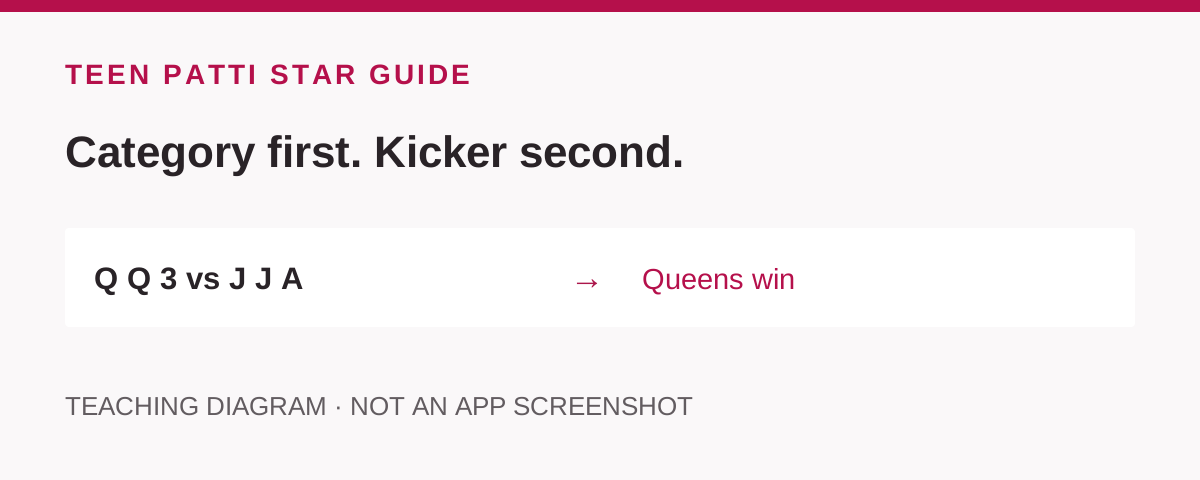
Teen Patti Hand Rankings: Examples and Tie-Breaks
Compare two Teen Patti hands with a free card selector. Follow category and kicker comparisons, choose the A-2-3 convention and work through tie examples.

Gameplay
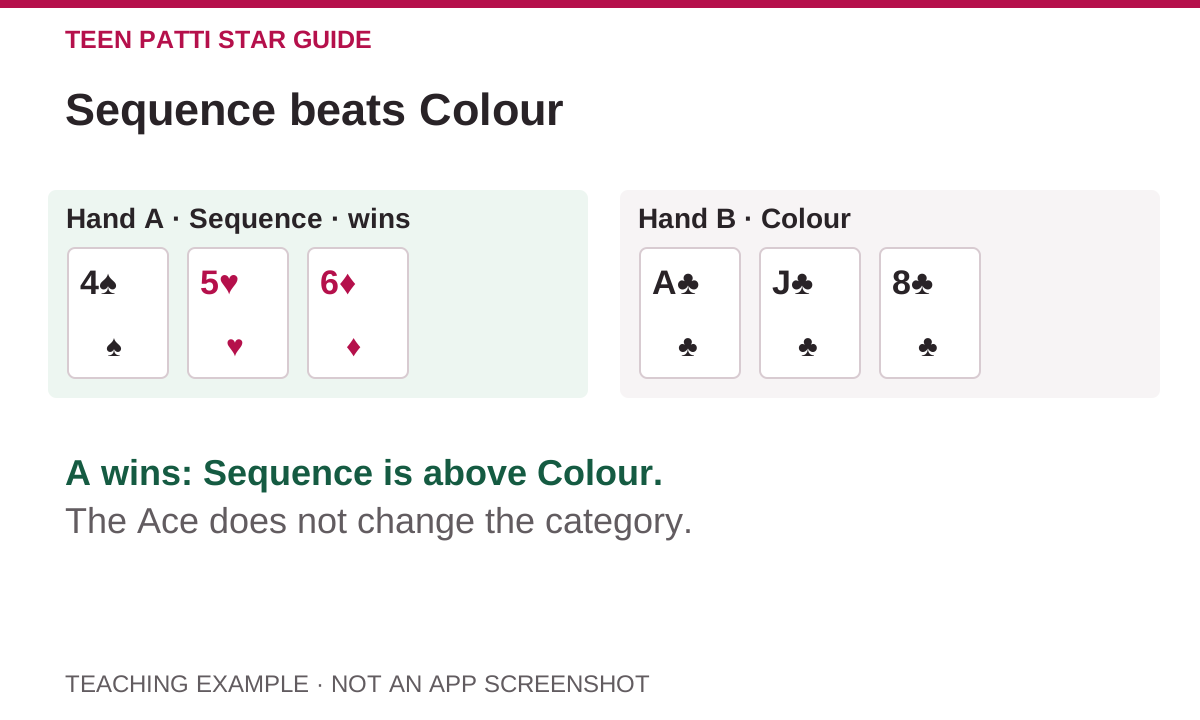
Teen Patti Sequence vs Colour: Which Hand Wins?
A small sequence beats an Ace-high colour in classic Teen Patti. Compare pure sequence, same-suit colour and red-card mistakes with worked hands and a short quiz.
Gameplay
Teen Patti Show vs Sideshow: Rules, Eligibility and Examples
Check who can request Show or Sideshow, compare Blind and Seen eligibility, and follow accepted, refused and tied-hand examples.