
Gameplay
Teen Patti Show vs Sideshow: Rules, Eligibility and Examples
A Show settles the round between the final two active players. A Sideshow is a private comparison during a continuing round and can be refused. Check player status before comparing cards: being Seen does not automatically make either request available.
Method: a public-documentation guide, not a hands-on test of a Star build. Diagrams are illustrative. Sources & limitations
First count the players still in the hand
Count active hands, not occupied seats. Someone who has packed is no longer an opponent in that round. Three people sitting at a table may therefore mean only two players remain. Conversely, a folded friend watching your cards does not make a final Show into a Sideshow.
This guide separates Pagat's published traditional convention from Octro's app-specific instructions. Examples use counters with no cash value. They are constructed teaching cases, not observations from a tested Star app.
Show and Sideshow at a glance
| Question | Show | Sideshow |
|---|---|---|
| Purpose | Decide the final two-player result | Remove one hand while the round continues |
| Cards compared | Final two active hands | Requester and eligible previous player |
| Can the target refuse? | Not an eligible, paid Show under the chosen convention | Yes, before accepting the comparison |
| Visibility | Both final hands are exposed | Only the two participants compare privately |
| An exact tie | Apply the agreed Show tie rule | Apply the agreed Sideshow tie rule |
Purpose
- Show
- Decide the final two-player result
- Sideshow
- Remove one hand while the round continues
Cards compared
- Show
- Final two active hands
- Sideshow
- Requester and eligible previous player
Can the target refuse?
- Show
- Not an eligible, paid Show under the chosen convention
- Sideshow
- Yes, before accepting the comparison
Visibility
- Show
- Both final hands are exposed
- Sideshow
- Only the two participants compare privately
An exact tie
- Show
- Apply the agreed Show tie rule
- Sideshow
- Apply the agreed Sideshow tie rule
Can a Blind or Seen player ask for Show?
The following is the Pagat convention, not a claim about every app. Let S mean current stake, not the last payment. Blind can request against either status for S; Seen cannot demand Show against Blind; two Seen players use 2S. The requester loses an exact tie. Pagat also records a higher-fee variation, so settle the convention first.
| You / opponent | Eligible with exactly 2 active players? | If current stake is 10 |
|---|---|---|
| Blind / Blind | Yes, on your turn | Show contribution 10 |
| Blind / Seen | Yes, on your turn | Show contribution 10 |
| Seen / Blind | No under this convention | Continue with an allowed action or pack |
| Seen / Seen | Yes, on your turn | Show contribution 20 |
Blind / Blind
- Eligible with exactly 2 active players?
- Yes, on your turn
- If current stake is 10
- Show contribution 10
Blind / Seen
- Eligible with exactly 2 active players?
- Yes, on your turn
- If current stake is 10
- Show contribution 10
Seen / Blind
- Eligible with exactly 2 active players?
- No under this convention
- If current stake is 10
- Continue with an allowed action or pack
Seen / Seen
- Eligible with exactly 2 active players?
- Yes, on your turn
- If current stake is 10
- Show contribution 20
Do not turn a previous payment of 40 into a Show price without identifying what it represented. For ordinary contribution arithmetic, use the Blind/Seen calculator. That calculator deliberately does not calculate Show fees.
Sideshow eligibility: two sources, two scopes
Pagat requires all remaining players to be Seen, then a minimum Seen contribution before asking the preceding bettor for a compromise. Acceptance leads to a private comparison; the weaker hand packs, and the requester packs on a tie. Refusal passes the turn onward without a comparison.
Octro's instructions instead describe a Seen requester and Seen previous player, with at least one other player remaining; the stated payment is twice current stake. Its paragraph does not impose Pagat's all-Seen condition. Do not merge these descriptions into one universal rule.
A request that changes when the convention changes
Three players remain: Asha is Seen, Dev is Blind and Meera is Seen. It is Asha's turn after Meera. Under the all-Seen convention, Dev's status blocks Sideshow even though Meera has viewed her cards. Under Octro's stated eligibility, the requester and previous player are Seen and another player remains. For an actual app, read its table rules rather than assuming either source controls it.
Worked example: accepted or refused Sideshow
Use an all-Seen practice table with three players, current stake 10 and an existing pot of 90. Mira pays the minimum 20 and asks the previous bettor, Neel, to compare. The pot is now 110. The request itself does not add a second 20 in this example.
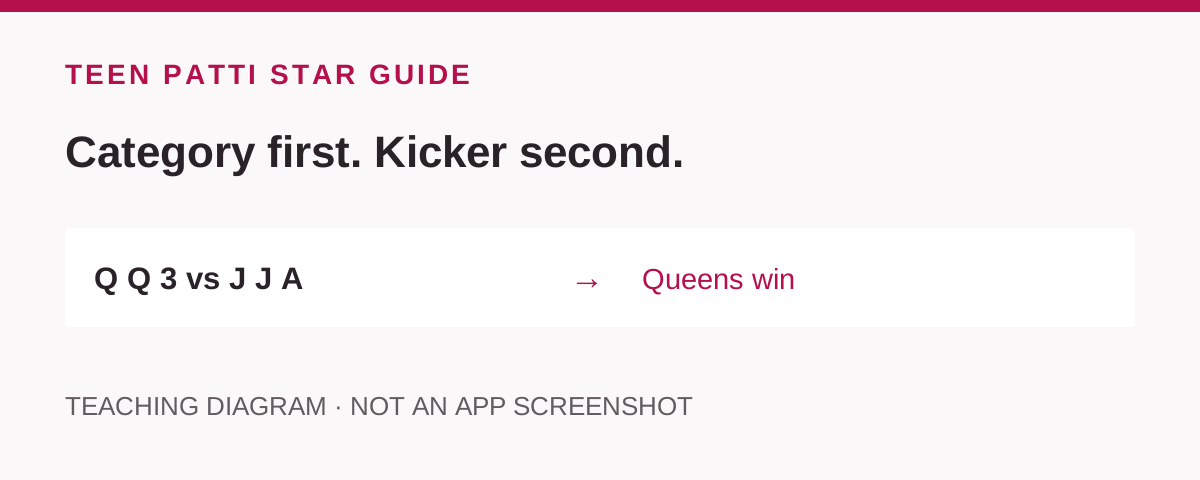
Mira holds Q♠ Q♥ 5♣. Neel holds J♦ J♣ A♥. If Neel accepts, Mira's pair of queens beats Neel's pair of jacks; the ace kicker cannot rescue the lower pair. Neel packs. Mira and the third player continue with the 110-counter pot; Mira does not collect it merely for winning this Sideshow.
If Neel refuses instead, no cards are compared and all three stay in. Under the cited sequence, Mira's contribution has already been made; it is not an extra deposit awaiting acceptance. The next player acts. An app with different payment timing must be followed on its own terms.
Worked example: identical ranks, different suits
For a separate final-Show example, Isha has K♠ Q♥ 9♣ and Ravi has K♥ Q♣ 9♦. Both are king-high hands with exactly the same comparison ranks. No card is duplicated and neither hand is a sequence or colour. Suits do not break this comparison.
With both Seen, current stake 10 and a pot of 80, Isha requests Show and adds 20. Under the stated requester-loses-ties convention, Ravi receives the 100-counter pot. This is not a split-pot rule. In an accepted Sideshow using that same tie convention, Isha would pack but the round would continue.
Use the hand comparison tool to check the ranks. A tool can report equal hands; it cannot award the pot without knowing who requested, which procedure was used and the applicable table convention.
Why the Sideshow option may be unavailable
| What to check | What it changes |
|---|---|
| Exactly 2 active players remain | Look for the final Show procedure, not a mid-round Sideshow |
| You have not viewed your cards | You are not a Seen requester |
| The preceding eligible player is Blind | Do not substitute a different Seen player simply to obtain a comparison |
| Another player is Blind | This blocks a request under the all-Seen convention |
| It is not your turn | Eligibility is checked at the correct point in the action |
| The mode has different written rules | Check that mode; this guide cannot diagnose its button from the name alone |
Exactly 2 active players remain
- What it changes
- Look for the final Show procedure, not a mid-round Sideshow
You have not viewed your cards
- What it changes
- You are not a Seen requester
The preceding eligible player is Blind
- What it changes
- Do not substitute a different Seen player simply to obtain a comparison
Another player is Blind
- What it changes
- This blocks a request under the all-Seen convention
It is not your turn
- What it changes
- Eligibility is checked at the correct point in the action
The mode has different written rules
- What it changes
- Check that mode; this guide cannot diagnose its button from the name alone
These are rule checks, not a tested fix for a missing Star button. If the interface still disagrees, record the mode, active-player count and statuses without exposing private account data. Avoid reinstalling an app to solve an unconfirmed rules question.
Questions before the next deal
Does winning a Sideshow win the pot?
Not in the continuing-round examples above. It removes the losing hand. With other opponents still active, there is more of the round to resolve.
Must every round end with Show?
No. If everyone but one player packs, there is no pair of active hands left to compare. Agree separately on any scheduled end or pot-limit procedure for a home game.
Is the Sideshow loser allowed to stay after paying again?
Not in the comparison procedure described here. Packing ends that hand's participation in this round; a later payment does not undo it. For a complete beginner session, follow the friends' practice round.
Sources & scope
Public sources checked on 24 September 2026. Examples are illustrative; no hands-on device test of a specific app was performed. Table and platform rules may differ.
- Pagat — traditional Show, compromise and variations
- Octro — published Blind, Seen and Side Show instructions
Related guides
Gameplay
Teen Patti Hand Rankings: Examples and Tie-Breaks
Compare two Teen Patti hands with a free card selector. Follow category and kicker comparisons, choose the A-2-3 convention and work through tie examples.

Gameplay
Blind vs Seen in Teen Patti: Rules and a Worked Round
Work out Blind and Seen contributions with a practice-counter calculator. Follow the current stake, a complete round and final Show eligibility.
Gameplay
How to Play Teen Patti Offline with Friends: Setup and Step-by-Step Rules
Set up a four-player Teen Patti game with a deck and no-money counters. Follow the deal, Blind/Seen turns, Show and a checked 15-counter round.