
Gameplay
How to Play Teen Patti Offline with Friends: Setup and Step-by-Step Rules
You can play Teen Patti offline with a standard deck, a few friends and tokens that have no monetary value. An app, internet connection or account is unnecessary.
Scope: worked examples of general Teen Patti rules, not rules tested in a specific Star app. Check your table’s rules. Sources & limitations
What You Need Before Starting
Use one standard 52-card deck with the printed jokers removed. Check that no cards are missing or duplicated.
Give each player 100 non-redeemable tokens. These can be counters or paper markers. Do not attach cash, prizes or debts to them.
Choose a dealer and sit in a circle. Leave room in the centre for the pot and a separate area for folded cards.
Keep a written ranking chart visible during the first few hands. That lets beginners check their cards without announcing what they hold.
Agree on a short session length, such as thirty minutes, and allow anyone to stop without pressure.
Agree on the House Rules
Give the host a small rule card
Before shuffling, fill in a card everyone can read: boot ___ counters; contribution limits ___; ace-sequence order ___; Show/tie convention ___; end time ___. Counters have no cash value and are not settled for money later.
Give the dealer the deck and a different person the tally sheet for the first teaching round. Have each player say “Blind”, “Seen” or “Pack” before moving counters. When a number is disputed, pause and reconstruct the last action rather than letting the loudest player decide.
If someone accidentally sees a card, pause before another contribution and apply the misdeal rule agreed by the group. Do not invent a penalty after learning who would benefit from it.
For this tutorial, use the following setup.
| Item | Rule for this learning game |
|---|---|
| Players | Four |
| Deck | Standard 52 cards, no jokers |
| Boot | One token from each player |
| Turn order | Clockwise, starting left of the dealer |
| Blind bet | Current stake or twice that stake |
| Seen bet | Twice or four times the current stake |
| Maximum current stake | Four tokens |
| Ordinary show | Available only with two active players |
| Sideshow | Disabled for the first session |
| Forced comparison | At the end of the third completed circuit, if needed |
| Equal hands in a forced comparison | Split among tied best hands |
Players
- Rule for this learning game
- Four
Deck
- Rule for this learning game
- Standard 52 cards, no jokers
Boot
- Rule for this learning game
- One token from each player
Turn order
- Rule for this learning game
- Clockwise, starting left of the dealer
Blind bet
- Rule for this learning game
- Current stake or twice that stake
Seen bet
- Rule for this learning game
- Twice or four times the current stake
Maximum current stake
- Rule for this learning game
- Four tokens
Ordinary show
- Rule for this learning game
- Available only with two active players
Sideshow
- Rule for this learning game
- Disabled for the first session
Forced comparison
- Rule for this learning game
- At the end of the third completed circuit, if needed
Equal hands in a forced comparison
- Rule for this learning game
- Split among tied best hands
The forced comparison is a learning house rule, not a universal Teen Patti requirement. It prevents an introductory hand from continuing indefinitely.
For this session, use A–K–Q first, A–2–3 second, then K–Q–J downward within both sequence categories. Treat K–A–2 as invalid.
Suits do not break rank ties.
Learn the Hand Rankings
Swipe the table sideways to compare.
| Strongest to weakest | Example | Description |
|---|---|---|
| Trail | 9♣–9♦–9♥ | Three matching ranks |
| Pure sequence | 6♠–7♠–8♠ | Consecutive cards in one suit |
| Sequence | 6♣–7♦–8♥ | Consecutive cards in mixed suits |
| Colour | A♥–9♥–4♥ | One suit without a sequence |
| Pair | Q♣–Q♦–5♠ | Two matching ranks |
| High card | K♣–10♦–3♥ | No stronger category |
Trail
- Example
- 9♣–9♦–9♥
- Description
- Three matching ranks
Pure sequence
- Example
- 6♠–7♠–8♠
- Description
- Consecutive cards in one suit
Sequence
- Example
- 6♣–7♦–8♥
- Description
- Consecutive cards in mixed suits
Colour
- Example
- A♥–9♥–4♥
- Description
- One suit without a sequence
Pair
- Example
- Q♣–Q♦–5♠
- Description
- Two matching ranks
High card
- Example
- K♣–10♦–3♥
- Description
- No stronger category
Compare the category before individual cards. A low sequence beats an ace-high colour, and a low pair beats an ordinary ace-high hand.
Within pairs, compare the paired rank first, then the unmatched card. For colours and high-card hands, compare the highest card, then the second and third if necessary.
These broad categories and the distinction between blind and seen play are described in published Teen Patti rules. Individual table conditions still need agreement. Octro’s Teen Patti rules.
Step 1: Collect the Boot and Deal
Each player places one token in the centre. With four players, the starting pot contains four tokens.
Shuffle thoroughly and let another player cut the deck. Deal one card at a time clockwise until each player has three face-down cards.
Keep the remaining deck separate. In this classic version, players do not draw replacements or exchange cards during the hand.
A pair will not develop into a trail through later drawing. Your cards remain the same until the hand ends.
Step 2: Choose Blind or Seen Play
A blind player has not looked at their cards. A seen player has examined them.
For the learning session, let players decide whether to look when their turn arrives. Once someone looks, that player remains seen for the rest of the hand.
Turning cards face down again does not restore blind status.
Blind play costs fewer tokens under the chosen rules, but it also provides less information. Beginners can start seen while learning how to classify hands.
Players should announce “blind” or “seen” clearly so the group can calculate the correct amount.
Step 3: Track the Current Stake
The current stake starts at one token. It is a reference amount used to calculate a legal turn.
A blind player may contribute the current stake or double it. That contribution becomes the new current stake.
A seen player may contribute twice or four times the current stake. Half of that contribution becomes the new current stake.
For example, when the current stake is two, a blind player may contribute two or four. A seen player may contribute four or eight.
Under our four-token stake cap, players cannot take an action that raises the reference stake above four. A seen player can still contribute eight at that cap because half of eight is four.
Announce the new current stake after a raise.
Step 4: Continue or Fold on Your Turn
When your turn arrives, make a legal contribution or fold.
Folding means leaving the current hand. Place your cards face down in the discard area. Tokens already contributed remain in the pot.
Folded players cannot re-enter, lend their cards to someone else or reveal information that helps an active player.
Teen Patti does not use the same contribution-matching process as many poker games. Blind and seen players may contribute different amounts, and everyone does not need to equalise earlier contributions before play continues.
Follow the chosen turn rules rather than importing a familiar poker procedure.
Step 5: Use the Agreed Show Rules
For this home game, adopt this show procedure when only two players remain:
A blind player may request a show on their turn by paying the current stake, before looking.
If both players are seen, the player whose turn it is may request a show by paying twice the current stake.
A seen player cannot demand an ordinary show against a blind opponent. They can continue or fold.
Reveal and compare both hands. For an exact tie in a requested show, the player who requested it loses. These are one established set of show conventions; published rules also document alternatives. Pagat’s Teen Patti show rules.
If the agreed third circuit ends first, use the separate forced-comparison house rule.
A Complete Four-Player Round
Asha, Ben, Cara and Dev each contribute one token. Dev deals, so Asha acts first.
Swipe the table sideways to compare.
| Action | Tokens added | Pot | Current stake |
|---|---|---|---|
| Four boot contributions | 4 | 4 | 1 |
| Asha plays blind | 1 | 5 | 1 |
| Ben looks and plays seen | 2 | 7 | 1 |
| Cara looks and folds | 0 | 7 | 1 |
| Dev plays blind and raises | 2 | 9 | 2 |
| Asha looks and folds | 0 | 9 | 2 |
| Ben continues seen | 4 | 13 | 2 |
| Dev requests a blind show | 2 | 15 | 2 |
Four boot contributions
- Tokens added
- 4
- Pot
- 4
- Current stake
- 1
Asha plays blind
- Tokens added
- 1
- Pot
- 5
- Current stake
- 1
Ben looks and plays seen
- Tokens added
- 2
- Pot
- 7
- Current stake
- 1
Cara looks and folds
- Tokens added
- 0
- Pot
- 7
- Current stake
- 1
Dev plays blind and raises
- Tokens added
- 2
- Pot
- 9
- Current stake
- 2
Asha looks and folds
- Tokens added
- 0
- Pot
- 9
- Current stake
- 2
Ben continues seen
- Tokens added
- 4
- Pot
- 13
- Current stake
- 2
Dev requests a blind show
- Tokens added
- 2
- Pot
- 15
- Current stake
- 2
Ben reveals J♣–J♦–4♠, a pair of jacks.
Dev reveals 8♥–9♣–10♦, a sequence.
Dev wins the fifteen-token pot because a sequence outranks a pair.
Ben contributed seven tokens in total, while Dev contributed five. That difference is allowed under the chosen blind-and-seen system.
Check everyone’s balance after the example
Start with 100 counters each. After Dev collects the 15-counter pot, Asha has 98, Ben 93, Cara 99 and Dev 110. Together they still hold 400. Dev’s net change is +10, not +15, because 5 of the counters in the pot were his own.
If your total is no longer 400, check the boot and each contribution before dealing again. This is a constructed teaching ledger, not a played session or a claim about winnings.
For another amount, the Blind/Seen practice calculator explains how a contribution changes the next stake. Keep the four-token cap in this home-game example; the calculator does not impose your house limits.
Step 6: Reset for the Next Hand
Collect all cards and check that the deck is complete. Move the dealer position one seat clockwise.
Resolve any rules question before collecting the next boot. Do not change a rule retroactively because someone dislikes the previous result.
If a player lacks the tokens needed to continue, pause and use an agreed equal practice reset between hands. Avoid introducing improvised loans, cash rebuys or side pots into the learning session.
Frequently Asked Questions
Can three people play offline?
Yes. Four is simply the example group used here. Adjust the initial pot to match the number of participants.
Do I need an offline Teen Patti app?
No. A physical deck and counters are enough. An app’s “offline” label also does not automatically mean it supports several friends on separate devices.
Must we use sideshows?
No. Leave them out while learning, then add a clearly agreed procedure later.
What if a card is accidentally exposed?
Pause immediately. For a practice session, an agreed redeal is a straightforward option. Establish the procedure before playing.
Is token play risk-free?
Using tokens without monetary value avoids financial stakes, but players should still respect time limits, privacy and anyone’s decision to stop.
Sources & scope
Specific sources revisited
These limited checks do not replace the original source dates below or constitute a device test.
Public sources checked on 8 September 2026. Examples are illustrative; no hands-on device test of a specific app was performed. Table and platform rules may differ.
Related guides
Gameplay
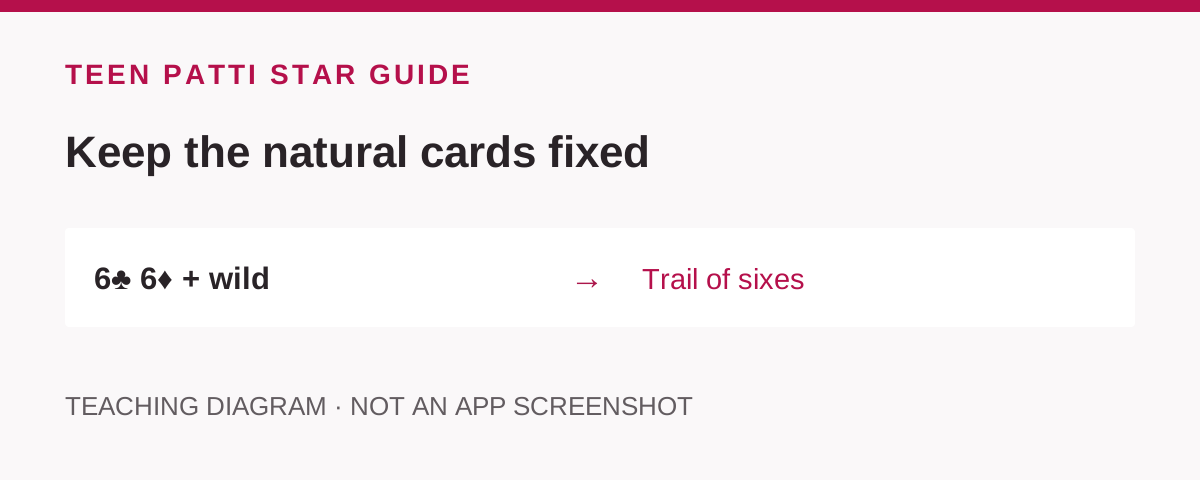
Joker Teen Patti Rules for Beginners: Wild Cards, Hand Rankings and Examples
Learn nominated-rank Joker Teen Patti with seven worked hands. Try three reveal-answer exercises and see why natural cards cannot change rank or suit.

Gameplay
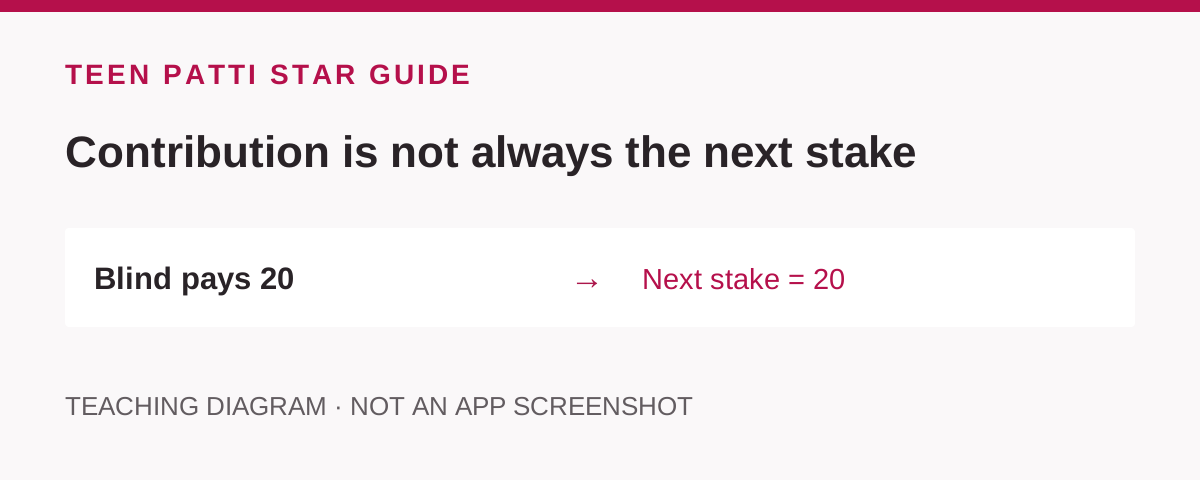
Blind vs Seen in Teen Patti: Rules and a Worked Round
Work out Blind and Seen contributions with a practice-counter calculator. Follow the current stake, a complete round and final Show eligibility.
Gameplay
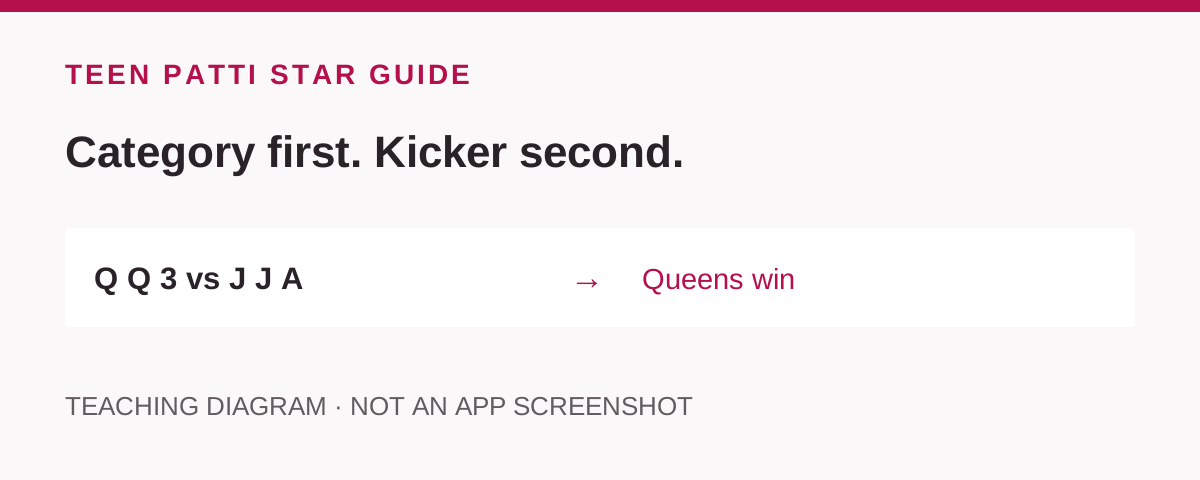
Teen Patti Hand Rankings: Examples and Tie-Breaks
Compare two Teen Patti hands with a free card selector. Follow category and kicker comparisons, choose the A-2-3 convention and work through tie examples.