
Gameplay
Revolving Joker Teen Patti: When Wild Cards Change
In Revolving Joker, indicator cards set the wild ranks. In Octro’s published version, packing or losing a sideshow triggers new indicators while play continues. Your three cards stay the same, but their best hand can change.
Scope: worked examples of general Teen Patti rules, not rules tested in a specific Star app. Check your table’s rules. Sources & limitations
What changes in Revolving Joker?
Your three physical cards stay in your hand. What changes is which ranks count as wild. Re-evaluate the hand against the current indicators rather than remembering the combination you made at the start.
Octro’s published version uses three exposed indicators and replaces them after a player packs or loses a sideshow, with stopping conditions involving two remaining players or the pot limit. This article explains that published rule family, not a feature tested in a Star app. The precise order at the stopping boundary should be checked in the table’s own help.
For ordinary wild-card substitution, start with our Joker hand examples. Here the new difficulty is that the substitution can stop being available during the same deal.
Follow one change without redealing the hands
Use four players for this paper exercise. Two hands are visible to us as readers; that does not mean players may share hidden cards during a game. A third player packs, leaving three active players, so the example does not depend on the two-player stopping boundary.
Swipe the table sideways to compare.
| Item | Before the pack | After the replacement |
|---|---|---|
| Exposed indicators | 4♣, 6♦, J♥ | K♣, 2♦, 5♠ |
| Wild ranks | 4, 6, J | K, 2, 5 |
| Hand A, unchanged | 9♣, 9♦, 4♥ | 9♣, 9♦, 4♥ |
| Hand B, unchanged | 8♣, 8♦, K♥ | 8♣, 8♦, K♥ |
Exposed indicators
- Before the pack
- 4♣, 6♦, J♥
- After the replacement
- K♣, 2♦, 5♠
Wild ranks
- Before the pack
- 4, 6, J
- After the replacement
- K, 2, 5
Hand A, unchanged
- Before the pack
- 9♣, 9♦, 4♥
- After the replacement
- 9♣, 9♦, 4♥
Hand B, unchanged
- Before the pack
- 8♣, 8♦, K♥
- After the replacement
- 8♣, 8♦, K♥
The indicators are separate physical cards, not extra cards that players take from the middle. This exercise treats every suit of an indicated rank as wild and permits substitution by rank and suit. All displayed physical cards are distinct. A different wild-card convention requires a different calculation.
Compare the same two hands before and after
Before the replacement, A uses 4♥ as a third 9. The completed category is Trail, three 9s. B has no wild rank in its hand: its best category is a pair of 8s with a king. A is ahead in this hypothetical comparison.
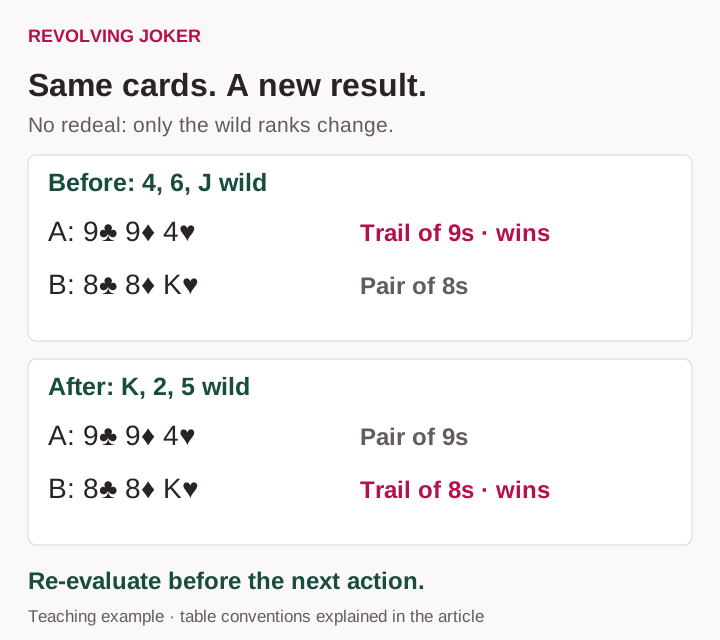
After the replacement, 4 is no longer wild. A falls back to a pair of 9s with a 4. K is now wild, so B can use K♥ as a third 8. B’s Trail now beats A’s pair. The printed 9s are still higher than the printed 8s, but category is compared before the rank of a pair.
Swipe the table sideways to compare.
| Stage | A’s best completed hand | B’s best completed hand | Higher hand |
|---|---|---|---|
| Wild: 4, 6, J | 9-9-9, Trail | 8-8-K, Pair | A |
| Wild: K, 2, 5 | 9-9-4, Pair | 8-8-8, Trail | B |
Wild: 4, 6, J
- A’s best completed hand
- 9-9-9, Trail
- B’s best completed hand
- 8-8-K, Pair
- Higher hand
- A
Wild: K, 2, 5
- A’s best completed hand
- 9-9-4, Pair
- B’s best completed hand
- 8-8-8, Trail
- Higher hand
- B
These are teaching comparisons, not recorded results from an app. They show why neither an old screenshot of the indicators nor an earlier hand label is enough to settle a later comparison. Review the full category order and tie-breaks if a pair with higher ranks still looks stronger to you.
Keep the event order separate from the hand ranking
Read the sequence as: current indicators → eligible action → any required indicator replacement → evaluate the next comparison. In particular, do not use future indicators to decide the sideshow that caused the replacement. That would change the evidence used to eliminate the player.
The published description leaves some edge cases less explicit than the headline rule. If a pack reduces the table from three players to two, does one final refresh happen first? What if a pot-limit showdown and a pack occur together? Do not invent an answer from the phrase “every time.” Read the current mode help or request clarification before relying on a boundary ruling.
Our Show and Sideshow guide explains the difference between those actions. Its classic examples do not override the indicator-refresh rules of a variant.
Three mistakes to avoid
Keeping an expired joker. In the example, 4♥ returns to its printed value after 4 leaves the indicator list. It is not permanently converted into a 9.
Counting jokers instead of evaluating a hand. A wild card matters because of the combination it completes. It does not add a fixed number of points. Both categories and tie rules still need to be checked.
Treating folding as a private change. A player who packs leaves that deal, but the resulting indicator update can affect the hands of everyone still playing. Do not coordinate folds with other players to manipulate the table. See what Pack does to participation and the pot.
A no-money practice check
Keep A as 9♣-9♦-4♥. Instead of K, 2 and 5, make the new wild ranks 9, 2 and 5. What is A’s strongest category?
The two 9s are wild, while the 4 remains natural. They can complete three 4s, a Trail. They cannot make three aces while leaving the natural 4 unchanged. This is a useful check that you are replacing only wild cards, not freely rewriting the entire hand.
Use physical cards or a written record without cash stakes. Record the indicator set beside every evaluated hand; a single “winner” column without that context is incomplete.
Questions to settle before joining a table
Check whether indicators nominate ranks or suits, which actions refresh them, when refreshes stop, how equal completed hands are treated, and whether natural hands receive special priority. The examples above avoid equal hands and do not assume a pot split.
Revolving Joker is not the same as Lowest Joker: the latter starts from a player’s own low card under its table convention. A mode name is a useful starting point, not a substitute for its rules.
Sources & scope
Public sources checked on 23 October 2026. Examples are illustrative; no hands-on device test of a specific app was performed. Table and platform rules may differ.
Related guides
Gameplay
Joker Teen Patti Rules for Beginners: Wild Cards, Hand Rankings and Examples
Learn nominated-rank Joker Teen Patti with seven worked hands. Try three reveal-answer exercises and see why natural cards cannot change rank or suit.

Gameplay
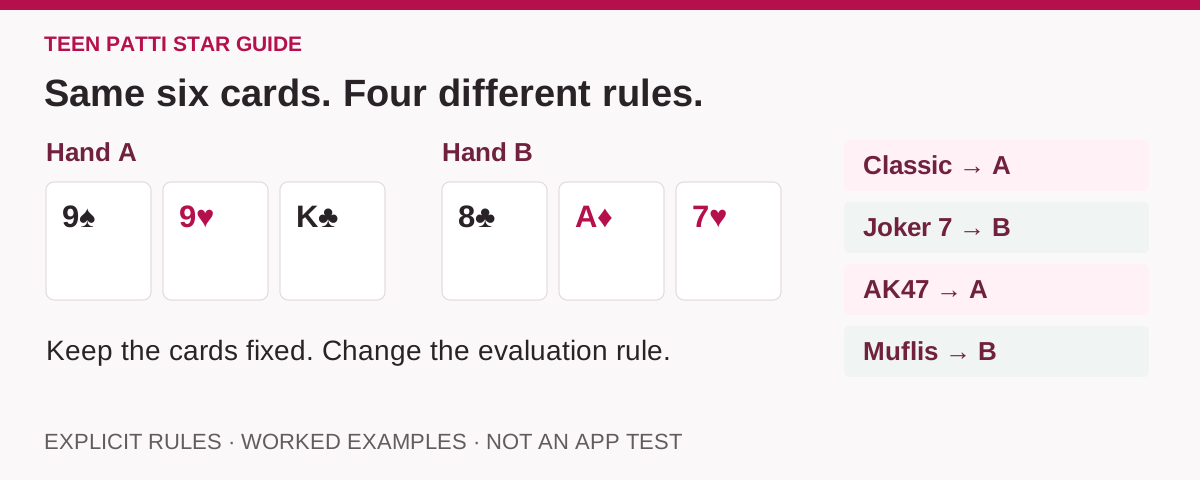
Teen Patti Variants Compared: Classic, Joker, AK47 and Muflis
Keep the same six cards and compare four Teen Patti variants. See the exact Joker and AK47 substitutions, the Muflis reversal and the rules to agree first.
Gameplay
Teen Patti Show vs Sideshow: Rules, Eligibility and Examples
Check who can request Show or Sideshow, compare Blind and Seen eligibility, and follow accepted, refused and tied-hand examples.