
Gameplay
Lowest Joker Teen Patti: Low Pairs, Aces and Examples
In Octro’s published Lowest Joker rule, the lowest-ranked card in each player’s own hand becomes wild; if that lowest rank is a pair, both cards are wild. Identify the wilds from the original hand, keep the other cards fixed, then compare the strongest permitted completed hands.
Scope: worked examples of general Teen Patti rules, not rules tested in a specific Star app. Check your table’s rules. Sources & limitations
Lowest means local to your hand
Unlike a nominated Joker round, there is no single rank that must be wild for everyone. One player can have a 3 as the lowest rank, while another has two 2s. Identify each hand independently. A low card shown by an opponent does not change your own wild set.
We use Octro’s published lowest-pair rule, with Ace high when identifying the lowest card, as illustrated by its A-K-K example. Natural cards cannot change. Wilds may represent a rank and suit needed for the best valid three-card completion. There is no added natural-hand bonus in our examples. This is a stated teaching model, not a test of Star app rules.
Decide which physical cards are wild
Read the printed ranks first. Mark the lowest rank once and keep that selection fixed while considering substitutions. Do not reselect a new “lowest” card after every substitution: that would silently turn natural cards into more wilds.
Swipe the table sideways to compare.
| Original hand | Wild cards | Cards that must stay fixed |
|---|---|---|
| Q♠ Q♥ 3♣ | 3♣ | Q♠ Q♥ |
| J♣ 2♥ 2♦ | 2♥ and 2♦ | J♣ |
| A♣ 5♠ 5♥ | 5♠ and 5♥ | A♣ |
| 8♣ 8♦ K♥ | 8♣ and 8♦ | K♥ |
Q♠ Q♥ 3♣
- Wild cards
- 3♣
- Cards that must stay fixed
- Q♠ Q♥
J♣ 2♥ 2♦
- Wild cards
- 2♥ and 2♦
- Cards that must stay fixed
- J♣
A♣ 5♠ 5♥
- Wild cards
- 5♠ and 5♥
- Cards that must stay fixed
- A♣
8♣ 8♦ K♥
- Wild cards
- 8♣ and 8♦
- Cards that must stay fixed
- K♥
A repeated rank is not automatically natural or automatically wild. Its position within the original hand decides. The Queen pair in the first row stays fixed because a lower 3 exists; the 8 pair in the last row is itself the lowest rank.
One joker can beat two: compare completed hands
3♣ → Q♦: Trail of Queens
2♥ → J♥; 2♦ → J♦: Trail of Jacks
Use player A’s Q♠ Q♥ 3♣ and player B’s J♣ 2♥ 2♦. The six physical cards are distinct. A has one wild: let 3♣ represent Q♦ to complete a Trail of Queens. B has two wilds: let 2♥ represent J♥ and 2♦ represent J♦ to complete a Trail of Jacks.
A wins the hand comparison. Queen rank is higher than Jack rank; the count of wild cards is not the deciding value. B cannot choose three Aces, because the natural J♣ has to remain a Jack. Calling both 2s wild gives two substitutions, not permission to replace the whole hand.
This reverses a common shortcut: “more jokers means stronger.” Count them to work out your options, then stop counting and evaluate the final category and ranks. The AK47 examples use a different wild-set rule but demonstrate the same final-hand principle.
Aces and gaps: do not stop at the first pair
With A♣ 5♠ 5♥, both 5s are wild under the stated Ace-high rule. Let them represent A♠ and A♥ to form three Aces. If your room treats Ace as low when selecting the Joker, the wild set is different. The example cannot simply be carried across unchanged.
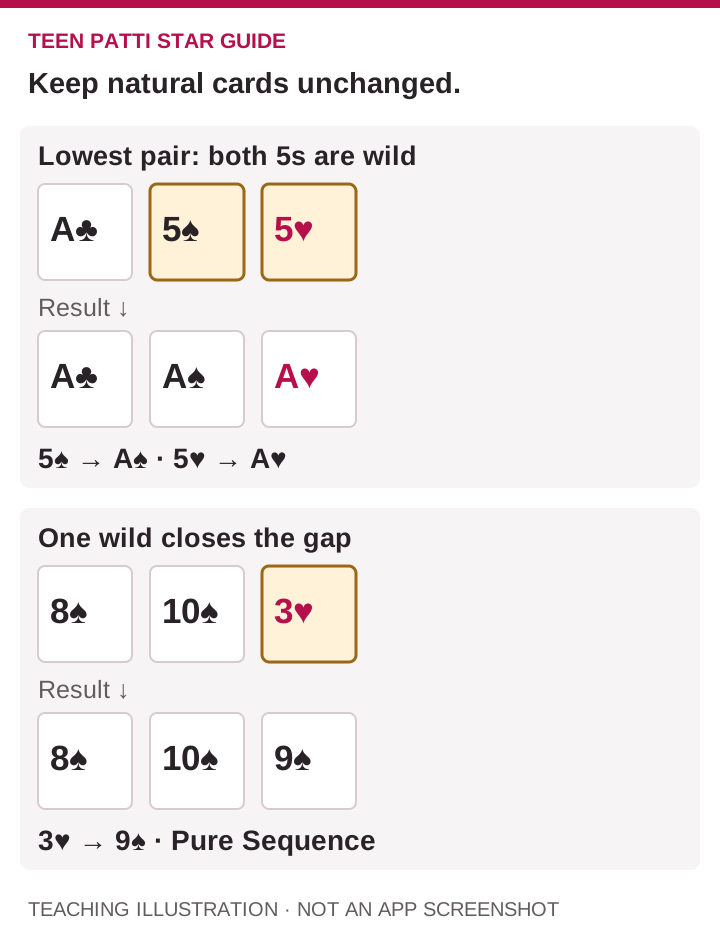
Now take 8♠ 10♠ 3♥. The 3 is wild and the two spades remain fixed. Making it an additional 10 produces a Pair. Making it 9♠ instead produces 8♠ 9♠ 10♠, a Pure Sequence, which is stronger. A Trail is not possible because the natural 8 and 10 have different ranks.
Before accepting a completion, check what the unchanged cards allow. For two natural cards of the same rank, a Trail is possible. For two different ranks of one suit, examine whether one wild can close a three-card run. Do not change a natural suit to make a Pure Sequence work. The general Joker guide explains that boundary.
Equal completions and unclear table rules
If two completed hands have equal category and comparison ranks, report equal strength first. Having more natural cards does not break the tie in this teaching model. A room may add a different convention, but it needs to be stated rather than inferred.
The brief source description does not settle every special case, such as an all-same-rank starting hand being treated as all wild versus retained as a natural Trail. Confirm that rule separately. Also check the Ace convention, any restricted substitutions and the final tie procedure. Show eligibility does not follow merely from having a strong completed hand.
Lowest Joker is not Muflis
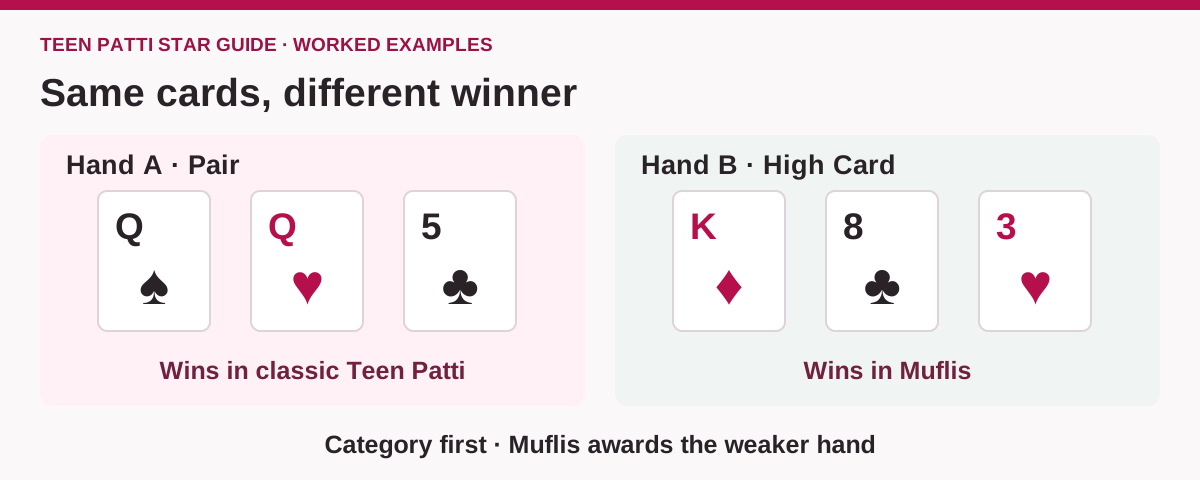
Lowest Joker changes which original cards may represent something else. It still aims for the stronger completed hand. Muflis changes which hand wins under a low-hand comparison; it does not automatically nominate the smallest card as wild. Keeping those mechanisms separate prevents a “low” label from reversing the wrong rule. See the Muflis examples for the separate model.
Practice with fixed natural cards
Try 7♣ 7♦ Q♥. Both 7s are the lowest pair and therefore wild. They can represent Q♣ and Q♦, giving Q♣ Q♦ Q♥, a Trail of Queens. The natural Queen prevents a Trail of Kings or Aces. Now try 7♣ 9♣ 2♦: the 2 can represent 8♣ to make a Pure Sequence. Do not mark the 7 wild after replacing the 2.
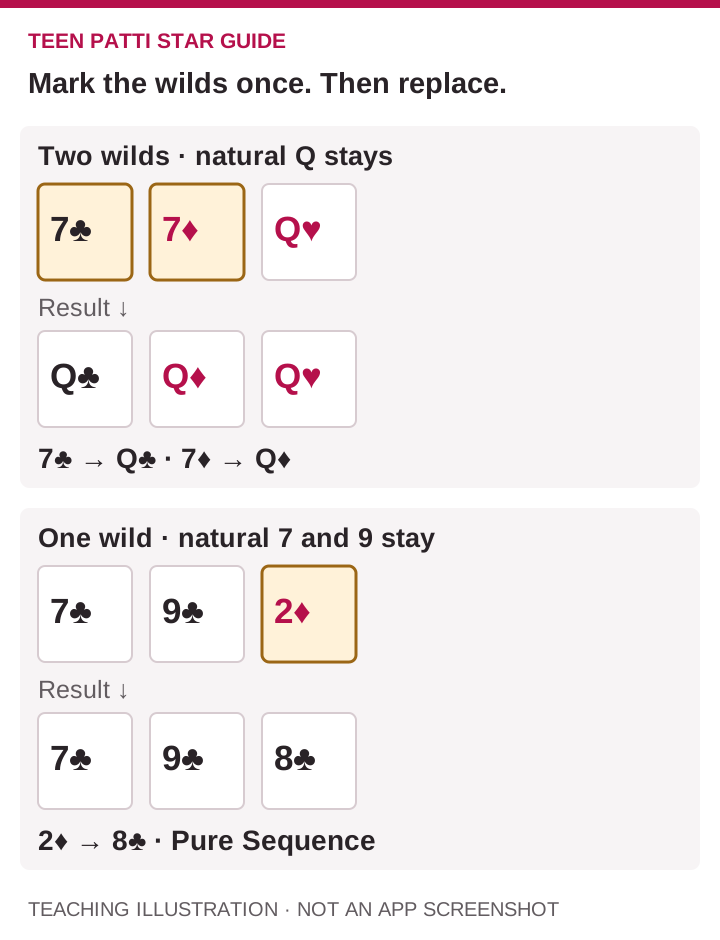
Practise by writing two lines: “original wild cards” and “represented cards.” A valid solution must preserve every natural card on the first line. Use non-cash counters if rehearsing a complete round; these evaluations are not betting instructions or a guarantee of winning.
Sources & scope
Public sources checked on 15 October 2026. Examples are illustrative; no hands-on device test of a specific app was performed. Table and platform rules may differ.
Related guides
Gameplay
Joker Teen Patti Rules for Beginners: Wild Cards, Hand Rankings and Examples
Learn nominated-rank Joker Teen Patti with seven worked hands. Try three reveal-answer exercises and see why natural cards cannot change rank or suit.

Gameplay
AK47 Teen Patti Rules: Wild Cards and Worked Examples
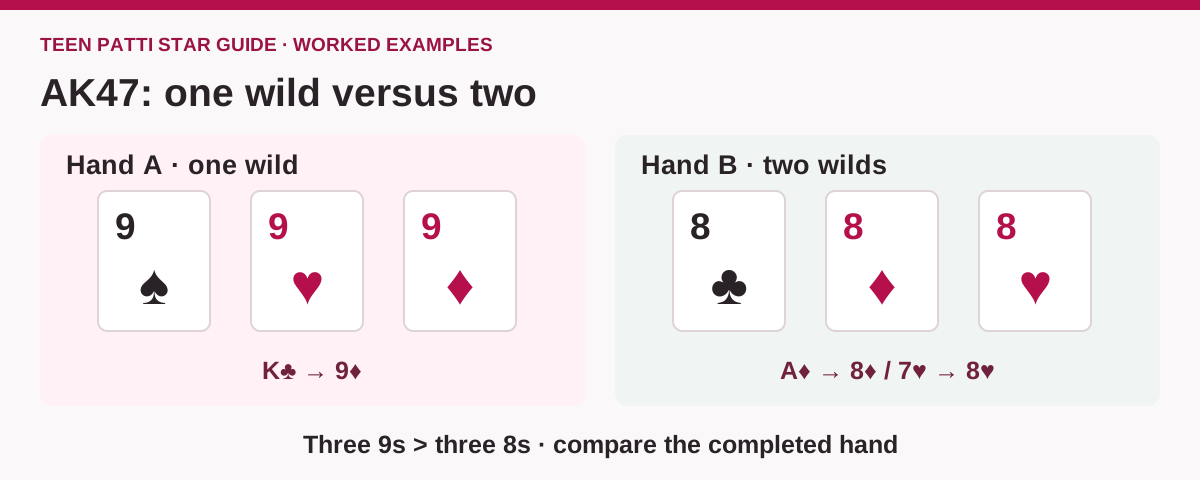
See exactly how A, K, 4 and 7 substitute in AK47 Teen Patti. Compare one wild making three 9s with two wilds making three 8s, then try worked hands.
Gameplay
Muflis Teen Patti: Which Hand Wins?
Compare the same hands in classic Teen Patti and Muflis. Work through reversed categories, high-card ties, pair kickers and explicit Ace conventions.