
Gameplay
Teen Patti Pack Rules: Folding, the Pot and Rejoining
Pack means folding out of the current hand. In the classic rules used here, you make no further contribution, cannot win that hand’s pot and cannot rejoin the same deal. Chips already contributed stay in the pot; joining the next deal is a separate decision.
Method: a public-documentation guide, not a hands-on test of a Star build. Diagrams are illustrative. Sources & limitations
Pack, fold and the end of one hand
Pack and fold describe leaving the current deal, not closing an account or taking a temporary pause. This lesson uses the classic folding rule described by Pagat. It does not claim that every mobile room has identical timers, confirmation buttons or reconnect behaviour.
The practical distinction is between your seat at the table and your participation in one hand. A person may remain seated while no longer being eligible to win that hand. Looking at the cards later does not reactivate them. For a no-money home game, leave folded cards face down and clearly separate from active hands so nobody accidentally includes them in a Show.
Follow the chips through one round
Four players, A, B, C and D, each start with 100 practice chips. Each contributes a boot of 5, making an initial pot of 20. A stays Blind and adds 5; B is Seen and adds 10. C and D then pack without contributing anything further. No chip has cash value.
Swipe the table sideways to compare.
| Action | Added now | Pot afterwards | Active players |
|---|---|---|---|
| Four boots of 5 | 20 | 20 | A, B, C, D |
| A plays Blind | 5 | 25 | A, B, C, D |
| B plays Seen | 10 | 35 | A, B, C, D |
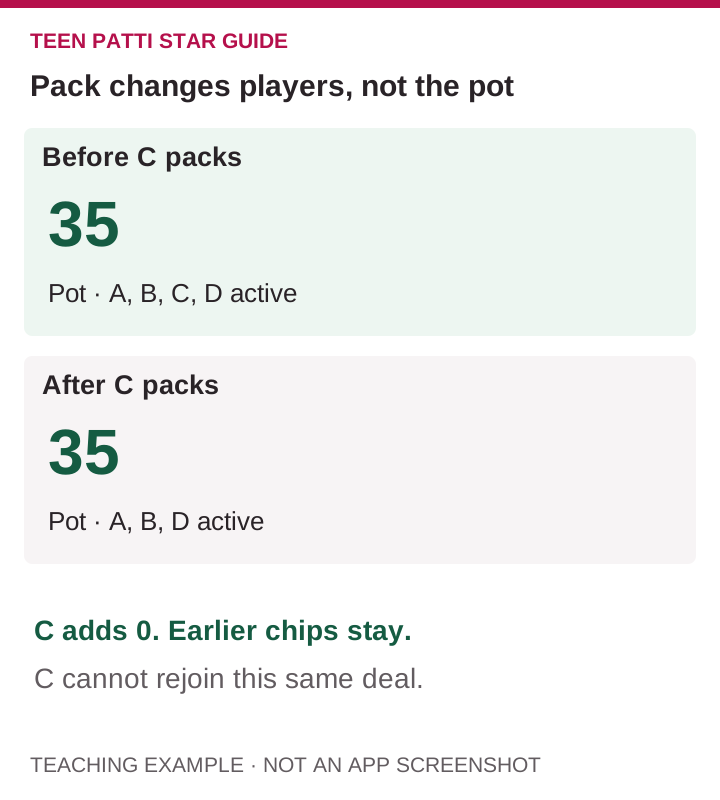
| C packs | 0 | 35 | A, B, D |
| D packs | 0 | 35 | A, B |
| A packs on the next turn | 0 | 35 | B |
Four boots of 5
- Added now
- 20
- Pot afterwards
- 20
- Active players
- A, B, C, D
A plays Blind
- Added now
- 5
- Pot afterwards
- 25
- Active players
- A, B, C, D
B plays Seen
- Added now
- 10
- Pot afterwards
- 35
- Active players
- A, B, C, D
C packs
- Added now
- 0
- Pot afterwards
- 35
- Active players
- A, B, D
D packs
- Added now
- 0
- Pot afterwards
- 35
- Active players
- A, B
A packs on the next turn
- Added now
- 0
- Pot afterwards
- 35
- Active players
- B
B is now the only active player and receives the pot without a hand-strength comparison. B contributed 15 in total, so finishing with the 35-chip pot means a net increase of 20, not 35. The ending stacks are A: 90, B: 120, C: 95 and D: 95. Together they still equal the original 400 chips.
The important observation is that packing changes the active-player list but does not subtract a previous contribution from the pot. C’s boot of 5 stays there even though C never paid a further turn. For the payment model behind A and B’s turns, see the Blind and Seen contribution guide.
Can you rejoin after packing?
Not in the same deal under this rule. Suppose C sees the remaining hands after folding and discovers that C’s cards would have been strongest. The earlier Pack still stands. Otherwise a player could avoid subsequent decisions while retaining a free chance at the pot.
The next deal starts fresh, subject to the table’s normal entry conditions. Receiving new cards is different from restoring the folded hand. Before an offline session, agree how players signal Pack and how the next deal starts. Do not invent a paid “undo” or buy-back rule halfway through a round.
Does a Blind player have to look before packing?
No: folding does not require proving that the cards are weak. A Blind player can leave the hand without inspecting it. A Seen player can also pack instead of making the next required contribution. The action is not restricted to a particular category such as High Card.
This is a rule explanation, not a chart prescribing when to risk more chips. Having already contributed is not an obligation to continue. Equally, a folded hand later turning out to be strong does not demonstrate that the next deal will be favourable. Use face-up, no-money practice when learning the sequence of actions.
Pack, refused Sideshow and final Show are different events
An accepted Sideshow can eliminate its losing participant; that is not the same event as merely receiving or declining a request. In the published rule used here, a refused Sideshow leaves the round continuing. Do not remove a player solely because the request was declined.
A final Show compares the two remaining eligible hands. By contrast, when everyone except one player has packed, there is no second active hand to compare. The Show versus Sideshow guide covers the eligibility conditions rather than treating every reveal as the same action.
Is closing the app the same as Pack?
Do not assume so. Losing connectivity, leaving a room, timing out and pressing Pack are different events in an app log. Without the exact product’s policy and round record, this guide cannot tell you whether a disconnect was auto-folded, paused or handled another way.
If the outcome is disputed, record the round reference, selected mode, approximate time and the visible status message. Keep a screenshot with private account details hidden. Reopen the same app and use its identifiable support route; reinstalling immediately may remove useful local context. For launch failures, follow the not opening or crashing guide instead of interpreting every missing screen as a fold.
Check your understanding
In the worked round, could C ask for a Show after packing? No: C is no longer active. Did D’s Pack reduce the pot from 35 to 30? No: D’s earlier boot stays. Did B win because B must have had the best cards? No: B was the sole remaining active player. Can A receive new cards in the next agreed deal? Yes; those are new cards in a different hand, not an undo of the previous Pack.
Sources & scope
Public sources checked on 19 October 2026. Examples are illustrative; no hands-on device test of a specific app was performed. Table and platform rules may differ.
Related guides
Gameplay
Blind vs Seen in Teen Patti: Rules and a Worked Round
Work out Blind and Seen contributions with a practice-counter calculator. Follow the current stake, a complete round and final Show eligibility.

Gameplay
Teen Patti Show vs Sideshow: Rules, Eligibility and Examples
Check who can request Show or Sideshow, compare Blind and Seen eligibility, and follow accepted, refused and tied-hand examples.
Gameplay
How to Play Teen Patti Offline with Friends: Setup and Step-by-Step Rules
Set up a four-player Teen Patti game with a deck and no-money counters. Follow the deal, Blind/Seen turns, Show and a checked 15-counter round.