
Gameplay
AK47 Teen Patti Rules: Wild Cards and Worked Examples
In AK47, every Ace, King, 4 and 7 is wild, regardless of suit. Keep the other cards fixed and choose the strongest permitted three-card hand. One wild completing three 9s beats two wilds completing three 8s: compare the completed hand, not the number of wild cards.
Method: a public-documentation guide, not a hands-on test of a Star build. Diagrams are illustrative. Sources & limitations
Which cards are wild in AK47?
Mark every A, K, 4 and 7 before evaluating the hand. In a standard 52-card deck, those are 4 ranks across 4 suits: 16 wild cards, not just 4 individual cards. Printed jokers are not needed for these examples.
Octro and TeenPatti Royale both describe these four ranks as wild and retain the strongest-hand objective. This article uses that definition. It does not establish that a particular Star app offers the mode. Unlike a nominated-rank Joker game, the wild ranks here are fixed by the variation name rather than selected afresh by the dealer.
Replace only the wild cards, one at a time
Compare all four modes using the same fixed deal before choosing a wild-card rule.
Use three columns on paper: dealt card, whether it is wild, and represented card. Copy each natural card unchanged. Assign a rank and suit to each wild, then read the completed hand as a whole. A replacement is an interpretation for comparison; you do not draw another physical card from the deck.
Our examples assume a wild may represent any rank and suit, with no natural-hand bonus. A special table restriction must be stated before you use the result. Do not change a natural 8 into a 9 simply because the rest of the hand is wild.
One wild making three 9s versus two making three 8s

These two dealt hands can occur together in one deck. Hand A is 9♠ 9♥ K♣. Hand B is 8♣ A♦ 7♥. First resolve each hand separately; do not compare the printed King with the printed Ace.
Swipe the table sideways to compare.
| Hand | Dealt card | Action | Represented card |
|---|---|---|---|
| A | 9♠ | Natural: keep | 9♠ |
| A | 9♥ | Natural: keep | 9♥ |
| A | K♣ | Wild: replace | 9♦ |
| B | 8♣ | Natural: keep | 8♣ |
| B | A♦ | Wild: replace | 8♦ |
| B | 7♥ | Wild: replace | 8♥ |
A
- Dealt card
- 9♠
- Action
- Natural: keep
- Represented card
- 9♠
A
- Dealt card
- 9♥
- Action
- Natural: keep
- Represented card
- 9♥
A
- Dealt card
- K♣
- Action
- Wild: replace
- Represented card
- 9♦
B
- Dealt card
- 8♣
- Action
- Natural: keep
- Represented card
- 8♣
B
- Dealt card
- A♦
- Action
- Wild: replace
- Represented card
- 8♦
B
- Dealt card
- 7♥
- Action
- Wild: replace
- Represented card
- 8♥
Hand A becomes a Trail of 9s; Hand B becomes a Trail of 8s. Both have reached the same category, so compare the Trail rank. Hand A wins. The single wild completes a higher Trail than the two wilds can make while preserving B’s natural 8.
That is a counterexample to “more wilds always wins,” not a claim that one wild is usually better. Wild count describes flexibility; it is not an extra hand-ranking category or a tie-breaker.
Four more hands: find the best legal completion
Each row below is an independent exercise. Keep the non-wild cards fixed even when a more attractive hand would be possible by changing them.
Swipe the table sideways to compare.
| Dealt hand | Substitution | Best category | Why stop there? |
|---|---|---|---|
| 5♣ 6♣ A♦ | A♦ → 7♣ | Pure Sequence: 5-6-7 | The fixed ranks differ, so a Trail is impossible; this run is higher than 4-5-6 |
| 9♠ J♥ 4♦ | 4♦ → 10♦ | Sequence: 9-10-J | The two natural suits differ, so it cannot become a Pure Sequence |
| 5♠ 9♦ A♥ | A♥ → 9♥ | Pair of 9s, kicker 5 | The natural ranks are too far apart for a run; different suits also rule out Colour |
| A♣ K♦ 7♠ | A♣ → A♠; K♦ → A♥; 7♠ → A♦ | Trail of Aces | All dealt cards are wild under the stated convention |
5♣ 6♣ A♦
- Substitution
- A♦ → 7♣
- Best category
- Pure Sequence: 5-6-7
- Why stop there?
- The fixed ranks differ, so a Trail is impossible; this run is higher than 4-5-6
9♠ J♥ 4♦
- Substitution
- 4♦ → 10♦
- Best category
- Sequence: 9-10-J
- Why stop there?
- The two natural suits differ, so it cannot become a Pure Sequence
5♠ 9♦ A♥
- Substitution
- A♥ → 9♥
- Best category
- Pair of 9s, kicker 5
- Why stop there?
- The natural ranks are too far apart for a run; different suits also rule out Colour
A♣ K♦ 7♠
- Substitution
- A♣ → A♠; K♦ → A♥; 7♠ → A♦
- Best category
- Trail of Aces
- Why stop there?
- All dealt cards are wild under the stated convention
The represented 7♣ in the first row is part of the declared completion. It does not trigger another replacement step: there is no loop of new cards being dealt. For category order and within-category comparisons, use the hand-ranking reference. Its ordinary-hand calculator does not accept AK47 wild-card inputs.
Equal completions do not get an invented wild-count bonus
Suppose independent hands both resolve to a Trail of Queens. The category and rank match. Do not decide that the hand with fewer substitutions automatically wins unless the table explicitly gives natural cards priority. Nor does the wild’s original suit become a higher-ranking suit.
A ranking tie still needs a settlement procedure: an app or home table may specify who loses a tied Show or how a forced comparison is settled. Read the actual procedure; do not silently turn equal ranks into a split pot. The Show and Sideshow guide explains why hand strength and request eligibility are separate questions.
Try a substitution before checking the answer
Take Q♣ Q♦ 4♥. Which card is permitted to change? Only 4♥. Represent it as Q♥ for a Trail of Queens. Now compare an opponent’s J♠ A♠ 7♦: the natural Jack stays, while A♠ and 7♦ represent J♥ and J♦. Queens beat Jacks even though the second hand contains more wilds.
For a second exercise, inspect 6♠ 10♥ K♦. Can it become a Pure Sequence? No: the fixed natural cards have different suits and cannot be made consecutive with one replacement. K♦ can represent 10♦ to make a Pair of 10s with a 6 kicker. Saying “a King is wild” does not make the natural cards movable.
Questions to settle before a round
Is AK47 the same as Muflis?
No. AK47 changes which cards can substitute; Muflis reverses the hand comparison. Do not combine the two just because both appear under a variations menu.
Are all three wild cards automatically a win?
They can make a top Trail under this convention, but another hand may complete the same rank. Equal-hand settlement still matters; there is no guaranteed exclusive win.
Can I use this as a tested Star-app tutorial?
No. These are original teaching examples based on published variation rules, not app screenshots or device tests. Practise with a deck and counters that have no cash value. Confirm wild restrictions, Ace-sequence order and tied-hand treatment before applying the examples to another table.
Sources & scope
Public sources checked on 26 September 2026. Examples are illustrative; no hands-on device test of a specific app was performed. Table and platform rules may differ.
- Octro — published AK47 and Muflis variations
- TeenPatti Royale — variation definitions
- Pagat — category comparisons and ace-sequence convention
Related guides
Gameplay
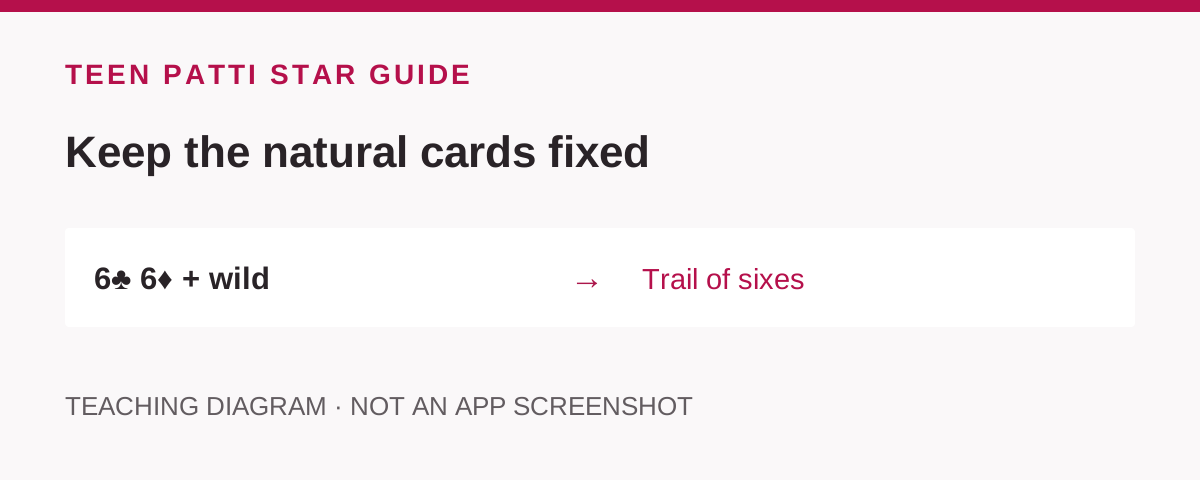
Joker Teen Patti Rules for Beginners: Wild Cards, Hand Rankings and Examples
Learn nominated-rank Joker Teen Patti with seven worked hands. Try three reveal-answer exercises and see why natural cards cannot change rank or suit.

Gameplay
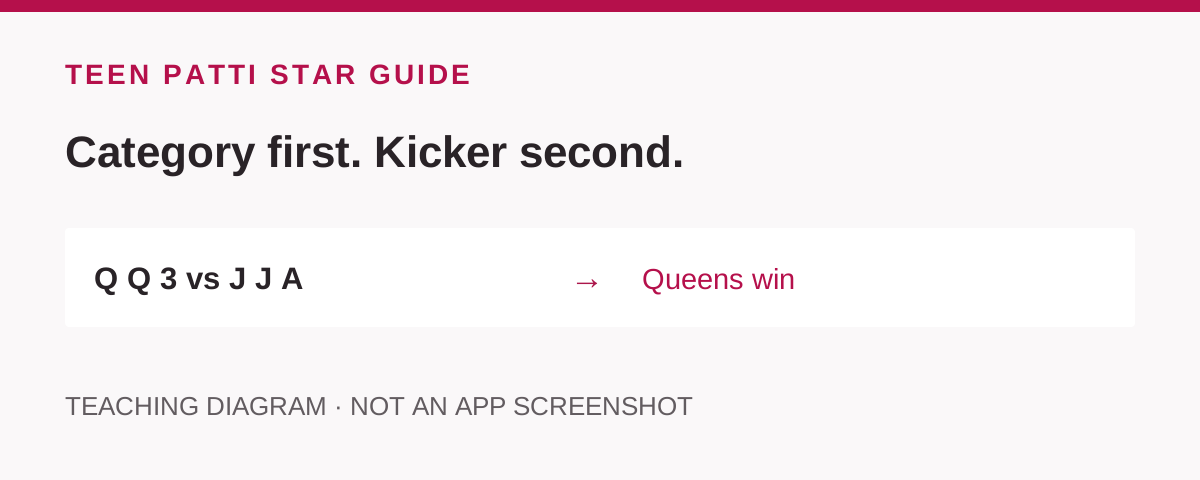
Teen Patti Hand Rankings: Examples and Tie-Breaks
Compare two Teen Patti hands with a free card selector. Follow category and kicker comparisons, choose the A-2-3 convention and work through tie examples.
Gameplay
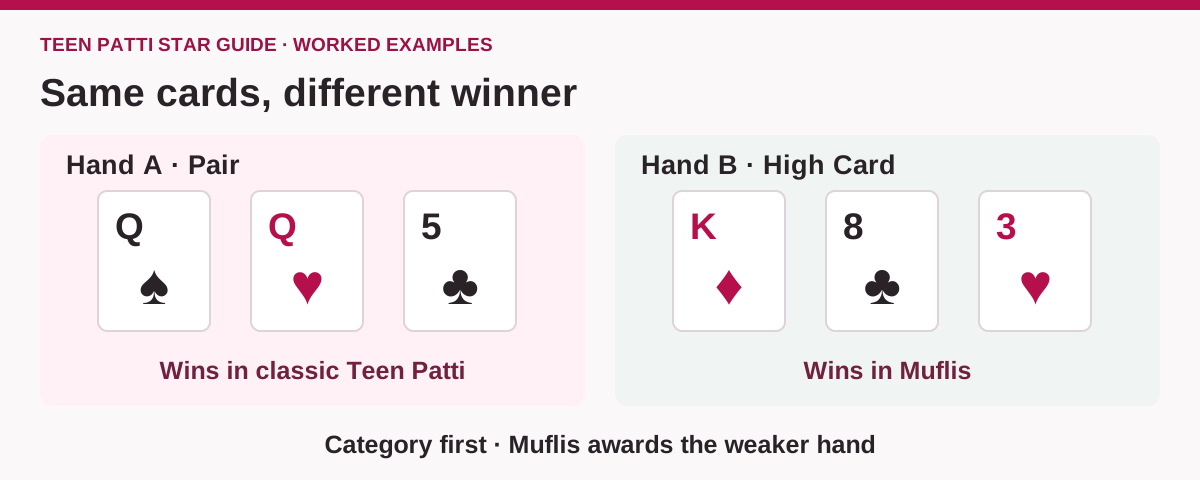
Muflis Teen Patti: Which Hand Wins?
Compare the same hands in classic Teen Patti and Muflis. Work through reversed categories, high-card ties, pair kickers and explicit Ace conventions.