
Gameplay
Hi-Lo Teen Patti: Wild Cards and Worked Hands
Hi-Lo makes the highest and lowest ranks wild in a three-distinct-rank hand. Under the published pair example used here, a pair supplies the two jokers instead. Identify the retained natural card before comparing completed hands.
Method: a public-documentation guide, not a hands-on test of a Star build. Diagrams are illustrative. Sources & limitations
What changes in Hi-Lo Teen Patti?
Hi-Lo changes which cards can act as jokers. It does not mean that the weakest hand wins, and it is not automatically a high-low split-pot poker game. In the version described by Octro, the highest and lowest cards in a player's hand are wild. A separate pair rule also needs attention: the published instructions treat a same-rank pair as jokers.
The practical consequence is that you must identify the natural card you are keeping before comparing hands. Two high-looking printed cards can be less important than the middle card. We use fresh practice examples below, with Ace high and ordinary Teen Patti hand-category order. These are teaching examples based on published rules, not captured Star gameplay.
The Octro variations guide states the rules briefly. Royale's published Hi-Low examples help explain the pair exception. Neither source should be treated as evidence that an unidentified Star APK includes this mode.
Three distinct ranks: keep the middle card
Take 3♠, 8♥ and K♦. With three distinct ranks, the 3 is the lowest and the King the highest. Mark those two cards as wild. The 8♥ stays natural. To make the best ordinary Teen Patti category, represent the two wild cards as other eights. Your evaluated hand is a Trail of eights.
Swipe the table sideways to compare.
| Physical card | Role in this example | Represented card |
|---|---|---|
| 3♠ | Lowest rank: wild | 8♠ |
| 8♥ | Middle rank: stays natural | 8♥ |
| K♦ | Highest rank: wild | 8♦ |
3♠
- Role in this example
- Lowest rank: wild
- Represented card
- 8♠
8♥
- Role in this example
- Middle rank: stays natural
- Represented card
- 8♥
K♦
- Role in this example
- Highest rank: wild
- Represented card
- 8♦
The result does not require physically changing the cards. “Represented card” is a way of explaining evaluation. A joker may represent a different suit as well as a different rank under the stated wildcard convention. The actual screen may display the original cards throughout.
Do not replace the middle eight with an Ace just because you want three Aces. It is not one of the marked wild cards. That single restriction is what makes this exercise useful: mark first, substitute second, compare last. If you skip the marking step, almost any hand can be incorrectly described as unbeatable.
Compare two hands with the same number of jokers
Player A holds 3♠, 8♥ and K♦. Player B holds 2♣, J♥ and Q♦. These six physical cards are all different, so they can coexist in a single ordinary deck. In A's hand the eight remains natural; in B's hand the Jack remains natural.
Swipe the table sideways to compare.
| Player | Original hand | Two marked wild cards | Best evaluated hand |
|---|---|---|---|
| A | 3♠ 8♥ K♦ | 3♠ and K♦ | 8♠ 8♥ 8♦ |
| B | 2♣ J♥ Q♦ | 2♣ and Q♦ | J♣ J♥ J♦ |
A
- Original hand
- 3♠ 8♥ K♦
- Two marked wild cards
- 3♠ and K♦
- Best evaluated hand
- 8♠ 8♥ 8♦
B
- Original hand
- 2♣ J♥ Q♦
- Two marked wild cards
- 2♣ and Q♦
- Best evaluated hand
- J♣ J♥ J♦
B wins this comparison because a Trail of Jacks beats a Trail of eights under the stated ranking. Both players used two jokers. The number of wild cards therefore cannot decide the winner by itself. Nor does A's printed King outrank B's printed Queen: those cards have already been designated wild, and the comparison is between the completed hands.
For the general sequence of category and rank comparisons, use our hand-ranking examples. This Hi-Lo exercise changes how the hand is constructed, not the principle of comparing its final category first.
The pair exception needs its own example
Now take 8♠, 8♥ and K♦. Applying “highest and lowest are wild” mechanically to every matching rank could appear to make all three cards wild. That is not the reading used in Royale's worked pair example. Its example keeps the unpaired card natural and uses the pair as the two jokers. We follow that explicit example here.
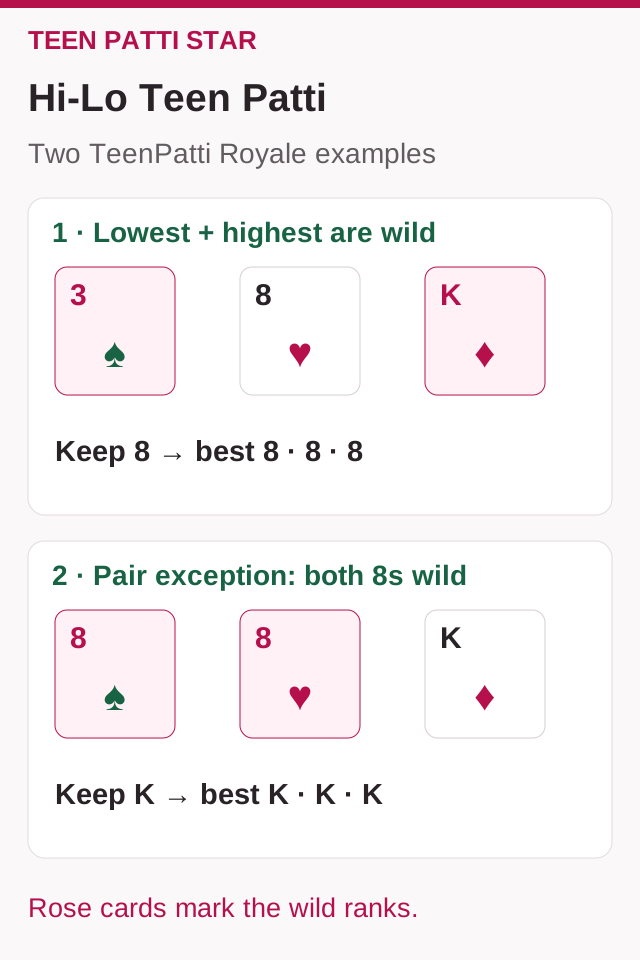
Mark both eights as wild and retain K♦. Represent them as K♠ and K♥. The resulting Trail is K♠ K♥ K♦. Notice the difference from the first exercise: the same physical King was wild in the three-distinct-rank hand, but it is retained in this pair-exception example.
This is why a mode's short name is insufficient to settle a dispute. A player who applies only the headline rule and another who applies the special pair interpretation can reach different answers from the same cards. Read the pair example or rule panel for the product you are using before playing.
If a table gives a different explicit pair convention, follow that documented convention and adjust the example. Do not combine parts of two publishers' descriptions into a supposedly universal rule. The Royale variations page is useful here specifically because it shows a paired hand being evaluated.
Hi-Lo, Lowest Joker and Muflis are not interchangeable
Compare the same 3♠ 8♥ K♦ under three conventions. With Hi-Lo as explained above, two cards are wild and the result is a Trail of eights. With Lowest Joker, only the 3 is wild; the natural eight and King cannot both become eights. Under a normal Muflis convention there is no automatic wildcard substitution at all, and weaker hands win.
Swipe the table sideways to compare.
| Mode | What changes | Question to ask first |
|---|---|---|
| Hi-Lo | Highest and lowest become wild, with a pair exception | Which card remains natural? |
| Lowest Joker | The lowest card or qualifying lowest pair becomes wild | What is the lowest rank under this table's Ace rule? |
| Muflis | The winning direction reverses | Which evaluated hand is weaker? |
Hi-Lo
- What changes
- Highest and lowest become wild, with a pair exception
- Question to ask first
- Which card remains natural?
Lowest Joker
- What changes
- The lowest card or qualifying lowest pair becomes wild
- Question to ask first
- What is the lowest rank under this table's Ace rule?
Muflis
- What changes
- The winning direction reverses
- Question to ask first
- Which evaluated hand is weaker?
Read the full Lowest Joker examples or Muflis comparison before moving between modes. A rule remembered from one variation can be precisely the wrong rule for another.
Equal hands: first identify how the comparison started
Under Octro's published Hi-Lo instructions, the player who shows first loses an exact tied comparison, while a tie after exceeding the pot limit leads to a split. These are mode-specific instructions. They do not mean every pot-cap comparison is a tie or every tied hand in every application has the same outcome.
For example, A could hold 2♠ 9♥ Q♦ and B could hold 3♣ 9♦ K♣. Each hand can become a Trail of nines using its two extreme ranks. The completed hands have equal rank; choosing different represented suits does not manufacture a stronger Trail. The remaining question is the table's tie procedure and the event that caused the comparison.
If the close is automatic, distinguish it from a manually requested Show. Our pot-limit ledger explains why that distinction is useful. Save a record of the comparison trigger if you are asking an application's support team to explain a result.
A quick practice check before joining another table
Use these checks with practice counters, not a promise of better results. The aim is to recognise which rule you are applying.
- Write down whether Ace is high or low when identifying the extreme ranks. Our examples treat it as high.
- Sort the printed ranks before marking any wild cards. Do not sort the imagined replacement cards instead.
- If there is a pair, read the special pair instruction before applying the distinct-rank method.
- Keep the natural card fixed, construct the best permitted hand and compare the completed categories and ranks.
- If completed hands are equal, check the Show or automatic-close tie rule rather than inventing a suit tiebreaker.
Try 4♣ 10♦ A♠ under these assumptions. The 4 and Ace are wild, so the retained ten produces a Trail of tens. Against the earlier Trail of Jacks it loses. An Ace appearing on a physical card did not make the completed hand a Trail of Aces.
Questions about Hi-Lo
Are all three cards wild when I am dealt a natural Trail?
The short public descriptions used here do not clearly settle every all-equal-rank edge case. Check the room's full rules or ask the publisher. We do not turn an ambiguous sentence into a guaranteed result for three identical ranks.
Is Hi-Lo the same as splitting a pot between high and low hands?
Not in the wildcard mode explained here. “Hi-Lo” can describe different games elsewhere. Identify the product and its rules rather than importing a poker rule because the name sounds familiar.
Does Seen status change the jokers?
Seeing the cards changes your information and may change permitted payments. The published Hi-Lo rule identifies wild cards from the hand's ranks; it does not say that looking at the hand changes those ranks.
Can I use these rules to identify a Star download?
No. Similar modes occur in different applications. A rule label does not establish the publisher, package name or download source. Use the separate APK identity guide for that task.
Sources & scope
Public sources checked on 26 October 2026. Examples are illustrative; no hands-on device test of a specific app was performed. Table and platform rules may differ.
Related guides
Gameplay
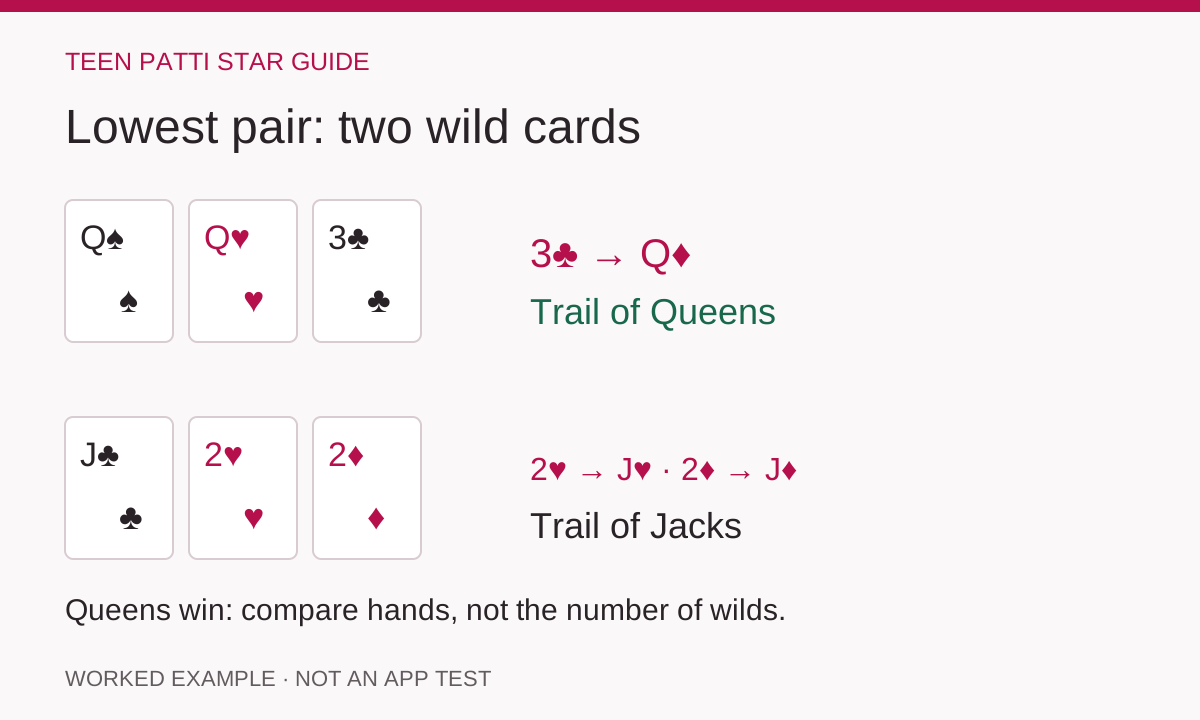
Lowest Joker Teen Patti: Low Pairs, Aces and Examples
Identify the wild cards separately in each hand, resolve a lowest pair and compare one joker against two. Includes fixed-card substitutions and an Ace check.

Gameplay
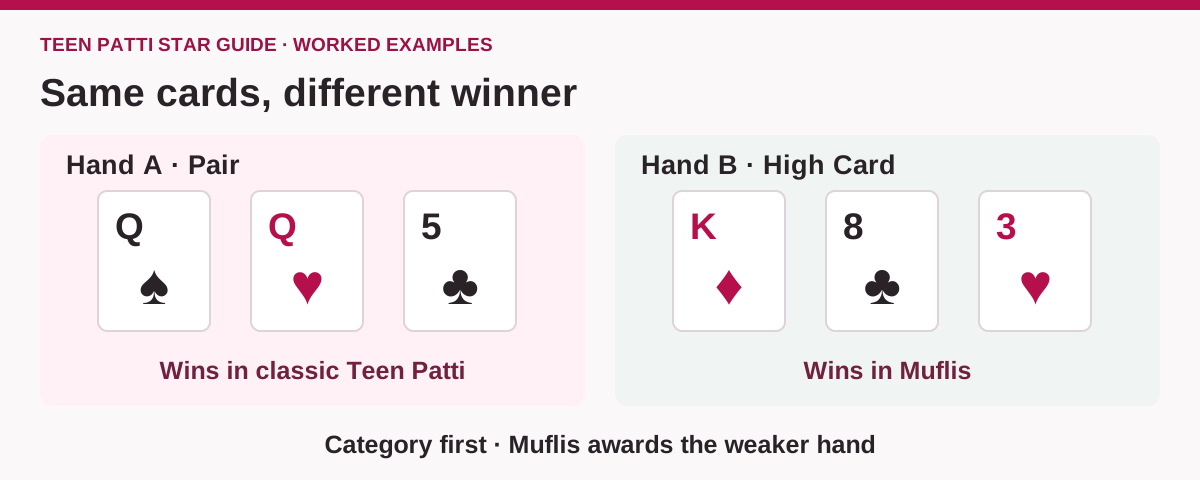
Muflis Teen Patti: Which Hand Wins?
Compare the same hands in classic Teen Patti and Muflis. Work through reversed categories, high-card ties, pair kickers and explicit Ace conventions.
Gameplay
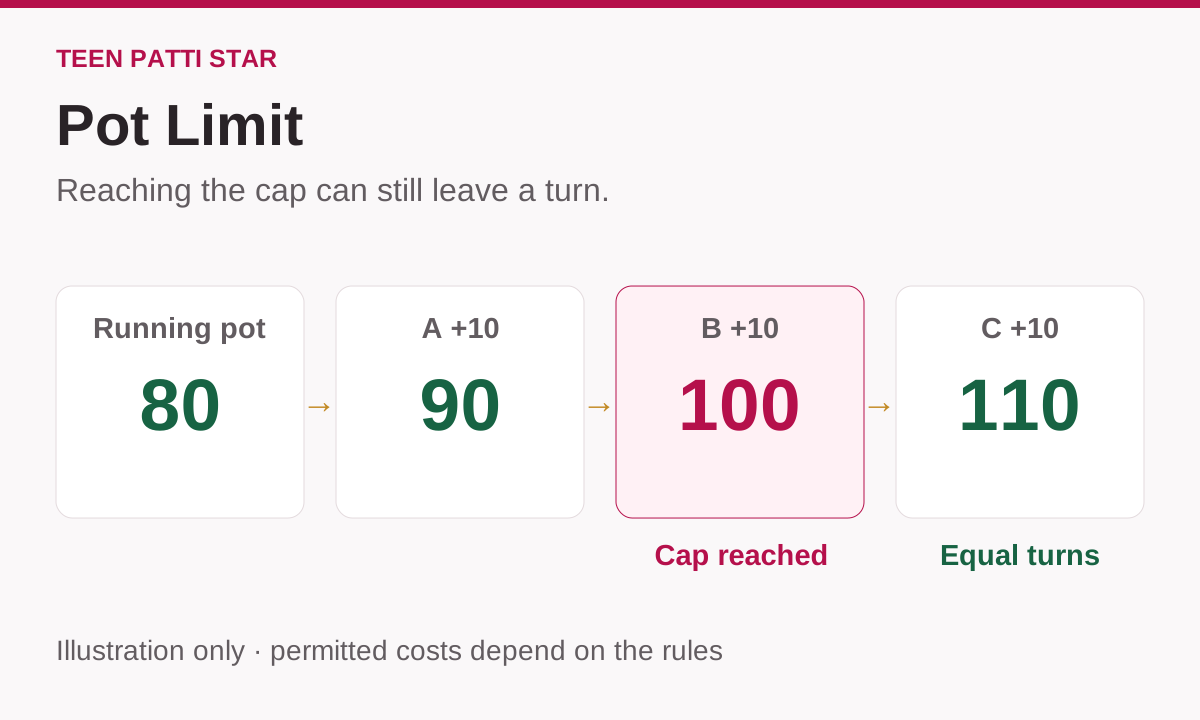
Teen Patti Pot Limit: When Does the Round End?
Separate pot and Chaal limits, follow an 80–110 chip ledger, and learn why an equal-turn closing rule can take a pot above its displayed threshold.