
Gameplay
Teen Patti Pot Limit: When Does the Round End?
A pot limit controls the closing stage of a round, not necessarily the size of one payment. TeenPatti Royale’s published equal-turn rule can let the final pot exceed the threshold; other tables may use a different procedure.
Method: a public-documentation guide, not a hands-on test of a Star build. Diagrams are illustrative. Sources & limitations
What does a Teen Patti pot limit actually limit?
A pot limit is a rule about the chips accumulated in one round. It is not automatically the largest amount you may contribute on your next turn, and it is not the balance in your account. These three numbers answer different questions. Confusing them can make an ordinary end-of-round procedure look like an incorrect deduction.
This guide separates those numbers, then follows an invented three-player round using counters with no cash value. The worked ledger explains a published rule; it is not a recording of a Star app. In particular, TeenPatti Royale says that players must finish an equal number of turns before a showdown, so its final pot can exceed the displayed limit. That procedure should not be assumed for every application bearing a similar name.
If you only need the basic payment calculation, start with the Blind and Seen round ledger. Here the question is narrower: what happens when the round reaches its ceiling?
Boot, Chaal limit and pot limit are different numbers
Think of the boot as an entry contribution, the Chaal limit as a constraint on one action, and the pot limit as an end-of-round threshold. A balance is separate again: it records what a player has available outside the shared pot. An amount that has already entered the pot should not be counted a second time as a new payment.
Swipe the table sideways to compare.
| Number on the table | What to check | What it does not establish |
|---|---|---|
| Boot | The starting contribution required from each player | The cost of every later turn |
| Current stake | The reference used to calculate permitted payments | The total accumulated in the pot |
| Chaal or bet limit | The largest permitted contribution for an action | When the whole round must end |
| Pot limit | The threshold that triggers the table's closing procedure | A promise that the final pot equals that exact number |
| Player balance | Chips available to that player | The amount already contributed by everyone |
Boot
- What to check
- The starting contribution required from each player
- What it does not establish
- The cost of every later turn
Current stake
- What to check
- The reference used to calculate permitted payments
- What it does not establish
- The total accumulated in the pot
Chaal or bet limit
- What to check
- The largest permitted contribution for an action
- What it does not establish
- When the whole round must end
Pot limit
- What to check
- The threshold that triggers the table's closing procedure
- What it does not establish
- A promise that the final pot equals that exact number
Player balance
- What to check
- Chips available to that player
- What it does not establish
- The amount already contributed by everyone
Labels differ between interfaces. If a screen simply says “limit”, look for its explanation before treating it as either a single-payment cap or a round cap. Taking a screenshot of the label and its help text is more useful than recording the number without context. Also distinguish a maximum accumulated pot from “pot-limit betting”, a term used for a betting structure tied to the pot's size. This guide explains the former; it does not supply a poker-style maximum-raise formula.
Worked example: a 100-chip threshold and a 110-chip finish
Assume three active players, A, B and C, have completed the same number of turns. The pot currently holds 80 practice chips. Its closing threshold is 100, and the example table permits a contribution of 10 from each player on the following turn. The payment sizes are assumptions for this illustration, not a universal Blind/Seen schedule.
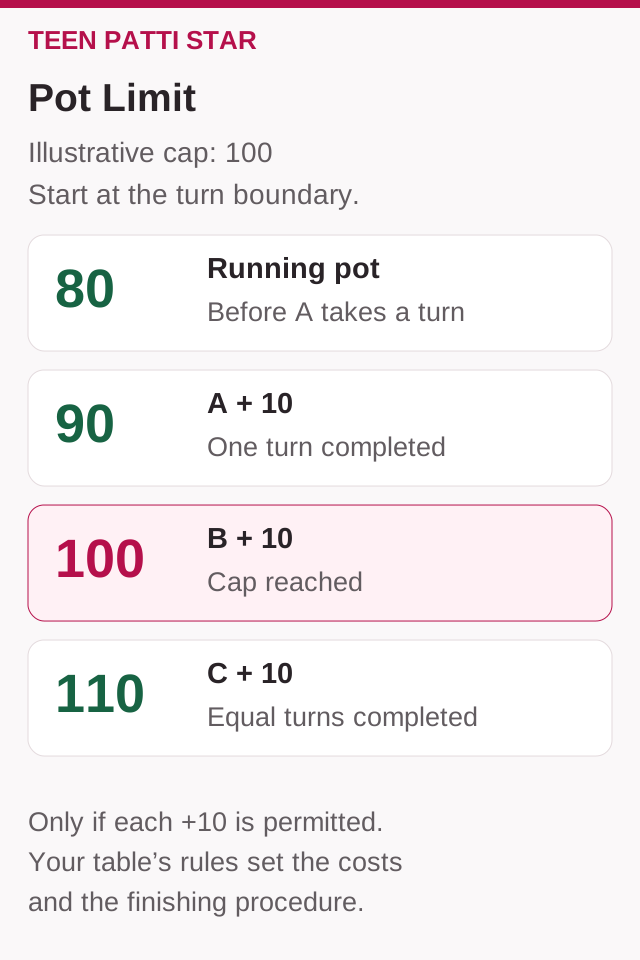
Swipe the table sideways to compare.
| Stage | Added now | Running pot | Turn-count position |
|---|---|---|---|
| Start of this rotation | 0 | 80 | A, B and C are level |
| A takes the next turn | 10 | 90 | A has one extra turn |
| B takes the next turn | 10 | 100 | A and B have one extra turn |
| C completes the rotation | 10 | 110 | All three are level again |
Start of this rotation
- Added now
- 0
- Running pot
- 80
- Turn-count position
- A, B and C are level
A takes the next turn
- Added now
- 10
- Running pot
- 90
- Turn-count position
- A has one extra turn
B takes the next turn
- Added now
- 10
- Running pot
- 100
- Turn-count position
- A and B have one extra turn
C completes the rotation
- Added now
- 10
- Running pot
- 110
- Turn-count position
- All three are level again
At B's action, the threshold is reached. Under the equal-turn procedure described by Royale, that does not require the comparison to occur before C has a matching turn. The final 110 therefore has an explanation: 80 + 10 + 10 + 10. It is not evidence that the displayed 100 meant “each person may bet 100”.
The important observation is the transition between B and C. A useful record would show the pot before B, B's accepted action, C's accepted action, and the closing comparison. A cropped picture showing only 110 and 100 cannot establish whether the procedure was followed.
Where the example stops applying
The Royale help article on maximum pots explains the equal-turn condition. It does not, in that short description, fully specify every case involving a packed player, an insufficient balance or a disconnected participant. Those cases need the application's more detailed rules or a support response.
Do not extend our simple three-player example into a guaranteed rule about those exceptions. If C packs instead of contributing, the actual closing pot and eligible hands may differ. If a game disables further actions immediately, its procedure may differ from Royale's. The first job is to identify which product and mode you are observing.
The same caution applies to exact thresholds. A number copied from an old help page or a different room is not proof of the limit in your current room. Record the room's own boot, contribution limits and pot threshold before the round starts, if the application displays them.
A forced showdown is not the same as requesting Show
A normal Show is an action whose eligibility and cost depend on the table rules and the remaining players. A pot-cap showdown is a closing procedure triggered by the round reaching a condition. They can lead to cards being compared, but that shared result does not make their initiation or tie rules identical.
Octro's published Hi-Lo rules illustrate why the distinction matters: they describe different outcomes for an equal hand depending on whether the comparison follows showing first or exceeding the pot limit. That is a rule for the documented mode, not a universal payout rule for all Teen Patti.
For manual comparison eligibility, read Show versus Sideshow. For the wild-card example behind that tie distinction, read Hi-Lo Teen Patti. Keep the three questions separate: who can request a comparison, what makes a hand stronger, and how an exact tie is resolved.
How to check an unexpected end to a round
Start with the sequence of actions rather than the outcome you hoped for. A short record makes it easier to distinguish a misunderstood rule from an unresolved display or account problem.
- Identify the application, room or mode, and the approximate time. An app name alone may not identify a particular product.
- Record the displayed boot, current stake, single-action cap and pot threshold where available. Mark missing values as unknown.
- Note the pot immediately before and after each relevant action. Keep “amount added” and “new total” in separate columns.
- Record which players were still active and whether the close followed a request, a threshold or another displayed condition.
- If the published rule does not explain the record, send the relevant round identifier and redacted screenshots through the application's verified support channel.
Do not share a password, OTP or full financial information to explain a chip calculation. Our customer-care guide explains how to distinguish an editorial website from an application's account-support channel.
Try the calculation without an application
Use three labelled counters and write down a starting pot of 140. Choose a threshold of 150. Suppose an illustrative table permits contributions of 5 from each of three players, with the equal-turn condition used above. A takes the pot to 145, B to 150, and C to 155. The final total is 155, not 150 and not 165.
Now change only the payment size to 10. A reaches 150, B reaches 160 and C reaches 170 if the same completion condition and permitted actions apply. This is arithmetic practice, not a recommendation to increase contributions. It shows why a closing threshold alone is insufficient to predict the final pot.
For a physical practice game, agree on the procedure before dealing. You can choose a simple hard stop or a complete-rotation rule, but everybody must know which one is being used. Do not change it after seeing the hands.
Questions about pot limits
Does a higher pot limit improve the cards I receive?
No. A closing threshold does not change the cards already dealt. It can change how long contributions continue. Hand strength and accumulated contributions are different measurements.
Can the pot finish below its limit?
Yes, a round can end through another permitted condition before the threshold is reached, such as everyone except one player packing. A maximum is not a target that every round must reach.
Does reaching the limit always split the pot?
No. First determine the winning hand and the mode's tie procedure. A split requires a rule that calls for one; merely reaching a threshold does not make unequal hands equal.
Is a final pot above the limit automatically an error?
Not under every rule set. An equal-turn completion procedure can explain an excess. If the observed sequence conflicts with the actual room rules, preserve the round record and request clarification rather than assuming our example applies.
Sources & scope
Public sources checked on 26 October 2026. Examples are illustrative; no hands-on device test of a specific app was performed. Table and platform rules may differ.
Related guides
Gameplay
Blind vs Seen in Teen Patti: Rules and a Worked Round
Work out Blind and Seen contributions with a practice-counter calculator. Follow the current stake, a complete round and final Show eligibility.

Gameplay
Teen Patti Show vs Sideshow: Rules, Eligibility and Examples
Check who can request Show or Sideshow, compare Blind and Seen eligibility, and follow accepted, refused and tied-hand examples.
Gameplay
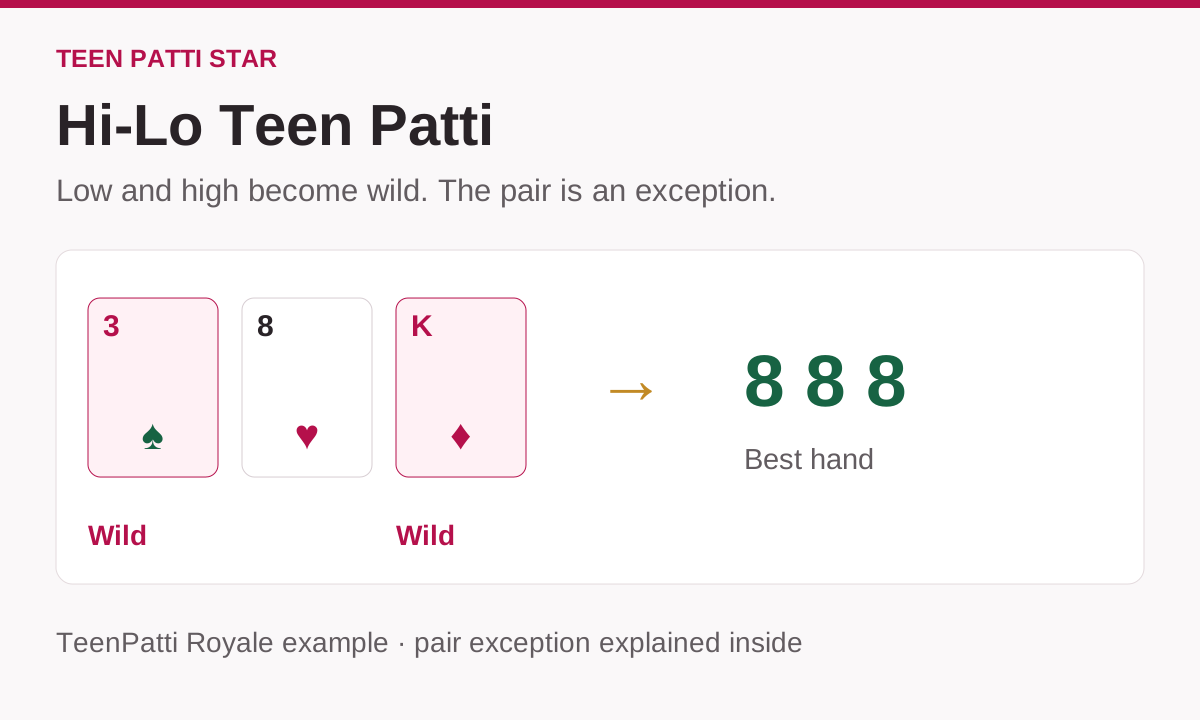
Hi-Lo Teen Patti: Wild Cards and Worked Hands
Mark the high and low wild cards, retain the natural middle card and compare worked hands. Includes the pair exception and mode-specific tie rules.