
Gameplay
How to Play Teen Patti for Free Without Real Money: Beginner’s Guide
You do not need to deposit money to learn Teen Patti. A deck of cards and counters with no cash value are enough for a practice game. A digital practice or social mode may also work, provided the specific mode requires no payment and its chips cannot be redeemed for money or prizes.
Scope: worked examples of general Teen Patti rules, not rules tested in a specific Star app. Check your table’s rules. Sources & limitations
Teaching diagram — not an app screenshot.
The key is to distinguish free play from free installation. An app can cost nothing to download while still selling chips, advertising paid rooms, or requiring a purchase for some features. A bonus balance is not automatically a cash-free practice environment either.
This guide explains how to set up genuinely no-money learning, assess digital options, and avoid turning a short practice session into unwanted spending. It does not claim that every Teen Patti Star listing has the same free mode or payment model.
What Counts as Playing Without Real Money?
For this guide, no-money play means there is no paid entry, deposit, purchase requirement, cash redemption, or side agreement to settle token balances later. Chips are simply a way to track the round.
That final point matters in home games. A group cannot call a session free while agreeing to pay the winner according to the final token count afterward. If counters become a record of money owed, the activity has changed.
Likewise, “free chips” inside an app describes only the label on a balance. You still need to know what room it accesses, whether payment is needed to continue, and whether the room offers anything redeemable.
| Description | What it establishes | What remains to check |
|---|---|---|
| Free download | No initial download charge | Purchases, subscriptions, and room access |
| Virtual practice chips | A non-cash-looking balance | Redemption terms and whether payment is required |
| No-deposit offer | No stated initial deposit for that offer | Eligibility, restrictions, and any later payment demand |
| Home game with valueless tokens | Counters can track decisions | No prizes or later cash settlement |
| Optional chip purchase | Spending may be available | Whether you can decline and still stop or practice freely |
Free download
- What it establishes
- No initial download charge
- What remains to check
- Purchases, subscriptions, and room access
Virtual practice chips
- What it establishes
- A non-cash-looking balance
- What remains to check
- Redemption terms and whether payment is required
No-deposit offer
- What it establishes
- No stated initial deposit for that offer
- What remains to check
- Eligibility, restrictions, and any later payment demand
Home game with valueless tokens
- What it establishes
- Counters can track decisions
- What remains to check
- No prizes or later cash settlement
Optional chip purchase
- What it establishes
- Spending may be available
- What remains to check
- Whether you can decline and still stop or practice freely
Option One: Use a Deck and Practice Tokens
The simplest controlled setup is an offline game. Remove jokers from a standard deck, give everyone an equal number of counters, and write down a small boot. Use beans, paper counters, or ordinary chips that cannot be redeemed.
Agree that the session ends after a set time or number of rounds. If someone runs out, pause, end the exercise, or start a new equally supplied practice session. Do not introduce borrowing, buy-ins, or a promise to repay tokens later.
Start without wild cards or complicated variants. A basic game already teaches the deal, the difference between Blind and Seen, folding, and hand comparison. Additional features can wait until everyone understands what a normal turn costs.
For a teaching round, you may reveal all cards and discuss each decision. Label this as an open learning exercise, because normal hidden-information play feels different.
Option Two: Check a Digital Practice Mode
If you prefer an app, identify the exact publisher and product before evaluating its free features. A similar name or familiar icon does not prove that you have found the intended game.
Read the room description and relevant terms. Look for a clear explanation of the chip type and whether those chips have cash value. If the app uses several balances, check which one the room deducts rather than assuming every chip icon means the same thing.
Next, try entering the practice area without providing payment information. If the app requires a deposit to unlock what you thought was a free room, stop and reassess. There is no need to pay merely to establish whether a free feature exists.
Do not confuse a multiplayer social mode with an offline mode. A game using virtual chips may still require internet access, an account, and active servers. Only the actual app’s stated features can answer those questions.
Set a Zero-Spend Boundary Before Starting
A practical rule is simple: no purchases during learning. If a purchase prompt appears, decline it. If you cannot continue without paying, finish the session or use physical cards instead.
Review the device’s purchase-authentication controls before playing, especially on a shared device. Do not depend on remembering to avoid one button while a fast-moving game presents multiple overlays.
Also set a time limit. A session can cost no money and still take more attention than you intended. Choose a stopping point in advance rather than letting a daily streak, countdown, or nearly completed challenge decide how long you remain.
Free play is successful when you learn something and stay within your boundary, not when you maximize the displayed balance.
A Beginner Practice Plan You Can Finish in One Session
Stage One: Identify Hands Without Betting
Deal several separate three-card hands and classify each one. Start with a pair, a high-card hand, a Colour, and a Sequence. Explain the defining feature rather than guessing from the highest card.
For instance, 5♣, 6♥, 7♦ is a Sequence. A♠, J♠, 8♠ is a Colour. The Sequence wins under the standard classic order even though the other hand contains an ace.
Stage Two: Track Player Status
Deal a new round and mark who remains Blind and who has looked. Ask each person to announce the amount required before contributing. Do not rush past a disagreement; resolving the rule is the point of the exercise.
Once someone has viewed their cards, they stay Seen for the rest of that deal. Covering the cards does not restore Blind status. This is an information rule, not a statement about whether opponents can see the hand.
Stage Three: Finish One Complete Round
Use a small boot and a written Show rule. Track each contribution, remove folded hands from active play, and identify the last player or winning comparison.
After awarding the pot, add every remaining stack. In a fee-free home exercise with no additional tokens, the total should equal the starting supply. If it does not, review the ledger instead of guessing where the missing counters went.
Worked Free-Play Example
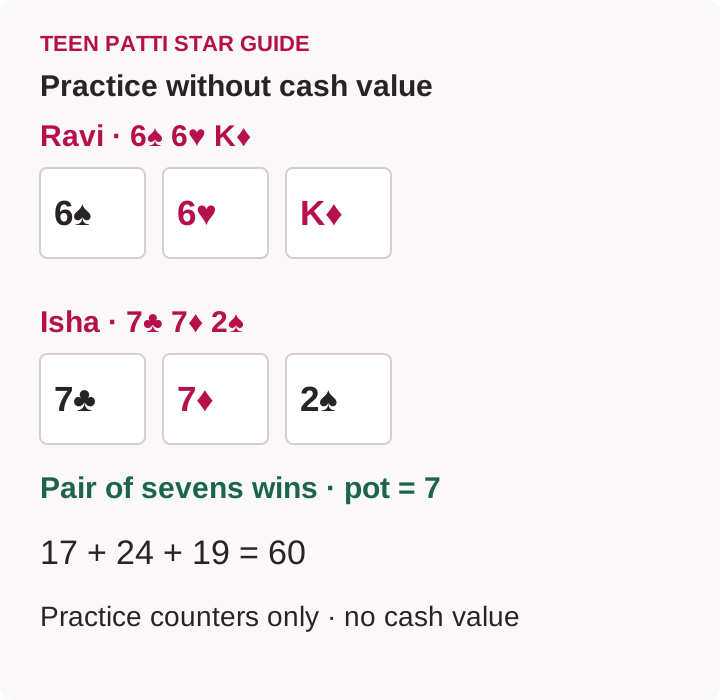
Three friends begin with twenty counters each. Their boot is one, making the opening pot three. They use a simple teaching convention: no raises, Blind continuation costs one, and Seen continuation costs two.
Ravi continues Blind for one. Isha looks and continues Seen for two. Noor looks and folds. The pot is now six, with Ravi and Isha remaining.
On his next turn, Ravi requests a Show. Their agreed rule allows a Blind requester to pay one before looking, so the final pot is seven. Ravi reveals 6♠, 6♥, K♦; Isha reveals 7♣, 7♦, 2♠. Isha wins because sevens beat sixes, regardless of Ravi’s king.
| Player | Contributed | Pot received | Final counters |
|---|---|---|---|
| Ravi | 3 | 0 | 17 |
| Isha | 3 | 7 | 24 |
| Noor | 1 | 0 | 19 |
Ravi
- Contributed
- 3
- Pot received
- 0
- Final counters
- 17
Isha
- Contributed
- 3
- Pot received
- 7
- Final counters
- 24
Noor
- Contributed
- 1
- Pot received
- 0
- Final counters
- 19
The final total is sixty, matching the initial supply. Nobody pays or receives money. The learning outcome is understanding a pair comparison and the accounting, not converting Isha’s four-counter increase into a financial result.
What to Do When Free Chips Run Out
Running out of virtual chips does not create an obligation to buy more. Stop, switch to physical practice, or use a legitimately available free replenishment option if the actual app offers one under acceptable terms.
Do not assume there is a universal daily bonus amount, reset time, or advertisement reward. These features vary by product and may change. Follow what your verified app currently states rather than a copied promotion from another game.
Avoid changing the device clock, opening duplicate accounts, or using automation to bypass limits. Such actions are not necessary for learning and may conflict with the service’s rules. A limit is a reason to pause, not a technical obstacle you must defeat.
Recognize Fake Free-Chip Offers
A website promising unlimited chips may ask for credentials, an OTP, a modified APK, or a payment to “activate” a reward. None of these requests is part of learning the rules of Teen Patti.
Do not grant an unfamiliar tool remote access to your device or permissions unrelated to its stated purpose. A moving progress bar or a page displaying your username does not prove that a generator is connected to the game.
If you have already entered a password into a suspicious page, secure the affected account through its genuine provider and review active sessions where supported. Do not send additional money to someone promising to recover a free bonus.
Frequently Asked Questions
Are virtual chips always free?
No. Virtual means they are digital units, not that they cost nothing. Some apps sell non-redeemable chips. Check both acquisition cost and redemption terms.
Can I withdraw practice winnings?
In the no-money practice setup described here, no. Tokens and practice results have no redeemable value. Any claim of withdrawal belongs to a different offer that needs separate scrutiny.
Is free play guaranteed to be harmless?
No. Time pressure, advertisements, privacy concerns, and purchase prompts can still matter. Respect the app’s age requirements and stop if play becomes stressful or difficult to control.
Final Thoughts
The most straightforward way to play Teen Patti for free is to keep money completely outside the session. Use valueless counters or a clearly verified practice mode, decline purchase prompts, and measure progress by understanding rather than chip totals.
The responsible gaming guide provides broader boundaries for time and spending. You do not need a deposit, a paid bonus, or an unlimited-chip tool to learn the game.
Sources & scope
Public sources checked on 15 September 2026. Examples are illustrative; no hands-on device test of a specific app was performed. Table and platform rules may differ.
Related guides
Gameplay
How to Play Teen Patti: Step-by-Step Beginner’s Guide with Hand Examples
Follow a complete Teen Patti practice round, from the boot and deal to Blind turns, folding, a final Show, and checking the token totals.
Safety
Teen Patti Star Hack Claims: Scam Risks and Account Safety
Do Teen Patti Star hacks, unlimited-chip generators, or mod APKs work? Learn how common hack scams operate and how to protect or recover your account.
Gameplay
How to Play Teen Patti Offline with Friends: Setup and Step-by-Step Rules
Learn to play Teen Patti offline with friends using a deck and tokens, including setup, hand rankings, blind and seen turns, and a worked round.