
Gameplay
Teen Patti 321 Rules: Split Six Cards and Count the Points
Teen Patti 321 splits six cards into separate groups of three, two and one. Octro’s guide awards 60 points to each winning group, divided among tied winners. A stronger three-card hand alone does not guarantee a higher total.
Method: a public-documentation guide, not a hands-on test of a Star build. Diagrams are illustrative. Sources & limitations
What does 321 mean in Teen Patti?
It means arranging six cards into three separate groups: one containing three cards, one containing two, and one containing one. All six cards are used, once each. The decision is not simply which three cards make the strongest Teen Patti hand.
Octro’s published 3-2-1 mode describes separate comparisons of those groups, 60 points for a group win, shared points for a tie, and five rounds. This is a guide to that documented format, not confirmation that every app with “321” in its name has the same rules. We have not played or measured a current app session.
Before using the examples, review Teen Patti hand rankings. A three-card straight flush is called Pure Sequence here. Two cards cannot form a three-card Pure Sequence, even if they share a suit and are adjacent ranks.
Set out the groups before selecting cards
For the paper exercises below, use standard three-card categories for the large group. For the two-card group, explicitly agree that a pair beats an unpaired hand; compare pair ranks or, for unpaired cards, the highest rank followed by the next. For the single card, agree that ace is high. These are declared exercise conventions: the publisher’s short overview does not fully specify every two-card and tie-break detail.
Swipe the table sideways to compare.
| Group | Cards required | What our exercise compares |
|---|---|---|
| Three-card group | 3 | Standard Teen Patti category, then ranks |
| Two-card group | 2 | Pair first; otherwise high card, then next card |
| Single-card group | 1 | Rank, with ace high |
Three-card group
- Cards required
- 3
- What our exercise compares
- Standard Teen Patti category, then ranks
Two-card group
- Cards required
- 2
- What our exercise compares
- Pair first; otherwise high card, then next card
Single-card group
- Cards required
- 1
- What our exercise compares
- Rank, with ace high
Use your installed mode’s rules if they differ. Do not silently apply a three-card ranking list to a two-card group, or assume that suits break a tie. No example below needs a suit tie-break.
Two ways to arrange the same six cards
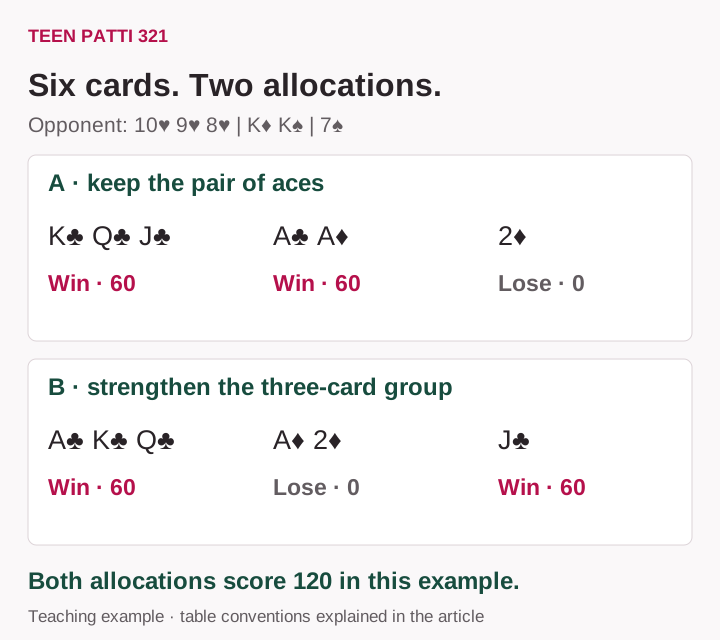
Take A♣, A♦, K♣, Q♣, J♣ and 2♦. The following allocations use identical cards, with no duplicate or replacement. Option A protects the pair of aces; option B uses one ace to strengthen the Pure Sequence and leaves the jack as the single card.
Swipe the table sideways to compare.
| Allocation | Three-card group | Two-card group | Single card |
|---|---|---|---|
| A | K♣ Q♣ J♣ | A♣ A♦ | 2♦ |
| B | A♣ K♣ Q♣ | A♦ 2♦ | J♣ |
A
- Three-card group
- K♣ Q♣ J♣
- Two-card group
- A♣ A♦
- Single card
- 2♦
B
- Three-card group
- A♣ K♣ Q♣
- Two-card group
- A♦ 2♦
- Single card
- J♣
Both large groups are Pure Sequences. Option B has the higher one, but its two-card group no longer contains a pair. Its single card is stronger than A’s. This is a trade-off across groups, not evidence that either allocation guarantees the best tournament result.
The A23 versus AKQ guide explains why ace conventions need checking. Our example avoids an A23 comparison, so that particular disagreement does not decide the result.
Compare each allocation with one opponent
Give the hypothetical opponent 10♥-9♥-8♥ in the three-card group, K♦-K♠ in the two-card group, and 7♠ alone. Those six cards are distinct from our six. In real play you may not know the opponent’s allocation before committing; we reveal it here only to teach comparison.
Swipe the table sideways to compare.
| Comparison | Allocation A | Allocation B |
|---|---|---|
| Three-card group against 10♥ 9♥ 8♥ | Win: K-Q-J Pure Sequence | Win: A-K-Q Pure Sequence |
| Two-card group against K♦ K♠ | Win: pair of aces | Lose: unpaired A-2 |
| Single card against 7♠ | Lose: 2 | Win: J |
| Total, at 60 per group win | 120 | 120 |
Three-card group against 10♥ 9♥ 8♥
- Allocation A
- Win: K-Q-J Pure Sequence
- Allocation B
- Win: A-K-Q Pure Sequence
Two-card group against K♦ K♠
- Allocation A
- Win: pair of aces
- Allocation B
- Lose: unpaired A-2
Single card against 7♠
- Allocation A
- Lose: 2
- Allocation B
- Win: J
Total, at 60 per group win
- Allocation A
- 120
- Allocation B
- 120
Strengthening the three-card group did not improve the score in this example. It already beat the opponent in A. B moved a win from the pair group to the single-card group instead. Change the opponent and the result can change; this is not a universal recommended arrangement.
This also explains why “always put your best three together” is incomplete advice for 321. Evaluate the remaining pair and single at the same time. The different task in Best of Four is to select one three-card hand and leave one card out, not to score every card across separate groups.
Calculate wins and ties separately
Under the published scoring schedule, three outright group wins yield 60 + 60 + 60 = 180 points for a round. Across five rounds the stated maximum is 900. Points are not rupees or a promise of a reward.
If exactly two players tie for the winning group, dividing its 60 points gives 30 each. A round with one outright win, one two-way winning tie and one loss therefore gives 60 + 30 + 0 = 90. A tie for a losing position is not automatically a share of the winning points. Check the result panel rather than assuming every equal rank earns something.
Check your allocation before confirming
Count the cards in order: 3, then 2, then 1. Check that every dealt card appears once, that no card is left outside the groups, and that the remaining groups still make sense after your last move. On a phone, selecting a card and confirming the full arrangement may be different actions; follow the controls shown by that version rather than a guessed button sequence.
There are 20 ways to select an unordered group of three from six cards. For each choice there are 3 ways to choose two of the remaining three, leaving one single: 20 × 3 = 60 allocations. Swapping the visual order inside a group does not create another allocation. You do not need to inspect all 60 in a timed game; this count is a way to check a practice worksheet or a future teaching tool.
Is 321 the same as 6 Patti?
No. Octro presents them as separate modes. Receiving six cards alone does not identify which mode you are playing. In this 321 exercise, all six cards contribute to three group comparisons; do not import another mode’s carry-over cards, round count or scoring without checking.
Practise the allocations with written cards and no cash stakes. For the wider difference between fixed wild ranks, low-card jokers and ordinary play, use our Teen Patti variants comparison. Record the format and its scoring next to every worked result.
Sources & scope
Public sources checked on 23 October 2026. Examples are illustrative; no hands-on device test of a specific app was performed. Table and platform rules may differ.
Related guides
Gameplay
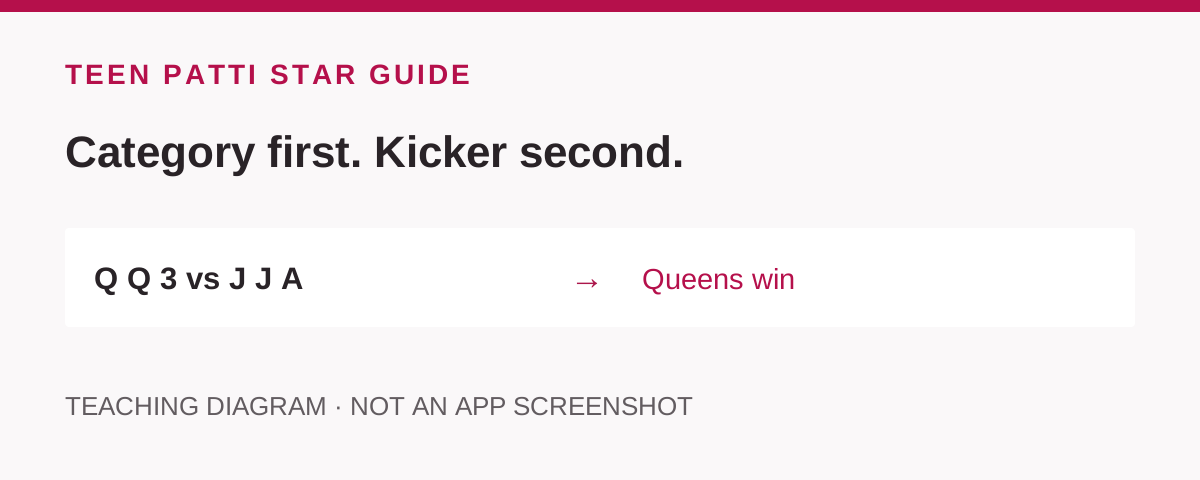
Teen Patti Hand Rankings: Examples and Tie-Breaks
Compare two Teen Patti hands with a free card selector. Follow category and kicker comparisons, choose the A-2-3 convention and work through tie examples.

Gameplay
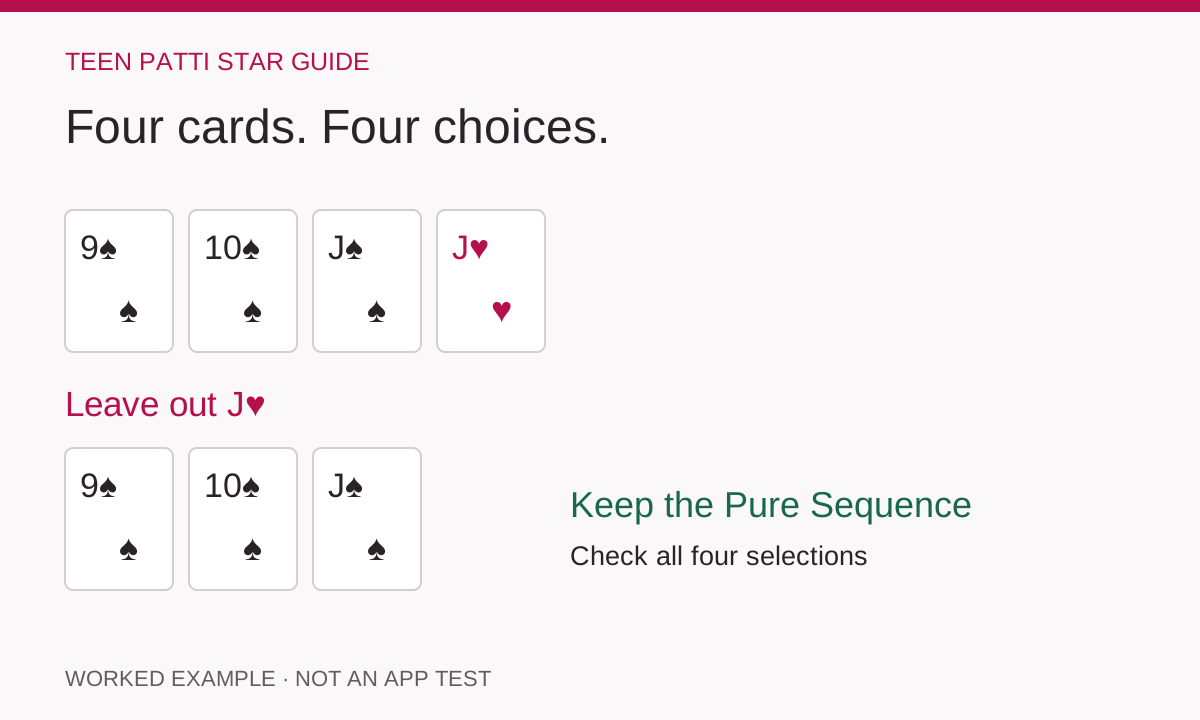
Best of Four Teen Patti: Choose the Best Three Cards
Compare all four selections from one deal, spot a hidden pure sequence and resolve two pairs. Includes Ace cases and a practice hand with an explained answer.
Gameplay
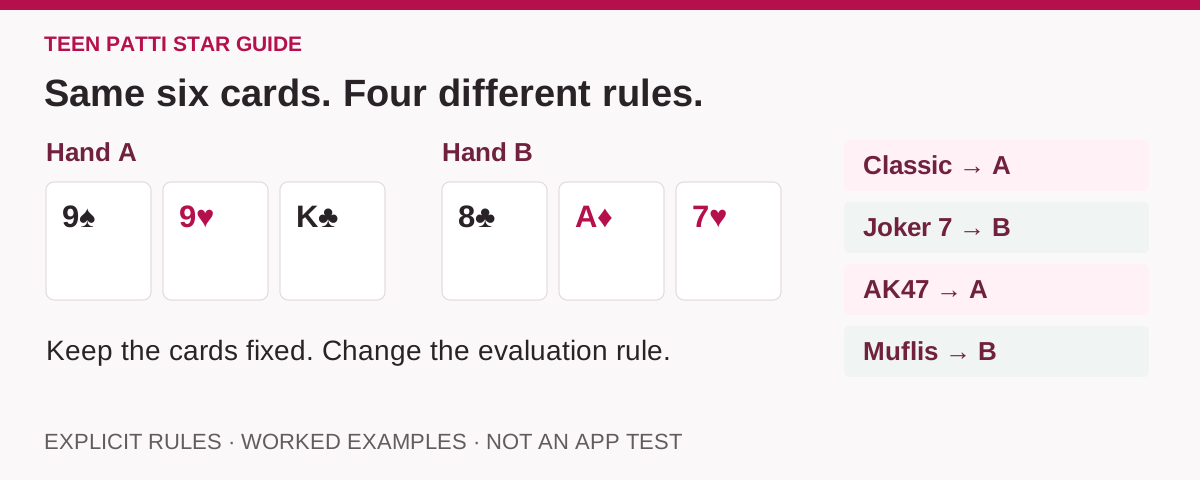
Teen Patti Variants Compared: Classic, Joker, AK47 and Muflis
Keep the same six cards and compare four Teen Patti variants. See the exact Joker and AK47 substitutions, the Muflis reversal and the rules to agree first.