
Gameplay
Best of Four Teen Patti: Choose the Best Three Cards
Best of Four deals four cards but compares a three-card hand. Omit each card once to make four candidates, classify them, then choose the strongest. Two pairs are not a final Teen Patti category, and the smallest printed card is not always the one to discard.
Method: a public-documentation guide, not a hands-on test of a Star build. Diagrams are illustrative. Sources & limitations
What changes and what stays the same
Four cards are the input; three cards are the result. The fourth card is not a spare kicker after you have selected your hand. Nor does this format automatically add a draw, a swap or a joker. Our worked examples use one standard deck, no wild cards and the ordinary stronger-hand objective.
The brief published definition establishes selection, not every room procedure. Before dealing, agree when selections become final, whether unused cards are visible and who evaluates a Blind hand at the end. Do not assume a mobile app uses the same controls as a home table. We have not tested this mode in a Star build.
A four-choice method that catches missed hands
Label the dealt cards A, B, C and D on paper. Your candidates are ABC, ABD, ACD and BCD. That is C(4,3) = 4 selections. Writing them down prevents the same group from being counted twice with its cards merely rearranged.
Use the normal order: Trail, Pure Sequence, Sequence, Colour, Pair, High Card. Classify before comparing individual ranks. Only when two candidates share a category should you compare their relevant ranks. The ranking guide and comparison tool explain that order. Do not feed two overlapping candidate hands into a tool that expects two different players: the shared physical cards would correctly trigger a duplicate-card error.
One deal with four different selections
Omit each card once.
Leave out J♥: keep the Pure Sequence.
The four cards are 9♠ 10♠ J♠ J♥. The pair of Jacks is easy to notice. However, keeping that pair would miss a stronger pattern.
Swipe the table sideways to compare.
| Card omitted | Three cards selected | Category | Comparison |
|---|---|---|---|
| J♥ | 9♠ 10♠ J♠ | Pure Sequence | Best: consecutive and one suit |
| J♠ | 9♠ 10♠ J♥ | Sequence | Below Pure Sequence |
| 10♠ | 9♠ J♠ J♥ | Pair of Jacks, 9 kicker | Below either sequence |
| 9♠ | 10♠ J♠ J♥ | Pair of Jacks, 10 kicker | Better pair, still not best |
J♥
- Three cards selected
- 9♠ 10♠ J♠
- Category
- Pure Sequence
- Comparison
- Best: consecutive and one suit
J♠
- Three cards selected
- 9♠ 10♠ J♥
- Category
- Sequence
- Comparison
- Below Pure Sequence
10♠
- Three cards selected
- 9♠ J♠ J♥
- Category
- Pair of Jacks, 9 kicker
- Comparison
- Below either sequence
9♠
- Three cards selected
- 10♠ J♠ J♥
- Category
- Pair of Jacks, 10 kicker
- Comparison
- Better pair, still not best
The fourth row improves the kicker over the third row, but neither defeats the first row. A locally sensible choice—improving the pair—is not necessarily the best choice across all four candidates. Keep 9♠ 10♠ J♠ and leave out J♥, not the lowest card.
This is a selection within one hand. The repeated cards in the table are intentional: they show alternative uses of the same deal, not simultaneous hands held by different players.
What if the four cards contain two pairs?
Take 8♠ 8♥ Q♦ Q♣. Keeping both Queens and either 8 makes a Pair of Queens with an 8 kicker. Keeping both 8s and either Queen makes a Pair of 8s with a Queen kicker. The Queen pair wins the selection because pair rank comes before kicker rank.
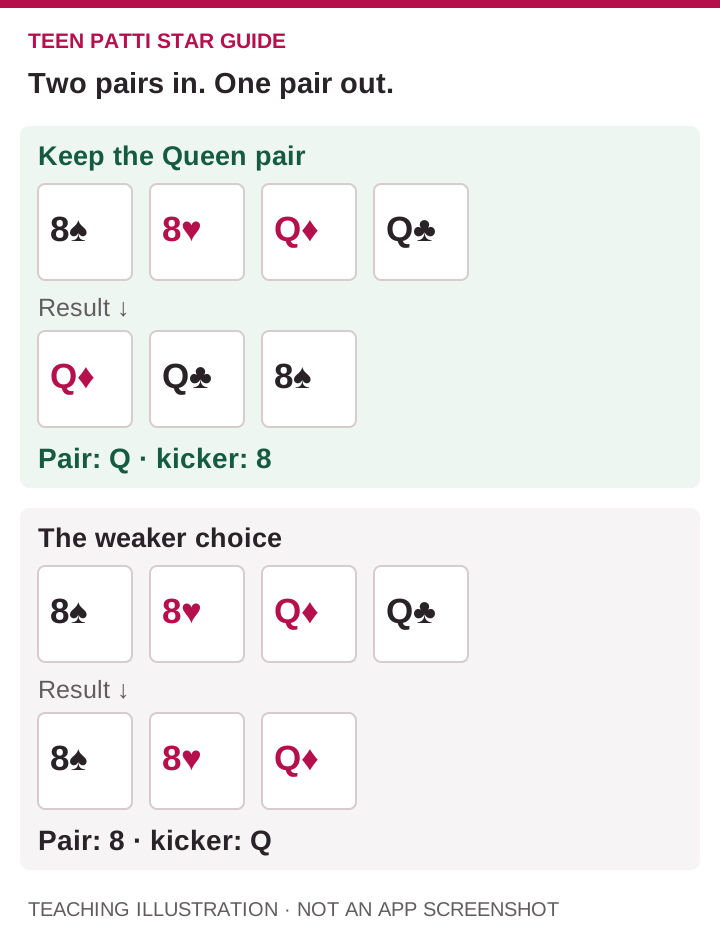
Do not call the final hand “two pair”: it uses only three cards. The two Queen-pair selections have equal rank under a no-suit-tiebreak convention. Choosing one 8 over the other does not make a higher pair. Record which physical card you keep according to the room’s selection procedure.
If a different deal is K♠ K♥ A♦ 6♣, the best pair selection is K♠ K♥ A♦. Here, unlike the first example, retaining the highest spare card is correct because no stronger category exists. The lesson is not “discard high cards”; it is “evaluate the category first.”
Ace cases: recognise the sequence before ranking it
With A♠ 2♥ 3♣ K♦, selecting A♠ 2♥ 3♣ makes a Sequence under the A-2-3 convention used here. K-A-2 is not a wraparound Sequence. The King cannot make that group consecutive just by sitting next to an Ace.
Agree where A-2-3 sits relative to A-K-Q and K-Q-J before comparing selected sequences against another player. This affects ordering between sequences, not the need to select only three cards. Our variant overview separates a selection change from wild-card and ranking changes.
A stronger selection is not a promised win
The extra card gives you more candidates, but the other players receive the same opportunity. It does not follow that a selected pair wins a particular round or that playing more rounds recovers losses. We do not assign profitable betting thresholds to these teaching examples.
The three-card probability table measures an ordinary random three-card deal. Selecting the best three from four changes that process. Do not copy its percentages into a Best of Four table: a separate four-card enumeration and explicit selection rules are needed.
Practice: which card would you leave out?
Try 4♦ 5♣ 6♥ A♠. Omitting A♠ leaves 4♦ 5♣ 6♥, a mixed-suit Sequence. Each other selection is High Card. Keep the low run, not the Ace. Now change only 6♥ to 4♣. The cards are 4♦ 5♣ 4♣ A♠: the best result is the Pair of 4s with an Ace kicker, leaving out 5♣.
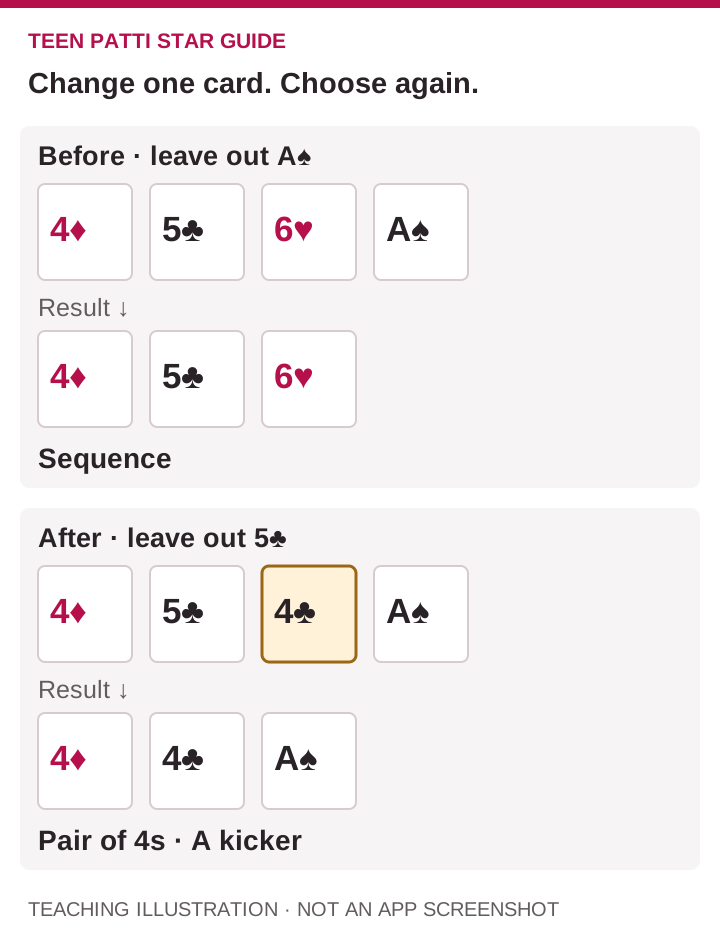
That one-card change removes the run and makes the Ace useful. Explain the category change before naming the discarded card. This is a useful practice exercise with a real deck and no stakes, as in the offline learning setup.
Sources & scope
Public sources checked on 15 October 2026. Examples are illustrative; no hands-on device test of a specific app was performed. Table and platform rules may differ.
Related guides
Gameplay
Teen Patti Hand Rankings: Examples and Tie-Breaks
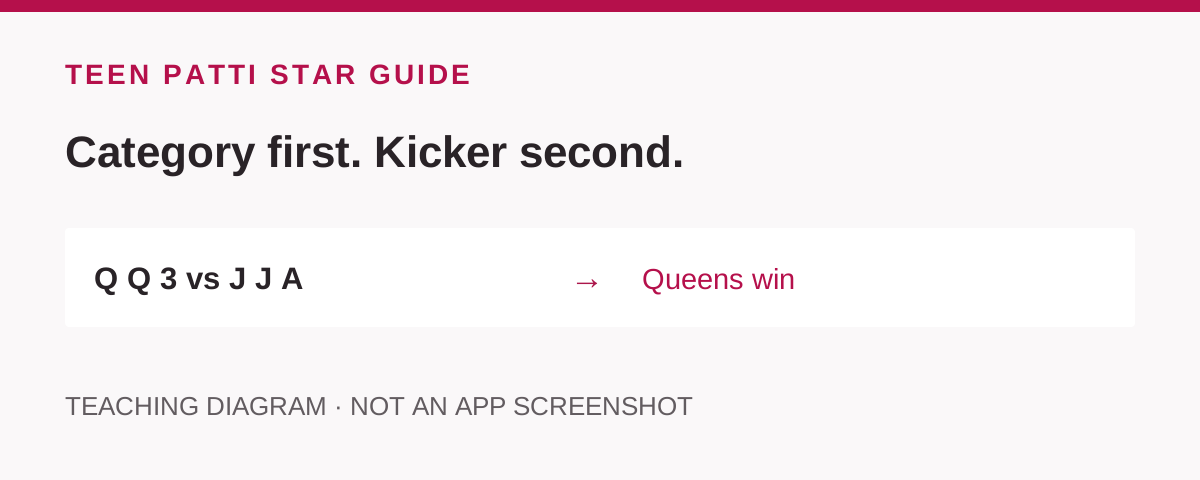
Compare two Teen Patti hands with a free card selector. Follow category and kicker comparisons, choose the A-2-3 convention and work through tie examples.

Gameplay
Teen Patti Variants Compared: Classic, Joker, AK47 and Muflis
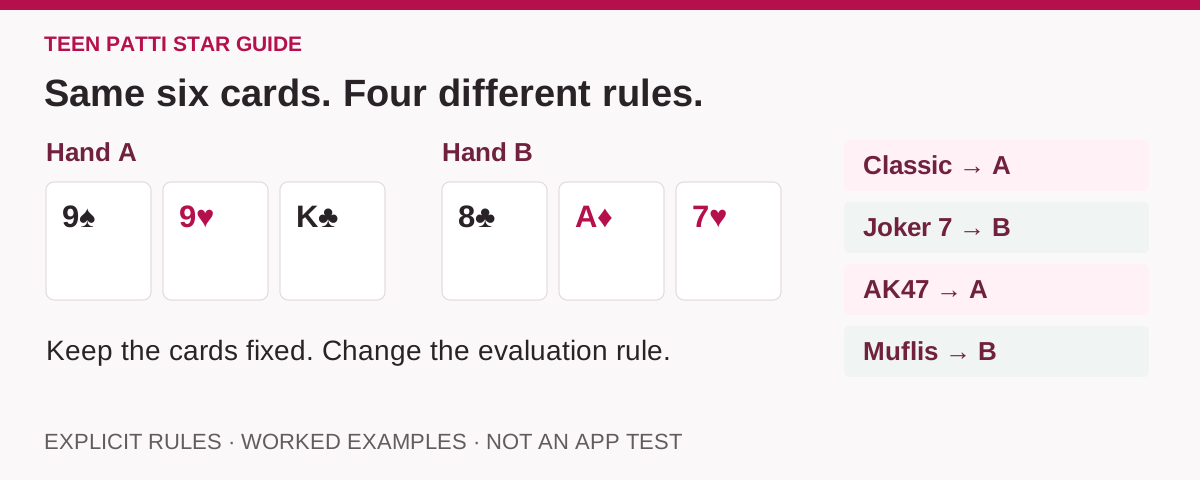
Keep the same six cards and compare four Teen Patti variants. See the exact Joker and AK47 substitutions, the Muflis reversal and the rules to agree first.
Gameplay
999 Teen Patti Rules: Card Values and Worked Scores
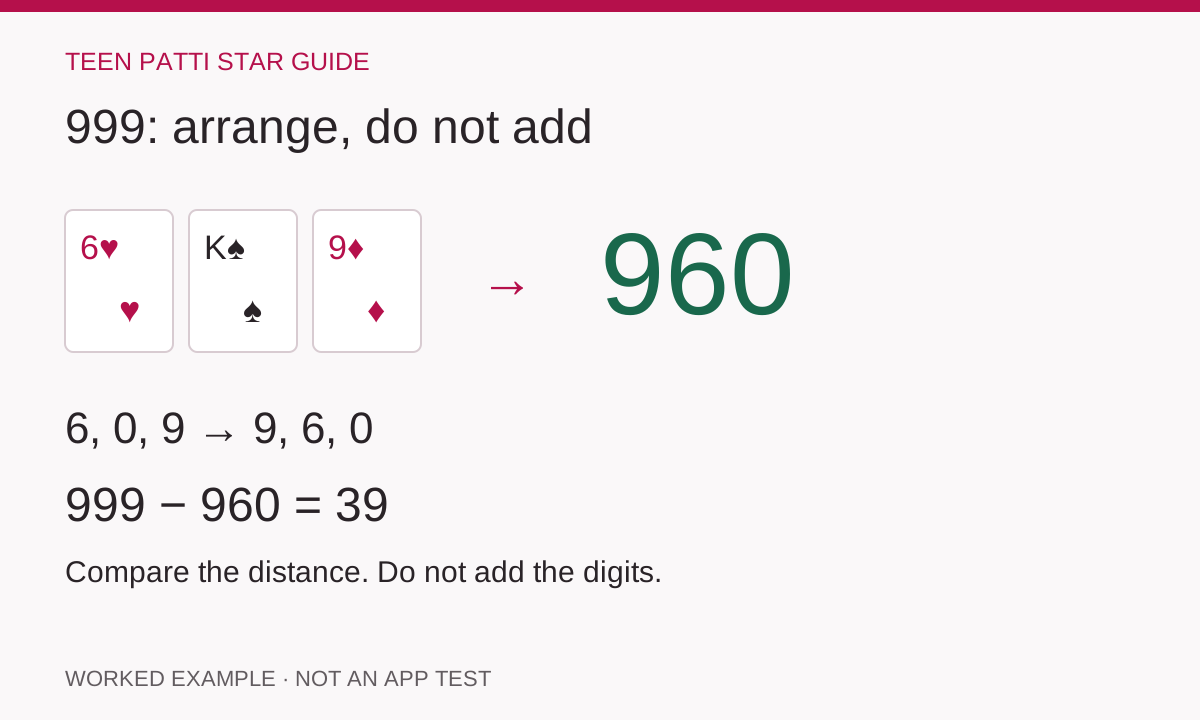
Turn three cards into a 999 score: check Ace, 10 and face-card values, compare six arrangements and see why adding the digits gives the wrong winner.