
Gameplay
How to Play Teen Patti: Step-by-Step Beginner’s Guide with Hand Examples
To play Teen Patti, each player contributes a starting boot and receives three cards. Players then take turns continuing with the permitted contribution or folding. The last remaining player wins, or the final two compare hands through the table’s Show procedure.
Scope: worked examples of general Teen Patti rules, not rules tested in a specific Star app. Check your table’s rules. Sources & limitations
Teaching diagram — not an app screenshot.
That short explanation becomes clearer when you follow one complete round. This guide uses four fictional players, a normal deck, and practice tokens with no cash value. You can reproduce the exercise at a table without downloading an app or paying to participate.
The examples use explicitly stated rules. Your app or home game may differ, particularly on ace sequences, Show fees, and pot limits. Keep the teaching example separate from claims about any particular Teen Patti Star product.
Step 1: Prepare the Table and Agree the Practice Rules
Use a standard fifty-two-card deck without jokers. Give Asha, Ben, Charu, and Dev fifty tokens each. The total supply is therefore two hundred tokens. These are counters only: no entry fee, cash value, or prize is attached.
For this exercise, each player pays a boot of two tokens. Players act clockwise, starting with Asha to the dealer’s left. Nobody raises during the worked round, so the base stays at two tokens. A Blind continuation costs two and a Seen continuation costs four.
The final Show follows this agreed convention: when only two players remain, a Blind player may request it on their turn for two tokens; two Seen players use a four-token Show. A Seen player cannot demand one against a Blind opponent. Equal hands make the requester lose. These are the teaching table’s stated rules, not a promise that every app uses them.
Step 2: Build the Opening Pot
Each player places two tokens in the middle. The pot contains eight, and every player has forty-eight remaining. Keep the pot physically separate from unused stacks.
The boot is not refunded if someone dislikes their cards. It is the agreed contribution for joining this round. If a player does not want to participate, they should sit out before the next deal rather than attempt to withdraw their boot after seeing a hand.
At home, nominate one person to announce pot totals during teaching rounds. This makes arithmetic errors visible before several more turns have happened.
Step 3: Deal Three Cards to Each Player
Shuffle, offer a cut, and deal one card at a time until each player has three face-down cards. Do not add a fourth card or place community cards in the center. The remaining deck is not a draw pile in classic Teen Patti.
For the worked example, the hands are shown below so you can audit the outcome. In actual play, keep them private. Asha remains Blind despite the reader being able to see her example cards.
| Player | Example hand | Category |
|---|---|---|
| Asha | 9♠ 10♥ J♦ | Sequence |
| Ben | K♠ 8♥ 3♦ | High Card |
| Charu | Q♣ Q♦ 5♠ | Pair |
| Dev | A♥ J♥ 7♥ | Colour |
Asha
- Example hand
- 9♠ 10♥ J♦
- Category
- Sequence
Ben
- Example hand
- K♠ 8♥ 3♦
- Category
- High Card
Charu
- Example hand
- Q♣ Q♦ 5♠
- Category
- Pair
Dev
- Example hand
- A♥ J♥ 7♥
- Category
- Colour
All twelve cards are distinct. This matters when using a single deck: two players cannot hold the same physical queen of clubs in the same deal.
Step 4: Decide Whether to Stay Blind or Look
Asha leaves her cards face down. She has no direct information about their strength, so she is Blind. Ben, Charu, and Dev look privately and become Seen.
Looking is not cheating; it is a normal choice. It changes the player’s information and, under these rules, their contribution amount. Once Seen, a player cannot return to Blind status by covering the cards.
For a first lesson, pause here and ask each person to say their status aloud without naming their cards. A beginner often confuses “my cards are hidden from everyone else” with “I am Blind.” Seen cards remain private from opponents too.
Step 5: Complete the First Circuit
Asha acts first and contributes two tokens. The pot rises from eight to ten. Ben looks at his high-card hand and folds. He adds nothing further, but his opening two tokens remain in the pot.
Charu continues as a Seen player and adds four, taking the pot to fourteen. Dev also continues Seen for four, so the pot reaches eighteen.
There are now three active players: Asha, Charu, and Dev. Ben does not take further turns in this round. His folded cards remain out of play and should not be shown to help a friend.
| Turn | Action | Added to pot | Pot afterward |
|---|---|---|---|
| Opening | Four boots of two | 8 | 8 |
| Asha | Continues Blind | 2 | 10 |
| Ben | Packs | 0 | 10 |
| Charu | Continues Seen | 4 | 14 |
| Dev | Continues Seen | 4 | 18 |
Opening
- Action
- Four boots of two
- Added to pot
- 8
- Pot afterward
- 8
Asha
- Action
- Continues Blind
- Added to pot
- 2
- Pot afterward
- 10
Ben
- Action
- Packs
- Added to pot
- 0
- Pot afterward
- 10
Charu
- Action
- Continues Seen
- Added to pot
- 4
- Pot afterward
- 14
Dev
- Action
- Continues Seen
- Added to pot
- 4
- Pot afterward
- 18
Notice that the Seen players paying four has not raised the base in this exercise. It is their minimum under the stated two-to-one convention. An actual raise would need to be identified and reflected in later amounts.
Step 6: Follow the Second Circuit
Asha continues Blind for another two tokens, making the pot twenty. Charu now chooses to fold. Dev remains active by contributing four, bringing the pot to twenty-four.
The example does not claim Charu’s fold is an optimal decision. It simply demonstrates how a player exits and how turn order skips inactive seats. A pair can lose, a high-card hand can remain uncontested, and a single result does not prove that one decision always works.
Only Asha and Dev remain. It is Asha’s turn next. She is still Blind and can use the agreed Show procedure instead of paying a normal continuation and waiting for another circuit.
Step 7: Request and Pay for the Show
Asha requests the final Show and pays two tokens before viewing her cards. The pot reaches twenty-six. The Show payment here replaces an ordinary continuation on that turn; it is not an extra two added after another unnecessary Blind payment.
Both active hands are revealed. Asha has a Sequence: nine, ten, jack in mixed suits. Dev has a Colour: three hearts that are not consecutive. Under the classic hierarchy, Asha’s Sequence beats Dev’s Colour.
The ace in Dev’s hand does not change the result. Compare the category first. Only when categories match do you move to the appropriate within-category comparison.
Step 8: Award the Pot and Check the Arithmetic
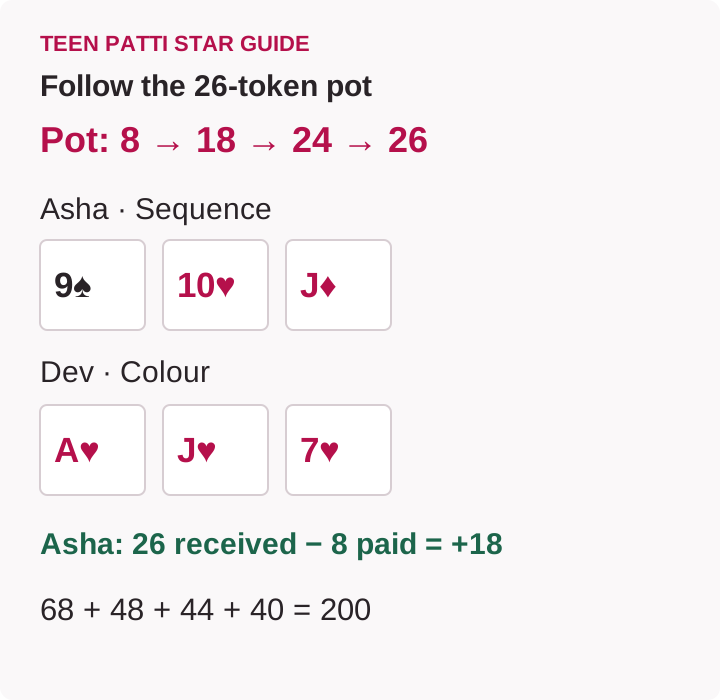
Asha receives the twenty-six-token pot. The final stacks should still total two hundred because this practice game has no fees or tokens entering from outside.
| Player | Total contributed | Pot received | Final stack |
|---|---|---|---|
| Asha | 8 | 26 | 68 |
| Ben | 2 | 0 | 48 |
| Charu | 6 | 0 | 44 |
| Dev | 10 | 0 | 40 |
| Total | 26 | 26 | 200 |
Asha
- Total contributed
- 8
- Pot received
- 26
- Final stack
- 68
Ben
- Total contributed
- 2
- Pot received
- 0
- Final stack
- 48
Charu
- Total contributed
- 6
- Pot received
- 0
- Final stack
- 44
Dev
- Total contributed
- 10
- Pot received
- 0
- Final stack
- 40
Total
- Total contributed
- 26
- Pot received
- 26
- Final stack
- 200
Asha’s net change is eighteen tokens, not twenty-six. The pot includes eight she contributed herself. Keeping “pot received” separate from “net change” prevents a common accounting mistake.
Collect all cards, rotate the dealer as agreed, and prepare a new deal. Folded players may join the next round; their previous fold does not exclude them from the rest of the session.
Practice Three More Hand Comparisons
Try these independent comparisons before adding more complicated table features:
| Hand A | Hand B | Winner and reason |
|---|---|---|
| 4♠ 4♥ 4♦ | 10♣ J♣ Q♣ | A: Trail outranks Pure Sequence |
| 10♠ 10♦ 2♣ | 9♥ 9♣ A♠ | A: higher pair decides before kicker |
| A♠ Q♦ 6♣ | A♥ J♦ 9♣ | A: aces tie, then queen beats jack |
4♠ 4♥ 4♦
- Hand B
- 10♣ J♣ Q♣
- Winner and reason
- A: Trail outranks Pure Sequence
10♠ 10♦ 2♣
- Hand B
- 9♥ 9♣ A♠
- Winner and reason
- A: higher pair decides before kicker
A♠ Q♦ 6♣
- Hand B
- A♥ J♦ 9♣
- Winner and reason
- A: aces tie, then queen beats jack
Explain the result aloud using the category and comparison rule. “Mine looks better” is not an explanation. For a further test, change only one card and ask whether the category changes or merely the tie-break rank.
Common First-Round Mistakes
Do not import the draw-and-discard step from rummy. Your three cards normally remain fixed. Do not treat three red cards as a Colour unless they are all the same suit. Do not assume that the player who has paid the most has the strongest hand.
Another mistake is revealing a folded hand. In a learning demonstration, cards can be discussed after the round, but exposing them during an active deal changes the information available to others.
Finally, do not continue simply because you already contributed. Earlier tokens are in the pot whether you fold or continue. The next decision concerns the next contribution, not recovering a past one by force.
Frequently Asked Questions
Can I practice with every hand visible?
Yes, as an explicitly open teaching exercise. It helps with rankings and arithmetic, but it does not reproduce the hidden-information decisions of a normal round.
Do I have to use raises or Sideshows immediately?
No. This lesson omits both. Learn clean turn order and final comparisons first, then add features after agreeing their precise rules.
Where can I read more beginner explanations?
The Teen Patti guide collection includes related material on hand rankings, Blind and Seen play, and offline setup. Use it as a reference, not as evidence that an unfamiliar app has identical controls.
Final Thoughts
A complete practice round teaches more than memorizing button names. You can now follow the boot, deal, player status, contributions, folding, final comparison, and token balance.
Keep practice free of real-money stakes, agree a stopping time, and pause whenever a rule is unclear. Learning the mechanics is the objective; neither a strong example hand nor a winning practice round predicts future results.
Sources & scope
Public sources checked on 15 September 2026. Examples are illustrative; no hands-on device test of a specific app was performed. Table and platform rules may differ.
Related guides
Gameplay
Teen Patti Rules for Beginners: Card Rankings, Blind vs Seen, and Show Rules
Learn classic Teen Patti rules with hand-ranking examples, Blind and Seen contributions, Show eligibility, tie-breaks, and table rules to confirm.
Gameplay
How to Play Teen Patti Offline with Friends: Setup and Step-by-Step Rules
Learn to play Teen Patti offline with friends using a deck and tokens, including setup, hand rankings, blind and seen turns, and a worked round.
Gameplay
How to Play Teen Patti for Free Without Real Money: Beginner’s Guide
Learn Teen Patti with non-redeemable tokens or a verified free mode. Understand virtual chips, optional purchases, practice limits, and scam warnings.