
Gameplay
What Is Teen Patti Indian Poker? Rules, Hand Rankings, and Poker Differences
Teen Patti is a three-card game often described as Indian poker. The nickname helps communicate the broad idea: players have private cards, make decisions with incomplete information, and compete for a pot. It does not mean that Teen Patti follows the rules of Texas Hold’em or every other game called poker.
Scope: worked examples of general Teen Patti rules, not rules tested in a specific Star app. Check your table’s rules. Sources & limitations
Teaching diagram — not an app screenshot.
In classic Teen Patti, each player receives three cards and normally keeps those same cards throughout the round. There are no shared flop, turn, and river cards. Players may play without viewing their own hand, and the game uses a specific six-category ranking system.
If you already know poker, some terms will feel familiar. The safest approach is to use that familiarity as an introduction, then learn where the mechanics differ. This guide focuses on classic Teen Patti and uses Texas Hold’em as the main comparison, rather than treating all poker variants as identical.
What Does “Teen Patti” Mean?
The name refers to three cards. That is the simplest starting point for understanding the game: the whole classic hand consists of three cards, not a best-five selection from a larger set.
The phrase “Indian poker” is a descriptive label, not proof of an app’s developer, certification, or rules. A search result using that phrase might discuss the traditional game, a social app, a modified room, or a different product entirely.
Before playing, ask what is actually being compared and against whom. A traditional player-versus-player pot game differs from a casino format in which each player compares with a dealer under a separate payout schedule. A familiar name should not replace reading the selected format’s rules.
How a Classic Teen Patti Round Begins
Players agree a boot, the initial contribution that forms the pot. Using non-redeemable practice tokens, six players paying one token each would create a six-token starting pot. The dealer then distributes three face-down cards to every participant.
A player can inspect those cards and become Seen or keep them unseen and remain Blind. Play proceeds in the agreed direction. On a turn, a player continues with the permitted contribution or folds, leaving earlier contributions in the pot.
Classic Teen Patti does not have a routine exchange step. You cannot discard a low card and draw a replacement simply because that would improve your hand. Nor do you wait for community cards to complete a combination.
The Six Hand Categories
The usual hierarchy is Trail, Pure Sequence, Sequence, Colour, Pair, and High Card. Learn it in that order rather than importing a five-card poker chart.
| Teen Patti category | Example | What to notice |
|---|---|---|
| Trail | 6♠ 6♥ 6♦ | Three matching ranks |
| Pure Sequence | 9♦ 10♦ J♦ | Consecutive cards of one suit |
| Sequence | 7♠ 8♦ 9♥ | Consecutive cards, mixed suits |
| Colour | K♣ 9♣ 5♣ | Same suit without a run |
| Pair | A♠ A♥ 4♣ | Two matching ranks |
| High Card | Q♦ 8♣ 2♥ | No stronger category |
Trail
- Example
- 6♠ 6♥ 6♦
- What to notice
- Three matching ranks
Pure Sequence
- Example
- 9♦ 10♦ J♦
- What to notice
- Consecutive cards of one suit
Sequence
- Example
- 7♠ 8♦ 9♥
- What to notice
- Consecutive cards, mixed suits
Colour
- Example
- K♣ 9♣ 5♣
- What to notice
- Same suit without a run
Pair
- Example
- A♠ A♥ 4♣
- What to notice
- Two matching ranks
High Card
- Example
- Q♦ 8♣ 2♥
- What to notice
- No stronger category
For example, 3♠, 4♥, 5♦ beats A♣, K♣, 9♣ because a Sequence ranks above a Colour. In ordinary five-card poker, a flush outranks a straight. This reversal is one of the most important differences for a poker player learning Teen Patti.
Another difference concerns the highest categories. A Teen Patti Trail beats a Pure Sequence. Do not assume that the phrase “straight flush” automatically places a hand above every three-of-a-kind in this game.
Teen Patti vs Texas Hold’em
| Question | Classic Teen Patti | Texas Hold’em |
|---|---|---|
| How many private cards? | Three | Two |
| Are there community cards? | Not in the classic format | Five across the board |
| What hand is evaluated? | The three private cards | The best five-card combination available |
| Can the board improve your hand? | There is no shared board | Yes, as community cards appear |
| What does Blind mean? | Playing without viewing your hand | Usually a required positional contribution |
| Does a flush beat a straight? | Colour loses to Sequence | Flush beats straight |
How many private cards?
- Classic Teen Patti
- Three
- Texas Hold’em
- Two
Are there community cards?
- Classic Teen Patti
- Not in the classic format
- Texas Hold’em
- Five across the board
What hand is evaluated?
- Classic Teen Patti
- The three private cards
- Texas Hold’em
- The best five-card combination available
Can the board improve your hand?
- Classic Teen Patti
- There is no shared board
- Texas Hold’em
- Yes, as community cards appear
What does Blind mean?
- Classic Teen Patti
- Playing without viewing your hand
- Texas Hold’em
- Usually a required positional contribution
Does a flush beat a straight?
- Classic Teen Patti
- Colour loses to Sequence
- Texas Hold’em
- Flush beats straight
In Hold’em, the board arrives in stages: three cards on the flop, followed by one on the turn and one on the river. Players form their best five-card hand from available hole and community cards; they need not use both hole cards. The Pagat Hold’em rules describe that structure.
In Teen Patti, your classic three-card combination is already complete after the deal. The unknown information concerns other hands and later decisions, not whether a future community card will complete your draw.
A Worked Comparison: The Missing Fourth Card
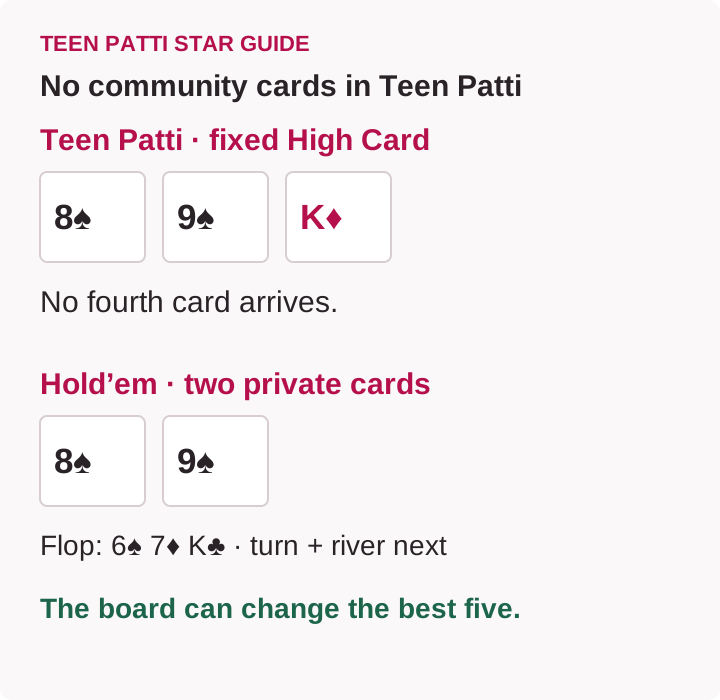
Suppose a Teen Patti player holds 8♠, 9♠, and K♦. The hand is High Card. Two neighboring spades do not make a Pure Sequence, and there is no scheduled turn card that might complete one.
Now imagine a Hold’em situation with 8♠ and 9♠ as hole cards and a flop containing 6♠, 7♦, and K♣. More board cards are still to come, so future cards can change the best available five-card hand. The player is solving a different problem.
The point is not that one format is better. It is that a “draw” in Hold’em and a weak fixed hand in classic Teen Patti should not be evaluated as though the same future events are available.
For a beginner, a useful question is: “Will I receive any more usable cards in this format?” Answering it correctly prevents many misplaced expectations.
Blind Play Is Not the Small Blind
In Teen Patti, Blind describes whether you have viewed your cards. Under many table rules, Seen and Blind participants face different contribution requirements. That information status can change when a Blind player looks, but it does not change back later in the same round.
In Hold’em, small blind and big blind normally describe required contributions associated with seat positions. Posting one does not mean a player must avoid looking at their hole cards.
These meanings are easy to confuse because the same word appears in both games. When a rule mentions a blind amount, determine whether it refers to a Teen Patti information state or a poker position before doing any arithmetic.
Show, Showdown, and Winning Without Revealing
A Teen Patti round can end when everyone but one player folds. The survivor wins without needing the highest hand among all the cards originally dealt. A folded hand is no longer competing for that pot.
When the final two remain, Show eligibility and cost depend on the chosen rules. Do not assume that reaching the end of a circuit produces an automatic multi-player showdown as in another poker format.
Exact ties also need attention. Some Teen Patti tables make the Show requester lose an equal comparison; others use a different stated resolution. It is unsafe to import a split-pot expectation without checking.
Two players holding A-K-8 in mixed suits may have equal High Card hands when suits have no priority. That describes the card comparison, not necessarily how the pot must be distributed.
Ace Sequences and Impossible Poker Hands
Confirm the table’s A-2-3 versus A-K-Q order. Different conventions exist, so neither a remembered poker wheel rule nor an app title alone settles the matter. K-A-2 is not an ordinary classic sequence.
Also remember the three-card limit. A full house needs five cards and cannot be a normal three-card Teen Patti hand. Four of a kind needs four. Two pair needs at least four. If an advertised room includes these categories, it uses additional cards or a different format that needs its own explanation.
The absence of those hands is structural, not a missing feature. A ranking chart must match the number of cards and how the hand is formed.
The App Name Is a Separate Question
“Indian Poker,” “Teen Patti,” and “3 Patti” in a title do not establish a shared account system. Check the actual developer and package before installing an app or attempting to move an existing profile.
The Teen Patti Star guide hub separates gameplay explanations from app-identity checks. Learning classic rules here does not confirm that a similarly named app has been tested, supports a particular device, or uses virtual-only chips.
Frequently Asked Questions
Is Teen Patti just three-card Texas Hold’em?
No. Classic Teen Patti has no Hold’em community board and uses different rankings, contribution mechanics, and Show conventions. The nickname describes similarities, not identical rules.
Are poker strategies guaranteed to work in Teen Patti?
No. General habits such as reading rules and controlling spending can transfer, but game-specific decisions depend on different mechanics. No strategy guarantees a favorable deal or result.
Can I learn Indian poker without an app?
Yes. A standard deck, a written rule card, and non-redeemable tokens are enough for a practice session with friends.
Final Thoughts
Teen Patti is called Indian poker because it shares private cards, uncertain information, and pot-based decisions with poker games. Its three-card structure remains distinct. Learn its own category order, Blind meaning, and Show procedure before relying on familiar terminology.
Use practice tokens while learning, and do not treat a nickname or rules guide as legal approval for paid play. Keep sessions limited and avoid viewing either poker or Teen Patti as a dependable source of income.
Sources & scope
Public sources checked on 15 September 2026. Examples are illustrative; no hands-on device test of a specific app was performed. Table and platform rules may differ.
Related guides
Gameplay
Teen Patti vs Rummy: What’s the Difference and How Do You Play?
Compare Teen Patti and Indian rummy, including card counts, turn structure, sequences, winning conditions, and beginner-friendly worked examples.
Gameplay
Teen Patti Rules for Beginners: Card Rankings, Blind vs Seen, and Show Rules
Learn classic Teen Patti rules with hand-ranking examples, Blind and Seen contributions, Show eligibility, tie-breaks, and table rules to confirm.
Gameplay
How to Play Teen Patti: Step-by-Step Beginner’s Guide with Hand Examples
Follow a complete Teen Patti practice round, from the boot and deal to Blind turns, folding, a final Show, and checking the token totals.