Gameplay
Faceoff Teen Patti: The 20-Card Deck Explained
Faceoff uses ranks 10, J, Q, K and A in four suits: 20 cards. Our examples keep ordinary Teen Patti category order, Ace high and no jokers; the shorter deck changes the possible hands, not automatically their ranking.
Method: a public-documentation guide, not a hands-on test of a Star build. Diagrams are illustrative. Sources & limitations
What is Faceoff Teen Patti?
Faceoff is a short-deck Teen Patti variation using only tens, Jacks, Queens, Kings and Aces. Keeping all four suits gives a deck of 20 cards rather than 52. You still compare three-card hands, but removing ranks two through nine changes which hands can be dealt and how often they occur.
The Faceoff description in Royale's published variations guide identifies these five ranks. This article works through that deck using ordinary Teen Patti category order, Ace high, no jokers and no wraparound sequences. Those are the stated assumptions for our examples and calculations. A particular application's full rules take precedence if they specify a different order.
The main lesson is not simply “all the cards are high”. A hand can still be weaker than another, and a rarer category does not automatically receive a higher rank. We will build the deck, compare actual hands and count the combinations so that each claim can be checked without installing an application.
Build the 20-card deck first
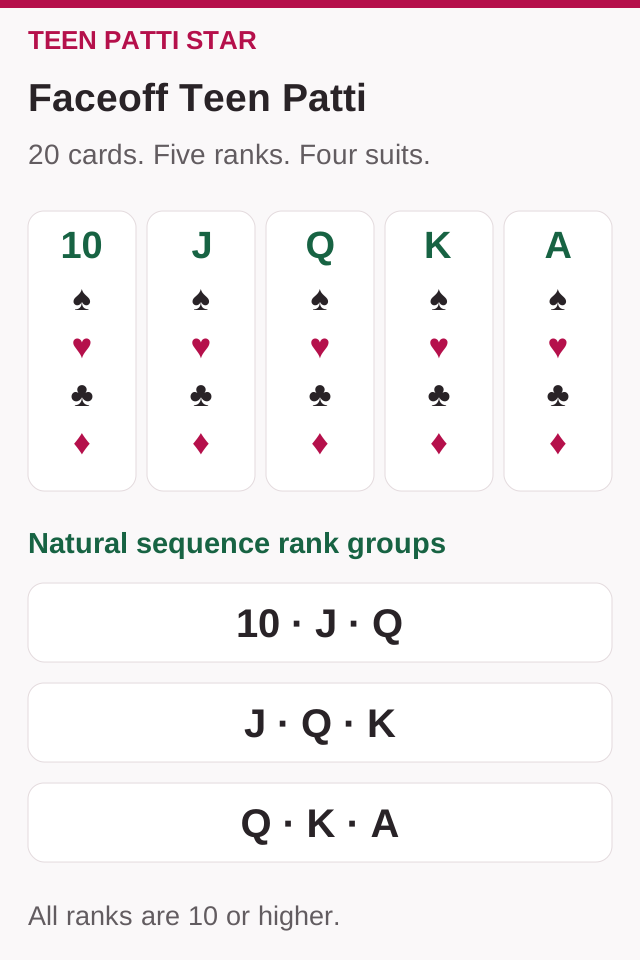
Start with a normal pack and retain 10, J, Q, K and A in each suit. Remove every 2, 3, 4, 5, 6, 7, 8 and 9, plus any printed jokers. Five retained ranks multiplied by four suits gives 20 distinct cards. Count the physical cards before dealing; accidentally leaving in a small card changes the game.
Swipe the table sideways to compare.
| Suit | Cards retained | Count |
|---|---|---|
| Spades | 10♠ J♠ Q♠ K♠ A♠ | 5 |
| Hearts | 10♥ J♥ Q♥ K♥ A♥ | 5 |
| Diamonds | 10♦ J♦ Q♦ K♦ A♦ | 5 |
| Clubs | 10♣ J♣ Q♣ K♣ A♣ | 5 |
Spades
- Cards retained
- 10♠ J♠ Q♠ K♠ A♠
- Count
- 5
Hearts
- Cards retained
- 10♥ J♥ Q♥ K♥ A♥
- Count
- 5
Diamonds
- Cards retained
- 10♦ J♦ Q♦ K♦ A♦
- Count
- 5
Clubs
- Cards retained
- 10♣ J♣ Q♣ K♣ A♣
- Count
- 5
With three cards per player, the deck contains enough cards for six complete hands with two cards left. That is a physical capacity calculation, not a claim about how many seats a particular app allows or how a dealer handles spare cards. A digital room may impose a smaller player limit.
“Royal” can be used as a mode name or as part of an application's brand. Do not assume every product using that word has this deck. Confirm the retained ranks in its own rules. Likewise, the phrase “short deck” alone does not identify Faceoff; other card games use different reduced decks and ranking changes.
Which sequences are possible?
Under the no-wraparound, Ace-high assumptions here, the available three-rank runs are 10-J-Q, J-Q-K and Q-K-A. Each can be mixed-suit or same-suit. A same-suit run is a Pure Sequence; a mixed-suit run is a Sequence under the ordinary category definitions.
Swipe the table sideways to compare.
| Candidate | Possible with this deck? | Reason |
|---|---|---|
| A-K-Q | Yes | All three retained ranks form a run |
| K-Q-J | Yes | Same run as J-Q-K when sorted |
| Q-J-10 | Yes | All three retained ranks form a run |
| A-2-3 | No | Twos and threes were removed |
| K-A-10 | Not a sequence under our assumptions | It wraps around the rank order |
A-K-Q
- Possible with this deck?
- Yes
- Reason
- All three retained ranks form a run
K-Q-J
- Possible with this deck?
- Yes
- Reason
- Same run as J-Q-K when sorted
Q-J-10
- Possible with this deck?
- Yes
- Reason
- All three retained ranks form a run
A-2-3
- Possible with this deck?
- No
- Reason
- Twos and threes were removed
K-A-10
- Possible with this deck?
- Not a sequence under our assumptions
- Reason
- It wraps around the rank order
This answers an important Ace question without arguing over normal A-2-3 conventions: there are no twos or threes in this deck. The separate A-2-3 versus A-K-Q guide concerns a deck where those cards are present. Carrying its Ace-low option into Faceoff would not put the missing cards back.
Worked comparisons: high printed cards are not enough
Consider A♥ A♣ K♥ against J♣ J♦ J♠. The first hand is a pair of Aces, despite containing three high printed cards. The second is a Trail of Jacks. Under the stated category order, the Trail wins before the pair's rank or King kicker is considered.
Now compare A♠ K♠ Q♠ with K♦ Q♦ J♦. Both are Pure Sequences. Compare the sequences within that category: the Ace-high run wins. There is no need to declare spades stronger than diamonds, and doing so would introduce an extra rule that has not been specified.
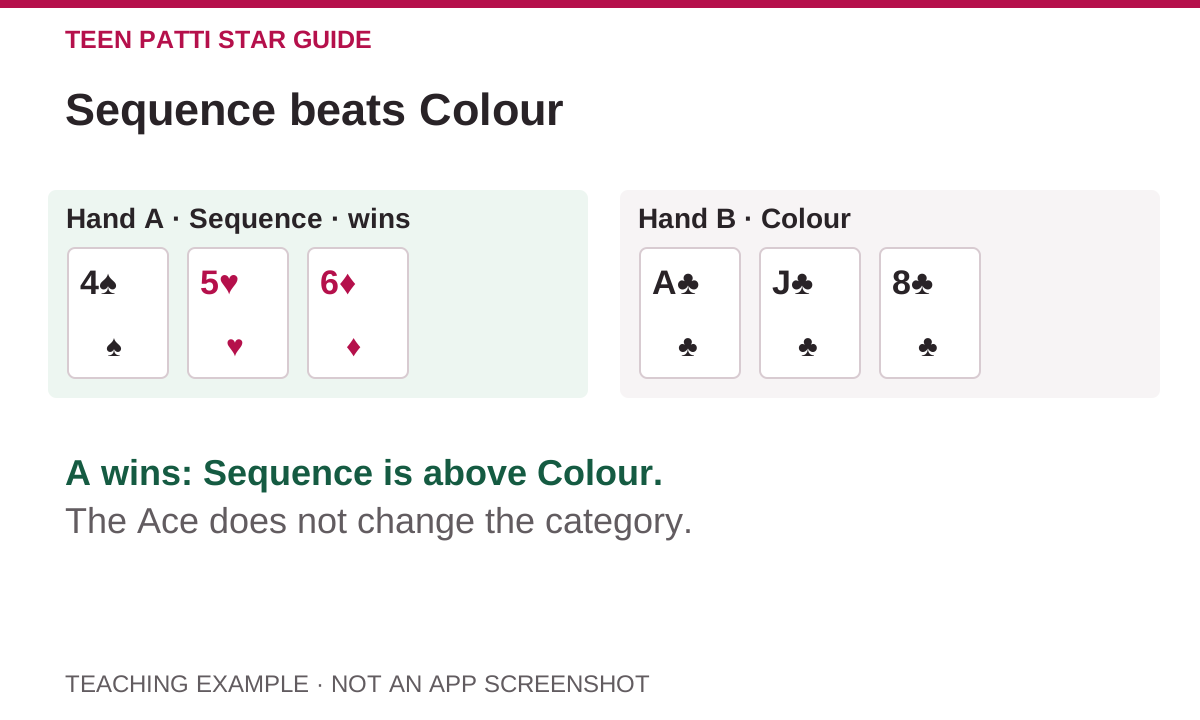
For a third example, compare A♣ K♦ Q♥ with A♥ J♥ 10♥. The first is a mixed-suit Sequence; the second is a same-suit non-sequence, or Colour. In ordinary Teen Patti category order, Sequence beats Colour. Some reduced-deck games use different rankings, so the rule order must be read rather than inferred from the deck size.
Our Sequence versus Colour comparison explains that category decision. The examples here deliberately use only retained Faceoff ranks and no duplicate physical card within each opposing pair.
Count the hands instead of guessing the odds
An unordered three-card hand from 20 distinct cards has 20 × 19 × 18 ÷ 6 = 1,140 possibilities. Division by six removes the six dealing orders for the same three cards. This count assumes a well-shuffled deck and an equally likely selection of three different cards, with no jokers or replacement.
The following counts are our calculation under the deck and sequence assumptions above. They are not published app-return figures, and they are not the chance of winning a round against several opponents.
Swipe the table sideways to compare.
| Exclusive category | Number of hands | Share of 1,140 |
|---|---|---|
| Trail | 20 | 1.7544% |
| Pure Sequence | 12 | 1.0526% |
| Sequence, excluding Pure Sequence | 180 | 15.7895% |
| Colour, excluding Pure Sequence | 28 | 2.4561% |
| Pair | 480 | 42.1053% |
| High Card, excluding other categories | 420 | 36.8421% |
| Total | 1,140 | 100% |
Trail
- Number of hands
- 20
- Share of 1,140
- 1.7544%
Pure Sequence
- Number of hands
- 12
- Share of 1,140
- 1.0526%
Sequence, excluding Pure Sequence
- Number of hands
- 180
- Share of 1,140
- 15.7895%
Colour, excluding Pure Sequence
- Number of hands
- 28
- Share of 1,140
- 2.4561%
Pair
- Number of hands
- 480
- Share of 1,140
- 42.1053%
High Card, excluding other categories
- Number of hands
- 420
- Share of 1,140
- 36.8421%
Total
- Number of hands
- 1,140
- Share of 1,140
- 100%
For Trails, choose one of five ranks and three of its four suits: 5 × 4 = 20. For Pure Sequences, choose one of three runs and one of four suits: 3 × 4 = 12. All suit arrangements across the three runs give 3 × 4³ = 192; subtract the 12 Pure Sequences to leave 180 ordinary Sequences.
For same-suit hands, each suit has ten ways to choose three of its five cards. Four suits give 40, and removing 12 Pure Sequences leaves 28 Colours. For pairs, choose the paired rank in five ways, its two suits in six ways, a different rank in four ways and that card's suit in four ways: 5 × 6 × 4 × 4 = 480. Subtracting these five exclusive categories from 1,140 leaves 420 High Card hands.
The categories are mutually exclusive, which matters. If you count a same-suit run as both Colour and Pure Sequence, your total becomes too large. If you want the chance of a particular event instead of a category, define the event first. “Contains an Ace” and “is a pair of Aces” are different questions.
Why rarity does not rewrite the hand order
Pure Sequences are less common than Trails in this particular 20-card calculation, yet our examples keep the stated ordinary category order with Trail above Pure Sequence. That is not a mathematical contradiction. Frequency describes how often a category is dealt; the game's agreed rules specify how it ranks.
Do not silently swap categories because one happens to be rarer in a reduced deck. If an application explicitly changes the order, record that change and use it throughout every example. You cannot combine a normal-ranking example with a short-deck ranking imported from another game.
For the 52-card calculation and a fuller explanation of “hand probability” versus “winning probability”, see Teen Patti hand probabilities. Opponents' cards are drawn from the remaining deck, not independent fresh decks, and decisions during the round also affect which hands reach a comparison.
Set up a practice round with clear rules
Use non-cash counters and write a short rule note before dealing: 20 cards; three per player; no jokers; Ace high; no wrapping; category order; exact-tie procedure. Decide the boot, permitted actions and stopping condition separately. A smaller deck does not by itself specify those payment rules.
Deal two hands face up and ask three questions in order: are all cards from the retained deck, what category does each hand make, and which rank comparison applies within that category? This catches more mistakes than immediately asking who wins. Change only one card and repeat the comparison to see which part of the result changes.
If you later practise in an app, first check that its mode actually uses this deck and ranking. A generic lobby image or an article mentioning Faceoff does not prove current availability in a specific version.
Questions about Faceoff
Can I play Faceoff with a normal 52-card pack?
Yes, by removing the ranks specified above before dealing. Leaving all 52 cards in the pack while merely ignoring low hands is a different procedure and does not produce these probabilities.
Is a pair guaranteed because the deck is small?
No. The exact-pair category accounts for 480 of 1,140 possible hands, about 42.1%, under our assumptions. High Card hands and other categories remain possible.
Does Faceoff automatically include wild cards?
Not in the version calculated here. Adding a Joker rule changes hand evaluation and the probability model. Do not reuse this table for a combined wildcard variant.
Is this a verified Star game mode?
No. This is a general rules guide based on a published Faceoff description and our worked calculations. We have not verified a particular Star application's mode list or conducted a device test.
Sources & scope
Public sources checked on 26 October 2026. Examples are illustrative; no hands-on device test of a specific app was performed. Table and platform rules may differ.
Related guides
Gameplay
Teen Patti Hand Probabilities: How Rare Is Each Hand?
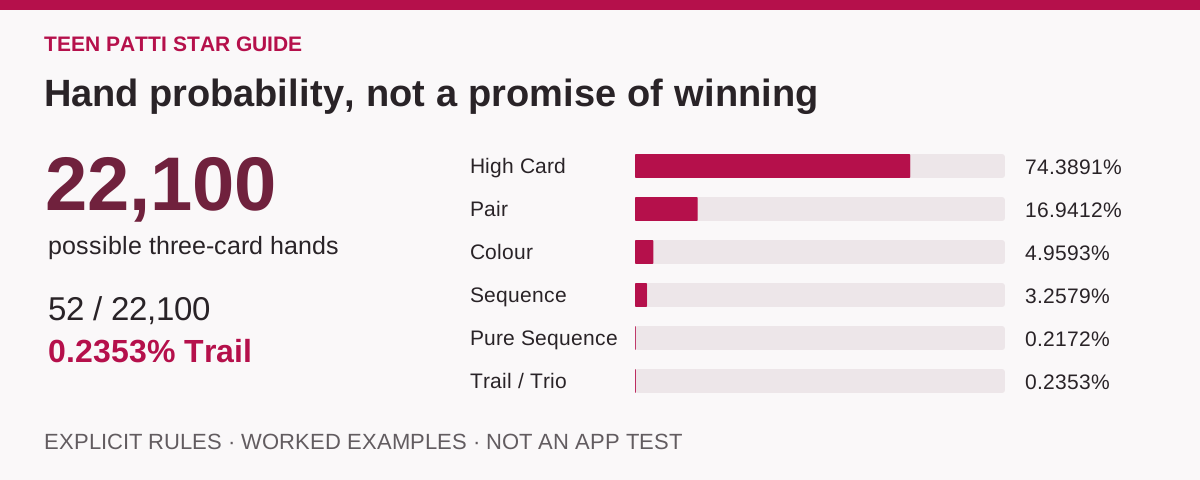
Exact counts for all 22,100 Teen Patti hands, with formulas and a reproducible check. Understand rare hands, Ace conventions and why deal probability is not win probability.

Gameplay
Teen Patti Sequence vs Colour: Which Hand Wins?
A small sequence beats an Ace-high colour in classic Teen Patti. Compare pure sequence, same-suit colour and red-card mistakes with worked hands and a short quiz.
Gameplay
Teen Patti Variants Compared: Classic, Joker, AK47 and Muflis
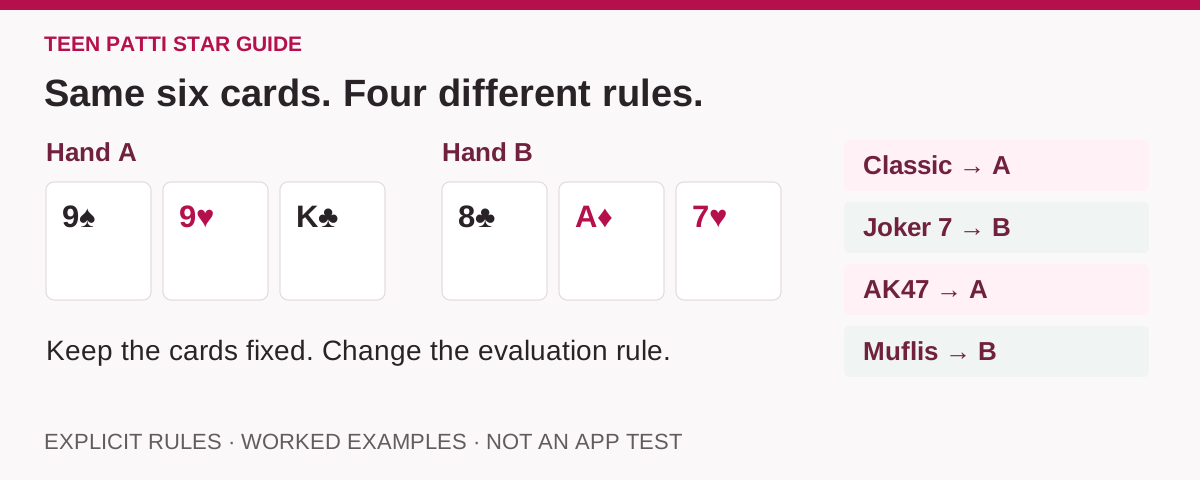
Keep the same six cards and compare four Teen Patti variants. See the exact Joker and AK47 substitutions, the Muflis reversal and the rules to agree first.