
Gameplay
999 Teen Patti Rules: Card Values and Worked Scores
In the 999 format described by Octro, A counts as 1; 10, J, Q and K count as 0; other cards keep their number. Arrange the three digits to make the number nearest 999. Do not add them together or use ordinary Trail-to-High-Card rankings.
Method: a public-documentation guide, not a hands-on test of a Star build. Diagrams are illustrative. Sources & limitations
The scoring rule this guide uses
“999” is a variant name, not the classic rule for three nines. This guide follows Octro’s published three-digit model. It does not use a sum, a last-digit total or a distance calculated separately for each card. If your room describes a different model, resolve that difference before comparing hands.
Our examples use a standard 52-card deck, no wild cards and practice counters without cash value. They are mathematical demonstrations, not evidence that a particular Star app offers this mode. For how rule changes differ, see the variant comparison.
Swipe the table sideways to compare.
| Printed rank | Digit in this model | What to avoid |
|---|---|---|
| A | 1 | Do not use 11 or 14 |
| 2 through 9 | The printed number | Do not change the value by suit |
| 10, J, Q, K | 0 | 10 does not occupy two digit positions |
A
- Digit in this model
- 1
- What to avoid
- Do not use 11 or 14
2 through 9
- Digit in this model
- The printed number
- What to avoid
- Do not change the value by suit
10, J, Q, K
- Digit in this model
- 0
- What to avoid
- 10 does not occupy two digit positions
Calculate one hand without guessing
Convert: 6, 0, 9
999 − 960 = 39
Take 6♥ K♠ 9♦. Convert the cards to 6, 0 and 9. Place the largest digit in the hundreds position, the next largest in the tens position and the smallest in the units position: 960. Its distance from the target is 999 − 960 = 39.
Why sort the digits? Each digit lies between 0 and 9, so every possible arrangement is at most 999. Making the number as large as possible therefore makes its distance from 999 as small as possible. You do not need to guess which arrangement is closer.
| Arrangement of the same digits | Distance from 999 |
|---|---|
| 960 | 39 |
| 906 | 93 |
| 690 | 309 |
| 609 | 390 |
| 096 | 903 |
| 069 | 930 |
960
- Distance from 999
- 39
906
- Distance from 999
- 93
690
- Distance from 999
- 309
609
- Distance from 999
- 390
096
- Distance from 999
- 903
069
- Distance from 999
- 930
The leading zero is retained to show all three positions, but 096 has the numerical value 96. These are six arrangements of one hand, not six additional deals. No card is drawn or replaced.
A comparison where adding gives the wrong answer
Compare A: 9♠ 2♥ 2♦ with B: 8♣ 7♥ 6♦. Every physical card is distinct. A forms 922, distance 77. B forms 876, distance 123. A is closer and wins this score comparison.
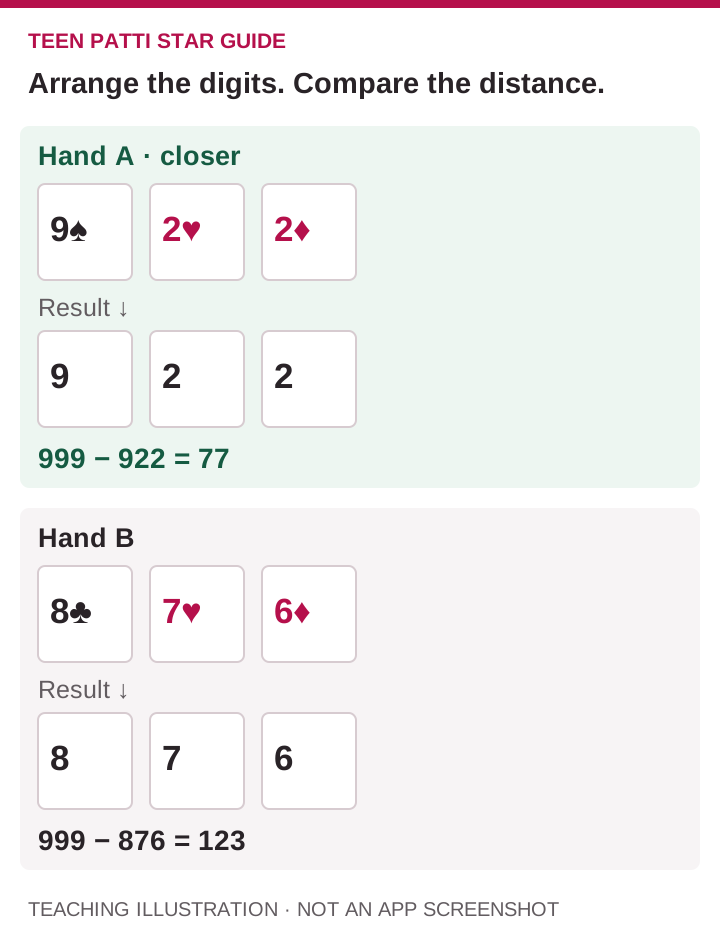
Adding would give A a total of 13 and B a total of 21. That would reward the wrong hand if you simply chose the bigger total. The position of each digit matters: the 9 in A’s hundreds position is more important than B’s larger sum.
Also compare Q♠ Q♥ Q♦ against 8♠ 5♥ A♣. The Queens form 000; the other hand forms 851. A classic Trail does not rescue 000 here. Do not use the ordinary ranking tool for 999: its category-based answer solves a different game.
Zeros, repeated digits and equal scores
10♠ J♥ K♦ makes 000, not 100. 9♠ 9♥ A♦ makes 991, not 199. Repeated ranks are allowed when the suits identify different physical cards. Three nines give the maximum score 999, but the example is not a reason to wait for or chase that deal.
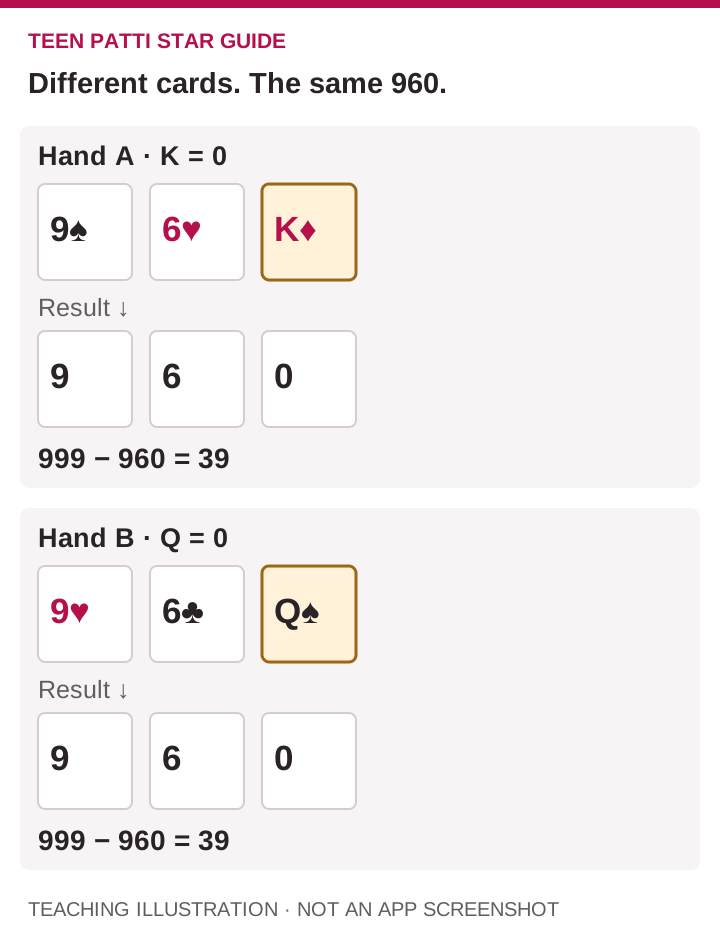
Different hands can have the same score. 9♠ 6♥ K♦ and 9♥ 6♣ Q♠ both become 960 because K and Q both convert to 0. A King does not automatically beat a Queen after both have been converted. Likewise, suits do not supply an extra digit.
The published 999 section defines the values but does not resolve every equal-score settlement. Mark this comparison as equal, then apply the room’s documented tie procedure. Do not invent a split pot, suit ranking or requester-loses rule from the name alone. Eligibility to compare is a separate question covered in Show versus Sideshow.
Check the room before using the example
Ask whether cards may be rearranged, whether 10 is 0, whether A is 1, and how equal scores are settled. Also check that there are no added wild cards. These conditions are what make this article’s arithmetic reproducible; a screen labelled “999” is not enough to establish them.
This guide explains how to evaluate an exposed hand, not how much to contribute while cards are hidden. It gives no winning percentage. The classic hand-probability article counts ordinary categories and must not be presented as a 999 win-rate table.
Try two hands, then check your result
First, compare 9♣ 4♦ 10♥ with 8♦ 8♥ 7♣. Write the three-digit scores before reading further. They are 940 and 887, with distances 59 and 112. The first hand is closer.
Next, arrange A♠ Q♥ 7♦. The result is 710, not 701 or a sum of 8. The Queen contributes 0 and the Ace contributes 1. If you got this wrong, repeat conversion before sorting: sorting the printed ranks first would incorrectly put the Ace at the front.
For another variant where a card changes its role rather than its digit, read Lowest Joker.
Sources & scope
Public sources checked on 15 October 2026. Examples are illustrative; no hands-on device test of a specific app was performed. Table and platform rules may differ.
Related guides
Gameplay
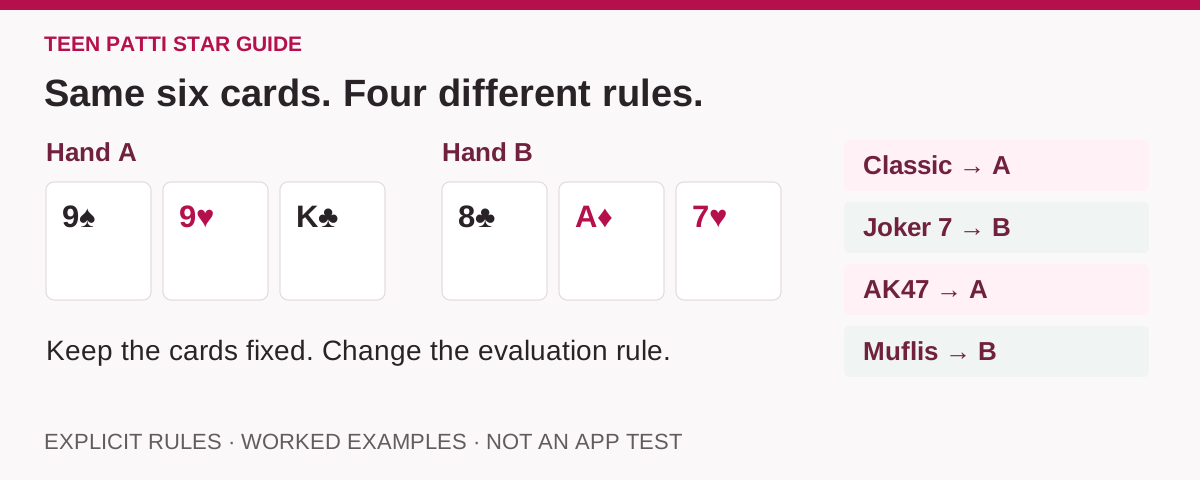
Teen Patti Variants Compared: Classic, Joker, AK47 and Muflis
Keep the same six cards and compare four Teen Patti variants. See the exact Joker and AK47 substitutions, the Muflis reversal and the rules to agree first.

Gameplay
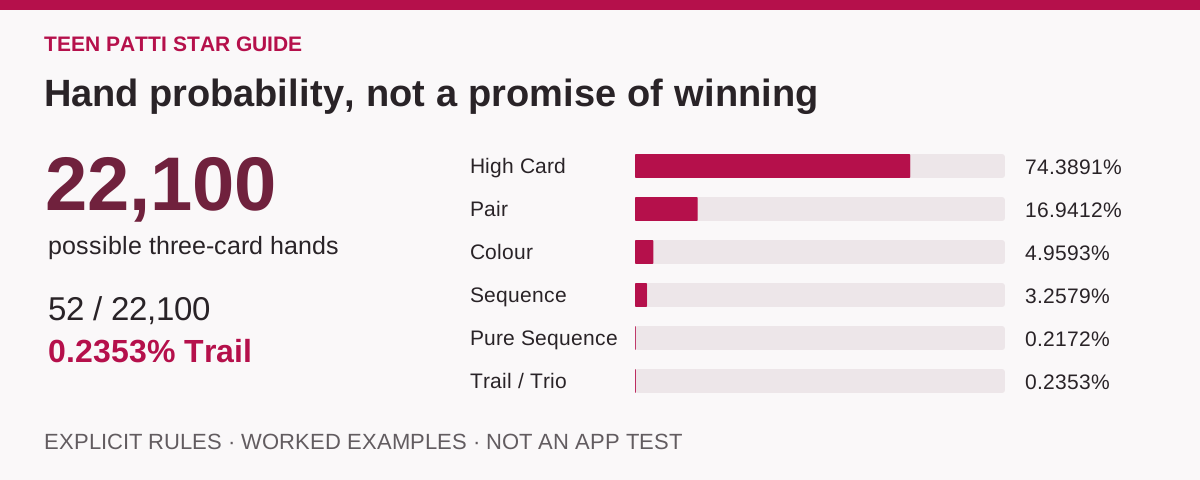
Teen Patti Hand Probabilities: How Rare Is Each Hand?
Exact counts for all 22,100 Teen Patti hands, with formulas and a reproducible check. Understand rare hands, Ace conventions and why deal probability is not win probability.
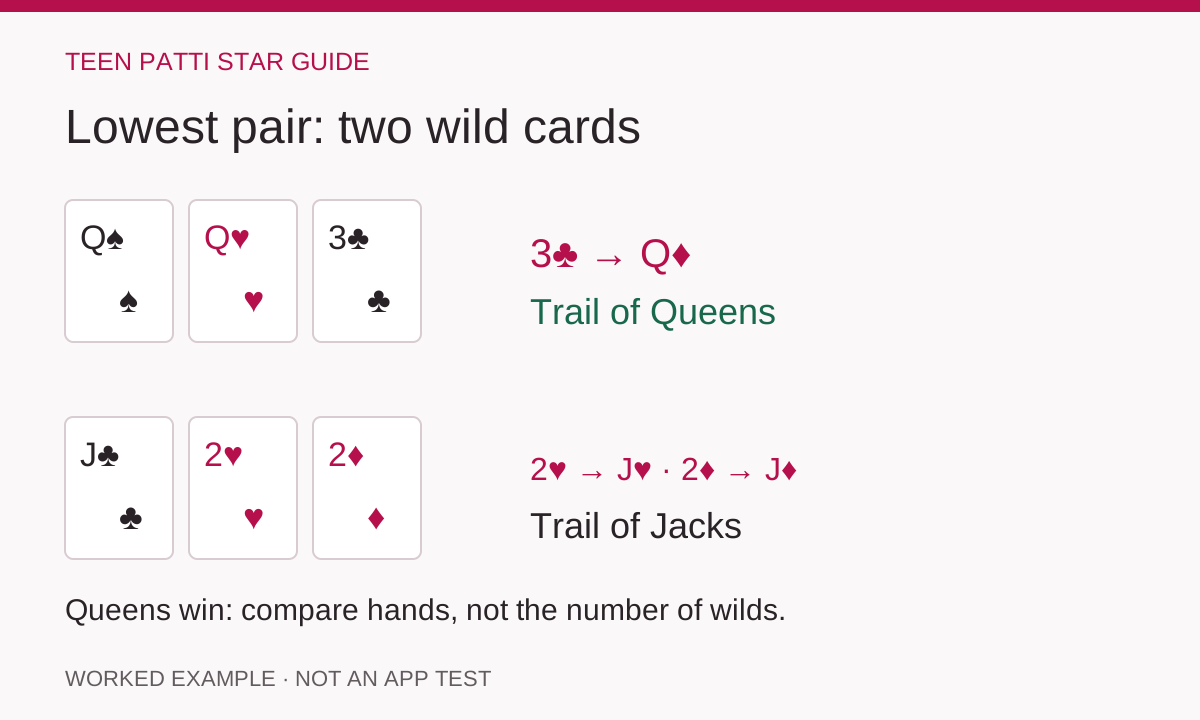
Gameplay
Lowest Joker Teen Patti: Low Pairs, Aces and Examples
Identify the wild cards separately in each hand, resolve a lowest pair and compare one joker against two. Includes fixed-card substitutions and an Ace check.