
Gameplay
Teen Patti vs Rummy: What’s the Difference and How Do You Play?
The main difference between Teen Patti and rummy is what you do with your cards. In classic Teen Patti, you receive three cards and decide whether to continue or fold while competing for a pot. In common 13-card Indian rummy, you draw and discard cards to assemble a valid arrangement of sequences and sets.
Scope: worked examples of general Teen Patti rules, not rules tested in a specific Star app. Check your table’s rules. Sources & limitations
Teaching diagram — not an app screenshot.
That distinction changes almost everything: the number of cards, the purpose of a turn, the meaning of a sequence, and the way a round ends. Learning one game does not automatically teach you the other, even when both appear inside the same app.
This guide compares classic Teen Patti with common 13-card Indian rummy. Other rummy variants and special Teen Patti tables can use different rules, so identify the selected mode before applying any example.
Teen Patti and Rummy at a Glance
| Feature | Classic Teen Patti | Common 13-card Indian rummy |
|---|---|---|
| Starting hand | Three cards | Thirteen cards |
| Main objective | Remain last in the round or win an eligible comparison | Complete the required valid card groups |
| Normal turn | Continue with the permitted contribution or fold | Draw a card, then discard a card |
| Changing your hand | No normal draw-and-replace step | Drawing and discarding changes the hand |
| Sequences | A category used to rank a three-card hand | Essential groups used in a valid declaration |
| Jokers | Not used in the classic format | Often available under the selected rules |
| Ending the round | Last player remaining or final Show | A valid declaration under the selected format |
Starting hand
- Classic Teen Patti
- Three cards
- Common 13-card Indian rummy
- Thirteen cards
Main objective
- Classic Teen Patti
- Remain last in the round or win an eligible comparison
- Common 13-card Indian rummy
- Complete the required valid card groups
Normal turn
- Classic Teen Patti
- Continue with the permitted contribution or fold
- Common 13-card Indian rummy
- Draw a card, then discard a card
Changing your hand
- Classic Teen Patti
- No normal draw-and-replace step
- Common 13-card Indian rummy
- Drawing and discarding changes the hand
Sequences
- Classic Teen Patti
- A category used to rank a three-card hand
- Common 13-card Indian rummy
- Essential groups used in a valid declaration
Jokers
- Classic Teen Patti
- Not used in the classic format
- Common 13-card Indian rummy
- Often available under the selected rules
Ending the round
- Classic Teen Patti
- Last player remaining or final Show
- Common 13-card Indian rummy
- A valid declaration under the selected format
Neither column describes the identity or payment model of an app. “Teen Patti” and “rummy” are game names; the developer, platform, and terms are separate questions.
How a Teen Patti Round Works
Players agree a starting contribution, usually called the boot, and place it into a central pot. A dealer distributes three face-down cards to each player. Those are normally the cards the player will use for the entire round.
A player may leave the cards unseen and play Blind, or look at them and become Seen. On a turn, the player either contributes the allowed amount to remain active or folds, often called Pack. Folding ends participation in that deal and does not retrieve earlier contributions.
The round can end without a card comparison. If everyone except one player folds, the remaining player takes the pot. If two players remain, the table’s Show rules determine who may request a final comparison and its cost.
Imagine that you hold 8♣, 8♦, and Q♥. You have a pair of eights. You are not waiting to draw another eight or discard the queen. Your decisions concern continuing with that fixed hand, not rearranging it into a better combination.
How a Rummy Round Works
In the common Indian format, each player starts with thirteen cards. A typical turn involves drawing from the permitted pile and then discarding a card. The aim is to finish with a valid thirteen-card arrangement, not merely one impressive group.
The usual declaration requirement is at least two sequences, including at least one pure sequence, with the remaining cards also grouped validly. A pure sequence uses consecutive cards of one suit without a joker standing in for a missing card. Exact treatment of designated wild cards and declaration controls should be checked in the selected rules. These core requirements are explained in the Indian rummy rules reference.
Suppose you hold 6♥ and 7♥. Drawing 8♥ could complete a sequence. That kind of improvement is central to rummy but has no equivalent draw step in classic Teen Patti.
The Word “Sequence” Means Different Things
This is one of the easiest mistakes to make when switching games. In Teen Patti, three consecutive ranks in mixed suits form a Sequence. When all three are the same suit, the hand is a Pure Sequence, which ranks higher.
In rummy, a normal natural sequence requires the same suit. Three consecutive numbers in different suits are not enough. A joker may complete a missing position where permitted, but that creates a different type of group rather than making mixed-suit natural cards consecutive.
| Cards | Teen Patti interpretation | Rummy interpretation |
|---|---|---|
| 6♥ 7♥ 8♥ | Pure Sequence | Pure sequence group |
| 6♥ 7♣ 8♦ | Sequence | Not a natural sequence |
| Q♠ Q♥ Q♦ | Trail | A three-card set |
| A♣ J♣ 8♣ | Colour | Not a sequence simply because the suit matches |
6♥ 7♥ 8♥
- Teen Patti interpretation
- Pure Sequence
- Rummy interpretation
- Pure sequence group
6♥ 7♣ 8♦
- Teen Patti interpretation
- Sequence
- Rummy interpretation
- Not a natural sequence
Q♠ Q♥ Q♦
- Teen Patti interpretation
- Trail
- Rummy interpretation
- A three-card set
A♣ J♣ 8♣
- Teen Patti interpretation
- Colour
- Rummy interpretation
- Not a sequence simply because the suit matches
The table is a comparison exercise, not a complete rummy declaration. A valid three-card group still leaves the rest of a thirteen-card hand to be accounted for.
Worked Teen Patti Comparison
Consider two players reaching a final comparison. Maya holds 5♠, 6♥, and 7♦. Dev holds A♣, J♣, and 9♣.
Maya has a mixed-suit Sequence. Dev has a Colour: all clubs, but not consecutive. Under the standard Teen Patti category order, the Sequence wins. Dev’s ace does not override the stronger category.
Now change the hands. Maya holds 10♠, 10♦, and 3♥. Dev holds 9♣, 9♥, and A♦. Both hands are pairs, so compare the paired rank first. Tens beat nines; the ace kicker does not rescue the lower pair.
These examples demonstrate a two-stage check: classify the hand, then compare ranks inside the category. Sorting all six cards together or simply selecting the highest individual card gives the wrong answer.
Worked Thirteen-Card Rummy Arrangement
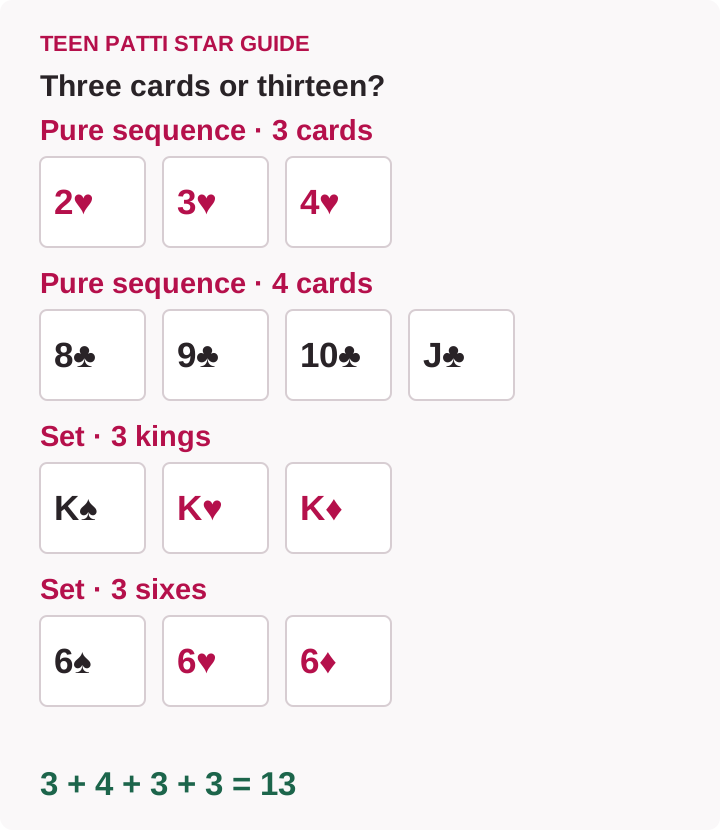
Here is an original practice layout using no jokers:
| Group | Cards | Why it fits |
|---|---|---|
| First sequence | 2♥ 3♥ 4♥ | Three consecutive hearts |
| Second sequence | 8♣ 9♣ 10♣ J♣ | Four consecutive clubs |
| First set | K♠ K♥ K♦ | Three kings of different suits |
| Second set | 6♠ 6♥ 6♦ | Three sixes of different suits |
First sequence
- Cards
- 2♥ 3♥ 4♥
- Why it fits
- Three consecutive hearts
Second sequence
- Cards
- 8♣ 9♣ 10♣ J♣
- Why it fits
- Four consecutive clubs
First set
- Cards
- K♠ K♥ K♦
- Why it fits
- Three kings of different suits
Second set
- Cards
- 6♠ 6♥ 6♦
- Why it fits
- Three sixes of different suits
The card count is three plus four plus three plus three: thirteen. There are two sequences, and both are pure. All remaining cards belong to valid sets. Under the common format described here, the arrangement meets the grouping requirement.
Now replace 4♥ with 4♠. The first group no longer forms a natural sequence. Although the numbers still look consecutive, the suit mismatch matters. You must rebuild the arrangement rather than relying on its visual similarity to the original.
This example also shows why a rummy player cannot declare simply because they have a strong set of kings. The other cards are part of the same validation problem.
Blind Play Does Not Mean the Same Thing as a Draw Pile
Teen Patti Blind play means that the player has not viewed their own hand. It changes the information available to that player and commonly affects the permitted contribution.
A face-down draw pile in rummy is something else. Players normally inspect and organize their own cards, then decide which cards to keep after drawing. The pile being hidden does not make the player a Blind participant in the Teen Patti sense.
Similarly, Teen Patti’s boot is not a rummy penalty score. A displayed number should be interpreted according to its function: starting contribution, points, balance, entry requirement, or something else. Do not carry a label from one mode into another.
Which Game Should a Beginner Learn First?
Choose based on the type of exercise you enjoy. Teen Patti is a compact introduction to classifying hands, following turns, and making decisions with incomplete information. Rummy places more emphasis on arranging cards and evaluating how a draw changes possible groups.
Neither choice guarantees easier wins. A shorter rule summary does not eliminate uncertainty, and a longer hand does not make every result controllable. For an introductory session, use non-redeemable tokens or a verified free practice mode.
A useful learning sequence is to practice without competition first. For Teen Patti, sort sample hands into categories. For rummy, construct a complete thirteen-card layout and explain why every card belongs. Only then add turn timing and other players.
App Names Do Not Change the Underlying Rules
A single app may advertise several card games, but the selected room determines which rules apply. A screen with three cards and a Pack button should not be approached as a thirteen-card grouping puzzle.
Also verify the app itself. A title containing “Star,” “Master,” or “Rummy” does not establish a shared developer, shared account, or compatible update. Use the Teen Patti Star guide hub when checking app identity and gameplay terminology.
Frequently Asked Questions
Is rummy another name for Teen Patti?
No. The games differ in their objectives, card counts, turn structure, and winning conditions. They can appear together in marketing or an app menu without becoming the same game.
Does a Teen Patti Sequence work as a rummy sequence?
Only if it satisfies the rummy rules too. Three consecutive mixed-suit cards form a Teen Patti Sequence but not a natural rummy sequence.
Can I learn both without real money?
Yes. Physical cards and tokens with no cash value are sufficient. Digital practice is another option if the specific mode genuinely requires no payment and offers no cash redemption.
Final Thoughts
Teen Patti asks you to make decisions around a fixed three-card hand. Rummy asks you to improve and organize a larger hand through drawing and discarding. Keep those objectives separate and the terminology becomes much easier to understand.
Play for learning and entertainment, set a time limit, and do not treat either game as a source of income. This comparison explains gameplay, not the legality or financial suitability of any particular app or paid contest.
Sources & scope
Public sources checked on 15 September 2026. Examples are illustrative; no hands-on device test of a specific app was performed. Table and platform rules may differ.
Related guides
Gameplay
What Is Teen Patti Indian Poker? Rules, Hand Rankings, and Poker Differences
Understand why Teen Patti is called Indian poker, how its three-card hands work, and how its rankings and Blind play differ from Texas Hold’em.
Gameplay
Teen Patti Rules for Beginners: Card Rankings, Blind vs Seen, and Show Rules
Learn classic Teen Patti rules with hand-ranking examples, Blind and Seen contributions, Show eligibility, tie-breaks, and table rules to confirm.
Gameplay
How to Play Teen Patti: Step-by-Step Beginner’s Guide with Hand Examples
Follow a complete Teen Patti practice round, from the boot and deal to Blind turns, folding, a final Show, and checking the token totals.